

Story and photo by Peter Barr
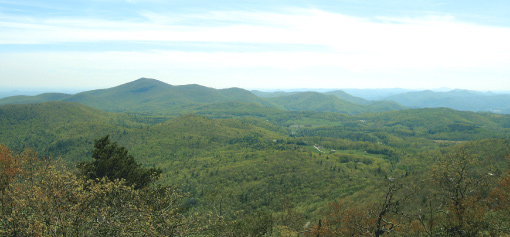
The view of Rabun Bald.
Two short hikes in northern Georgia’s Blue Ridge Mountains climb to the state’s highest peaks and reward visitors with its most stunning views. While the elevations of Brasstown Bald and Rabun Bald reign supreme in the Peach State, their picturesque scenery and fascinating cultural history are also difficult to surpass.
Brasstown Bald
At 4,784 feet above sea level, Brasstown Bald — beaming with natural beauty — is the highest peak in Georgia, and offers both moderate and strenuous excursions.
A paved road east of Blairsville enables visitors to drive most of the way up the mountain. From a parking area south of the peak, a half-mile trail climbs the remaining distance to the summit. The paved path ascends steeply, gaining about 400 feet in elevation while tunneling through a forest of rhododendron and mountain laurel. Hike to the summit in late spring for the added bonus of its colorful blooms.
The summit of Brasstown Bald — surrounded by Chattahoochee National Forest — is crowned with a tall structure that looks much like an air traffic control tower. The lookout is occasionally manned by the U.S. Forest Service to provide rapid detection of forest fires in the surrounding national forest.
While the tower itself is closed to the public, an observation deck at its base affords hikers a 360-degree view of four states. On clear days, the skyscrapers of Atlanta are visible some 90 miles to the south.
Accompanying the observation deck is a small visitor center, open seasonally, that offers exhibits on the natural and cultural heritage of the mountain. The center’s motion-activated animatronic mannequins — which verbalize local lore — may be one of the most bizarre sights you ever encounter on a mountain hike.
What Brasstown Bald boasts in natural scenery, it matches in rich cultural history. For millennia, the mountain was frequented by Native Americans; hunting camps and petroglyph carvings have been discovered near the peak.
Hikers seeking a more challenging route may trek the 4.5-mile Jacks Knob Trail, which connects Brasstown Bald to the Appalachian Trail near Chattahoochee Gap, or the 5.5-mile Arkaquah Trail, which begins south of the town of Young Harris and links the summit to Trackrock Gap, the location of an archaeological petroglyph site. Both paths are designated National Recreation Trails.
Rabun Bald
When famed naturalist William Bartram passed near northern Georgia’s lofty Rabun bald in 1775, he wrote, “My progress was rendered delightful by the sylvan elegance of the groves, cheerful meadows, and high distant forests, which in grand order presented themselves to view.”
Georgia’s second-highest peak, at 4,696 feet, Rabun Bald is located 10 miles northeast of Clayton. To reach its summit, hike the Bartram Trail, the venerable footpath named in honor of the naturalist who was so enthused by the region’s scenery nearly 250 years ago.
To access the Bartram Trail from the trailhead at Beegum Gap, ascend steeply to the south on an unmarked but well-worn path. Climb through the hardwood forest until reaching a junction with the Bartram Trail, blazed with yellow rectangles, at 0.3 miles. Turn right and follow the Bartram Trail, climbing moderately to reach a roadbed crossing on the right at 0.8 miles.
Here, veer left to remain on the Bartram Trail and ascend up the steep and increasingly narrow ridgeline via a quick succession of switchbacks. The trail tunnels through a dense thicket of rhododendron, emerging at the summit of Rabun Bald at 1.5 miles.
Like Brasstown Bald, a fire lookout tower atop Rabun fosters a breathtaking view of the Blue Ridge range. The squat stone structure constructed by the Civilian Conservation Corps in the 1930s now hosts a wooden observation deck with a panoramic vista of the surrounding Chattahoochee National Forest. A keen eye can detect Brasstown Bald, 30 miles to the west.
“I beheld with rapture and astonishment a sublimely awful scene of power and magnificence, a world of mountains piled upon mountains,” wrote Bartram when he climbed the nearby Nantahala Mountains, visible just to the north. There is no doubt that his feeling of awe and wonder can still be experienced with a hike up Rabun Bald today.
Brasstown and Rabun Balds
Info: Chattahoochee National Forest (770) 297-3000
BRASSTOWN BLAD
Getting There: From Blairsville, drive US 19/129 south 8 miles to GA 180. Turn left and drive 9 miles to GA Spur 180. Turn left and drive 3 miles to the park.
Length and Difficulty: Summit Trail, 0.5 mi, moderate; Jake Knob Trail, 4.5 mi., strenuous; Arkaquah Trail, 5.5 mi., strenuous.
RABUN BALD
Getting There: From Dillard, drive US 441 north for one mile. Turn right and drive 4.3 miles on GA 246 toward Highlands, N.C., to Old Mud Creek Road. Turn right and drive 2.9 miles to Kelsey Mountain Road. Turn right and drive 0.9 miles to the end of the road and trailhead at Beegum Gap.
Length and Difficulty: Reach the summit of Rabun Bald via the Bartam Trail in 1.5 mi., strenuous.
About the Author: Peter Barr is the trails & outreach coordinator at Carolina Mountain Land Conservancy, as well as the author of “Hiking North Carolina’s Lookout Towers.”
Related Articles
Latest News
More Stories

Neighbors Help Neighbors
A photo essay that celebrates the volunteer spirit of the grassroots group Hurricane Helene WNC and speaks to the resourcefulness, collaboration and hard work embodied by thousands and thousands of volunteers, first responders and aid workers across the region after Hurricane Helene.

Halloween Approaches, and Night School Is in Session
The House of Art in Bluefield, West Virginia, looks like a haunted tower, making it the perfect location for its sixth annual haunt event: Night School. The Night School will be open every Friday and Saturday night through Oct. 31.

‘The Most Perfect Act of Love’
Hundreds of people attended the second annual Affirming Sumner Pride celebration on a 24-acre farm dubbed “Fruity Farm” in Bethpage, Sumner County, Tennessee.

Signs of Life: Endangered Bats Found in Nantahala for First Time in More Than a Decade
In the Nantahala National Forest, a team of biologists spotted Indiana bats, an endangered species that hasn’t been seen in North Carolina for the last 11 years.

‘First Line of Defense’
During Hurricane Helene and its aftermath, rural fire departments and other first responder hubs played critical roles in keeping their communities safe, even without power and cut off from outside support for days or weeks after the storm. Two years later, plenty of work remains to ensure these hubs have the resources they need to operate day to day and be ready when emergencies or natural disasters strike.

The Rocky Road — and Bridge — to Recovery
Hurricane Helene is estimated to have damaged nearly 7,000 private roads and bridges in Western North Carolina. Two years later, many restoration projects are complete, but the journey hasn’t been easy — and isn’t over for others.

Leave a comment
Your email address will not be published. Required fields are marked *
Leave a Comment