Follow Us on Twitter: Appalachian Voices | iLoveMountains.org

Posts Tagged ‘Great Smoky Mountains National Park’

April 20-28 is National Park Week and includes free admissions

Thursday, April 25th, 2013 - posted by Alix

Growing up in the suburbs of Washington, D.C., opportunities to marvel at the beauty of nature didn’t come often. Luckily, my grandparents lived Woodstock, Va., nestled in the Shenandoah Valley. On our trips to visit, we would often change into our most comfortable clothes, lace up our sneakers and head out to the mountains.

Feeling the fallen leaves crunch with every step I took, witnessing squirrels and rabbits frolic on the forest floor and listening to the silence — only disturbed by our voices or the call of a wild animal — was eye-opening. It showed this city girl why preserving the land was so important.

From April 22-26 all national parks waive their entrance fee. It’s the perfect week to celebrate the great outdoors and visit a national park near you.

Visit one of these national parks today:

Great Smoky Mountains National Park

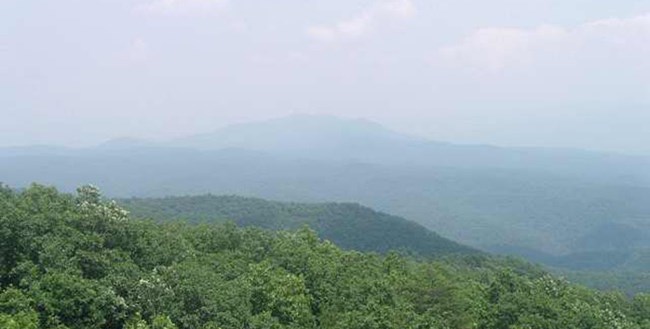
Courtesy of National Parks Service

  • Size: 521,085 acres.
  • Mammals: 65 species.
  • Birds: Over 200 species.
  • Amphibians/Reptiles: 80 species.
  • Fish: 50 species.
  • Flowering plants: 1,600 species.
  • Trees: 100 species.
  • Shrubs: 100 species.
  • Always free to the public.
  • Learn more

(more…)

Tuesday, April 16th, 2013 - posted by Jil

A Failure To Cooperate Over Wilderness Right-of-Way

Rutherford Electric Membership Corporation filed a condemnation petition in January that would allow the utility to build power lines through Box Creek Wilderness, a 5,100-acre tract of preserved forest east of Asheville, N.C. REMC says the utility needs the line to supply power to members in McDowell County and has almost reached capacity with current power lines. The wilderness is owned by Epic Games founder Tim Sweeney, who said in a press release that he’s “going to do everything [he] can to protect this beautiful, unique ecosystem from the proposed devastation.” The N.C. Dept. of Environment and Natural Resources recently designated Box Creek as the 24th most significant natural heritage area in the state. Sweeney had until the end of March to respond to REMC’s petition.

Seeing is Believing: Air Quality Improves in Great Smoky NP

A new Colorado State University study of air quality in national parks shows a major reduction in particle pollution in the Great Smoky Mountains National Park. “In the Eastern United States, most of our air pollution comes from power plants and vehicle emissions. Nitrates in the air and sulfates are a lot of what we see,” Molly Schroer, park spokesperson, said in an interview with WBIR in Knoxville, Tenn. “It’s getting better. That is the trend that we are seeing in our data as far as the air.”

Unhappy Appalachia

Gallup and Healthways recently released their annual Well-Being Index for 2012 and, as in years past, Appalachia’s health and happiness ranked low. West Virginia (50th) and Kentucky (49th) brought up the rear, while Tennessee slid down a few spots over the last year to 47. The Well-Being Index compiles survey results from all over the nation on subjects from emotional and physical health to food access and healthcare.

Virginia’s Dominion Settles in Clean Air Pollution Lawsuit

In April, Dominion Resources Inc., a Virginia-based electric utility, agreed to pay $13.2 million to settle federal air pollution violations for three out-of-state coal plants. While the company denies the allegations that it violated the Clean Air Act, it settled rather than engage in a drawn-out and expensive legal fight. The company’s shareholders will bear the cost of the settlement, said company spokesperson Dan Genest.

Road Trippin’: Corridor K Still Threatens Goforth Creek

The Southern Environmental Law Center recently named Goforth Creek Canyon as one of its “Top 10 Endangered Places in the Southeast for 2013.” The wild resource is threatened by the proposed Corridor K, a highway that would connect Chattanooga and Asheville. The Tennessee Department of Transportation said that different alternatives for the highway are being reviewed, and that studies are ongoing to help find the best solution. TDOT will release its draft environmental impact statement about the project late this summer.

Unquenchable Thirst: Water Runs In Ga./Tenn. Land Dispute

Georgia legislators in March passed a resolution authorizing the state’s attorney general to sue the state of Tennessee if it refuses to voluntarily give up a 1.5 square-mile parcel of land that they say is rightfully theirs. The land would grant Georgia access to the Nickajack Reservoir, which is fed by the Tennessee River. The move comes as rapidly expanding metropolitan Atlanta struggles to find a stable water supply after suffering severe droughts in recent years.

The Conception of Wild Ideas: Scientists Confront Conservation Challenges of Our Times

Wednesday, February 13th, 2013 - posted by Jil

This essay by Travis Belote, Greg Aplet, and Pete McKinley ran abridged in the print version of The Appalachian Voice.


1934 was a big year for conservation in the southern Appalachians. The Great Smoky Mountains National Park was established in June, and in October, on a roadside somewhere outside of Knoxville, The Wilderness Society was born.

The story of The Wilderness Society’s conception has been told different ways, but all versions involve a heated roadside discussion centered on the novel idea of protecting wild places from the growing threat of “recreational motoring” and its associated roads.

In Bernard and Miriam Frank’s car on that October Friday were Benton MacKaye (father of the Appalachian Trail), Harvey Broome (notable Tennessee author and conservationist), and Bob Marshall (namesake for a million acre wilderness area in Montana). This group of five was simmering on a provocative, and at that time new, idea: that some places should be left to their own devices where people could experience nature on its own terms. Setting aside large tracts of land as untrammeled wilderness provided the best way to protect nature’s wildness.

That historic day marked the beginning of The Wilderness Society, the organization most closely associated with the Wilderness Act, establishing a National Wilderness Preservation System that now contains over 100 million acres. These wilderness areas provide the core of a network of wildlands aimed at protecting nature and passing it on to future generations. As conservation science has developed, wilderness designation has repeatedly been shown to effectively protect wildlife and their habitats, clean water, and refuges from many pernicious threats.

Recently, however, a host of threats including climate change, pervasive invasive species, and atmospheric pollution have been shown to transcend wilderness boundaries and now threaten the species and processes we value from nature. Some have even begun to question the appropriateness of wilderness in such a profoundly altered world.

Last fall, 77 years after The Wilderness Society was conceived, TWS research ecologists met in the Smokies to take on a new provocative idea: how do we ensure that future generations will have opportunities to experience nature under increasing pressures from climate change and other threats unknown to our founders?

We came from all over the country (from Alaska to Maine) and convened in Tennessee, not because our organization was conceived there, but because the region hosts special landscapes that exemplify the conservation challenges of our time. Southern Appalachian wildlands support a rich array of biological diversity jeopardized by existing and future threats, where boundaries of a national park or wilderness area may not be enough to protect the wildness within. At the core of our work are the values of our founders, but we have come to understand that sustaining those values will require new thinking.

The challenge before us now is that wilderness conservation inherently values nature operating without human control – “untrammeled by man” in the words of the Wilderness Act – but increasingly, many of the things that we value in wilderness are under threat from external forces that bring human impacts well inside the boundary lines of wilderness and other protective reserves drawn on maps.

What do we do if protecting nature – or at least nature’s parts – requires intervening to fend off the effects of climate change, invasive species, and pollution? Do we value “untrammeled” nature more than we value the diversity of native species and the processes they maintain? Will human-caused climate change impacts be more destructive than management interventions undertaken to assist the maintenance of nature’s parts and processes? Do we have to let go of the ideal of wilderness and pursue the control of nature everywhere? Do we have to make a choice?

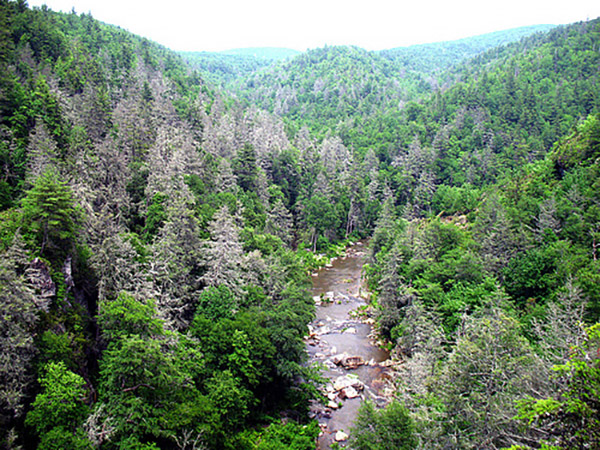
The Wilderness Society’s ecologists went to the Smokies to explore these questions and seek understanding of the role of wilderness in the 21st century. There, pervasive stressors and their impacts are well-known and include loss of American chestnut as a foundational species from the invasion of a nonnative blight. Other examples of invasive species in the Smokies abound: European wild hogs impact soils and streams; numerous exotic plants compete with natives and alter ecological characteristics; and eastern hemlocks are being lost to the hemlock woolly adelgid (a small sap sucking aphid).

In the high elevation forests of the southern Appalachians, red spruce and Fraser fir face pervasive stressors that have been taking their toll the past couple of decades. Invasive balsam woolly adelgids have killed many of the large Fraser firs. Acid deposition has altered the soil chemistry, creating a toxic environment for red spruce. And, given that species in this forest type can’t move upslope (they already occur at the crest of the Smokies), climate change may increasingly contribute to the cumulative stress on this system. Ultimately, climate change may be the last straw leading to local loss of these species.

Intervening in nature to remove existing stress to these forests may be the best defense to prepare the species for future changes in climate. In such a case, an argument can be made that ‘trammeling’ in the form of restoration is needed to head off greater and longer term threats to wilderness coming from the pervasive, and mostly unknown, impacts of human-caused climate change. The National Park Service already actively controls invasive plant and animal species in GSMNP. Most agree that that investment in this kind of punctuated, defensive action is warranted to sustain the park’s native ecosystems.

But, what about situations where continuous pressure like climate change threatens the ecological integrity of wilderness? If we allow nature to respond to changes in climate without intervening, we would maintain the untrammeled nature of wilderness and its role as a barometer against which to judge management elsewhere, but a hand’s off approach may in some cases jeopardize the very species and populations we hope to preserve. How resilient will nature be in the face of climate change? The answer is uncertain, but in cases where the threat of climate change-induced extinction seems likely, how should we respond?

By our analysis, no single approach is capable of addressing all concerns. Instead, a diversity of approaches is necessary. While in the Smokies, TWS ecologists concluded that the soundest course to the future will require a “portfolio approach” in which some parts of the landscape are devoted to forestalling change through the process of ecological restoration, some parts are devoted to innovative management that anticipates climate change and prepares for it, and other parts are left to change on their own time – on wilderness time – to serve as scientific “controls” and continue to provide the benefits of wilderness.

An important aspect that should guide how we respond to environmental change emerged from our discussions on the trails and around campfires in East Tennessee last fall. Bad decisions of the past, conducted with good intentions, have led to some natural resource disasters (think planting kudzu to control soil erosion). Whatever we do and however we respond, a Hippocratic Oath to land management and conservation should be considered: first, do no harm.

Despite 77 years of separation in time, the ecologists at The Wilderness Society went to the Smokies to discuss provocative and new ideas of our generation. The storied history of our organization’s conception during a heated debate of once and still profound ideas gave rise to our own impassioned conversations.

At their core, our values and those of the founders remain the same: we hope to convey into the future that which we inherited from the past. New approaches are needed and The Wilderness Society scientists are on the front lines of applying the latest science to these challenges. Future generations will live in a different world, just as we live in a different world from 1934.

However, preserving wildlands and the biodiversity therein, offers a chance that our grandchildren may live in a rich, productive, interesting, and beautiful world. Our thinking and approaches to conservation will evolve, but our commitment to preserving wildlands has changed little since that October day in 1934.

They’re Here: Alien Species in Appalachia

Wednesday, December 5th, 2012 - posted by meghan

By Matt Grimley

Brown marmorated stink bugs circle on unsuspecting apple. When feeding on these tree fruits, the insects cause catffacing, a deformity that makes the fruit unmarketable. Photo by Tracy Leskey, courtesy of the Appalachian Fruit Research Station

Anything that costs $120 billion every year to control can’t be good.

That’s just one estimate of the costs of invasive species in the United States, courtesy of the Rocky Mountain Research Station. In Appalachia, the everyday costs are more apparent: the smear of house sparrow droppings on your windshield, the garlic mustard that fills your yard, the anthracnose wilting your dogwood’s leaves.

And that’s not even the half of it.

Just Shoat Me
They estimated it would supply 500 to 700 pounds of sausage. The feral hog, dubbed “Monster Pig,” was shot nine times by an 11-year old boy in Alabama who wielded a .50-caliber revolver. The prodigious pig weighed 1,050 pounds and measured over nine feet long.

Picture that humongous ham and you might get an idea of the enormous problem that feral pigs — known as shoats when young — pose in the United States. From populating a few states such as Hawaii and California, they flourished to over five million nationwide, snorting their way through at least 35 states, where they cause over $1 billion in damages and control costs every year.

The Great Smoky Mountains National Park knows all about them. In 1912, a hunting preserve on Hooper’s Bald in North Carolina received a shipment of European wild boar, which flourished on the land. When the reserve went bankrupt in 1920, locals hunted off some, but many hogs escaped.

By the 1970s, wild hogs had taken over the park. In the intervening years, the wild boars coupled with domesticated pigs. Still lean and tusked like European wild boars, wild hogs today also show spots, short snouts and curly tails.

Some might call these hybrid pigs “cute,” but they effectively churn the earth, squashing seed growth, dredging up soil communities and vegetative cover, and devouring almsot anything, including the unique Jordon’s salamanders, which are found only in the park.

The hog is also a carrier for diseases such as pseudorabies, which the pork industry in North Carolina — among the biggest in the nation — spends millions of dollars fighting every year.

Bill Stiver, a wildlife biologist with the park, says they remove about 300 wild hogs a year via hunting and trapping.
According to him, that’s considered “maintenance level” for the population.

“With the existing manpower, we’re doing a pretty good job keeping them down to that low level,” he says.

Kudzu basket, photo courtesy of Nancy Basket

He says that the hogs are more reproductively-talented than even the white-tailed deer: they can breed at six-months old and have two litters per year, with three to eight piglets per litter. And if the swining-and-dining wasn’t enough, hunters are also suspected of moving the hogs illegally, which may account for new populations in the mountains of North Carolina and Tennessee.

Remember Monster Pig? Turns out its name was Fred, and he was a domesticated pig that a commercial hunting preserve bought and passed off as wild. Fred’s previous owners said the lovable loaf loved playing with children and eating cans of sweet potatoes.

Smells of Cilantro
Nobody invited it. The brown marmorated stink bug first showed up in Pennsylvania in the late 1990s, probably having hitchhiked on some crates from China or Japan. Since dropping in on Maryland in 2003 and West Virginia in 2004, it has spread to 39 states across the country.

This stinker is 1.7 centimeters long and shaped like a shield, characteristic of many stink bugs. Over its brown back are marmorated (or marbled) patches of off-white, black, blue and copper. When threatened, the bug releases a cilantro-like smell.

The brown marmorated stink bug, with its sucking proboscis, can eat over 100 recorded food sources, including tree fruits, berries, ornamental trees, and row crops such as corn and soybeans. “It’s not a fussy eater,” says Tracy Leskey, a research entomologist who works at the U.S. Department of Agriculture’s Appalachian Fruit Research Station in Kearneysville, W. Va.

2010 was by far the worst year for these stinkbugs in Appalachia, she says. In particular, the noisome nuisance devoured apples like they were going out of style. Many growers lost up to 80 percent of their apple crops and had to choose between selling a pittance or not even harvesting.

This year, Leskey says, her research team has made progress in identifying the pheromone of brown marmorated stink bugs. With this perfume in hand, they hope to bait a trap to capture and monitor the bug’s populations. Other ongoing efforts include researching possible native predators such as praying mantises and parasitoid wasps, as well as providing farmers with monitoring equipment so that they can be timely in their pest management.

For those who find a brown marmorated stink bug, Leskey suggests that if you’re in a state without an official population, submit the sample to your local land-grant university or state department of agriculture to have it confirmed. You can look on stopbmsb.org for more information. Second of all, don’t panic — it’s good to identify a population.

This busy bug, along with other invasives like spotted wing drosophila and kudzu bugs, are changing the dynamics of pest management by targeting crops that haven’t been attacked before. “We didn’t have to worry about this in the past,” says Leskey.

Vining For More
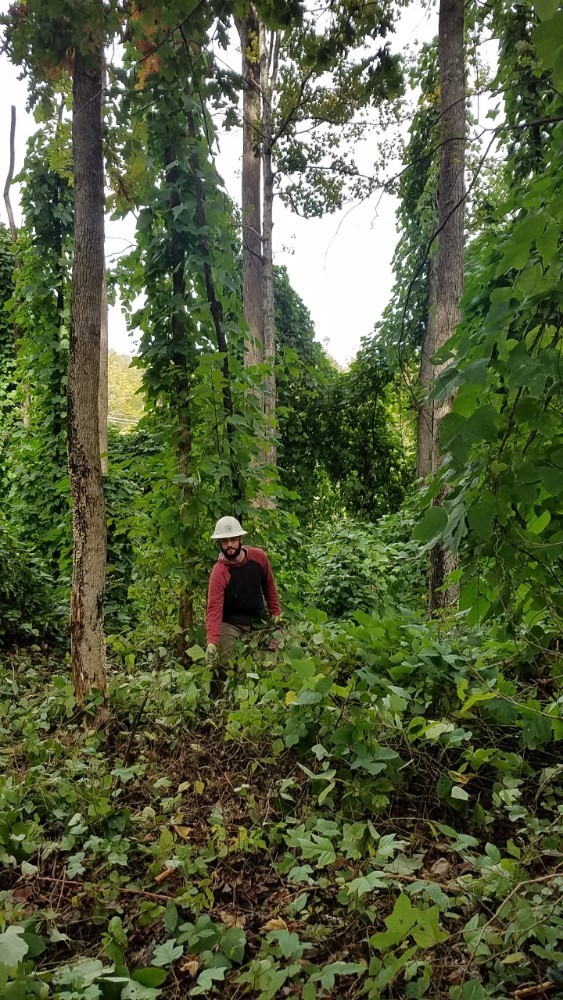
As if by pure muscle, kudzu strangles a landscape, blanketing trees, shrubs and grass with green as it reaches out to the sunlight. The vine, with three million hectares in the United States already under its belt, continues to swallow 50,000 hectares a year, mostly in the Southeast.

According to the U.S. Army Corps of Engineers, the Eastern U.S. should anticipate that the effects of climate change will bring higher temperatures and higher CO2 levels. Combined with increased natural habitat fragmentation, these changes all favor kudzu’s aggressive, foot-a-day growth and could signal a warning for cooler, higher-elevation locales like Appalachia.

It can take about $5,000 per hectare per year to control kudzu. And sure, a person can control it by digging up and eradicating its extensive root system and selectively spraying it with herbicides. But people like Nancy Basket in Walhalla, S.C., have a different idea.

“Since it’s growing in a ravine in the back of my house,” says Basket, “I use it out of self-defense.”
Dedicated kudzu crafters are able to make lamp shades, insulation, sculptures, paper from the leaves, barns out of dessicated bales, clothes, soap from the root (which also might, according to a Harvard study, be used to curb alcohol consumption).

“You can even eat kudzu,” Basket says.

Kudzu first shipped over from Asia in 1876. At first propagated to control soil erosion, with the federal government paying many farmers to plant it, it was eventually recognized as a pest weed by the U.S. Department of Agriculture in the 1950s.

From her shop, where she’s been for 16 of her 32 years in the kudzu craft, Basket chooses only vines that are thumb-width or thicker to make her baskets. By coiling and sewing the vines together, the traditional Cherokee style, she is able to create art and celebrate her Native American heritage simultaneously.

She teaches her art to all grades and ages, visiting schools, working at museums, and giving presentations to anyone who’ll listen. “If I blaze a trail through kudzu, maybe others will do it, too,” she says. “And then we won’t have to fight it. We can live with it. Get fed, live in it, use it for containers, a home. What else do you need?”

One can only hope that her teaching grows faster than the kudzu.

—————————————————————

Other Facts

Exotically Appalachian

The more (invasives) you know:

  • European starling: Released in 1890 by a Shakespeare lover, its murmuration pecks up over $800 million in agricultural damages every year.
  • Multiflora rose: Not a rose by any other name; this Japanese import fills 45 million acres of fields, pastures and forest edges with impenetrable thickets.
  • Kudzu Bug: It sucks out the juice from soybean crops and smells awful when touched, but it controls kudzu … we’re grateful?
  • Tree-of-heaven: Prolific seed production and rotten-peanut butter smell only add to the charm of this aggressively growing Chinese tree
  • Beech bark disease: An insect eats the bark, the fungus infects the wound, and the important forestry tree, the American beech, enjoys nature’s use of teamwork.
  • Appalachia’s Gifts to the World:

  • Gray squirrel: They have scurried all over North America, South Africa, Italy, Ireland and Britain. The British hate the squirrel because it eats seven times more food per hectare than its cousin, the native red squirrel, who is still queued up and waiting for food. (Word is, it’ll get “nuttin.’”)
  • Crayfish plague: Back in the 1800s, our crawdads somehow infected Italian waters with water mold. Because native European crayfish are entirely susceptible to this deadly fungus, their populations nosedived. Resistant non-native crayfish were then introduced to combat the plague, but they outcompeted the rest of the European stock and spread the disease even further. Note: never fight non-native species with more non-native species.
  • American bullfrog: A traveler of 40 countries and four continents, this proliferative polliwog is blamed for the deadly chytrid fungus that is responsible for declining amphibian populations worldwide. They outcompete native species, eat endangered amphibians and also make a delectable snack, so don’t think twice about introducing that croaker into your crock pot.
  • Non-Native and Delicious

    Remember, if you’re hungry for some exotically tasty treats, go to www.appvoices.org/2012/12/17/invasive-species-recipes/ for some invasive species recipes!

    Abrams Falls Trail: A Jaunt to a Jewel of the Smokies

    Wednesday, August 8th, 2012 - posted by meghan

    By Stephen Otis

    Waterfall at Abrams Fall

    Don’t be fooled by Abrams Falls’ serene surroundings-this pretty cascade features powerful water, and the pool at its base has a reputation for an undertow. Photo by Jenny Pansing

    The Abrams Falls Trail has historical nuances you won’t find just anywhere.

    Located in the Cades Cove area of the Great Smoky Mountains National Park in Tennessee, the trail, creek and falls are named after a historic leader of the Cherokee Nation, Chief Abram; a short side trail leads to Elijah Oliver’s house, the first settler of Cades Cove circa 1818.

    It has a reputation in the world of adventure as well, earning a spot on Backpacker Magazine’s list of the 10 most dangerous hikes in the country. Of course, if you are a local like me, and you like to hike the trail for its moderate footpath along the serene Abrams Creek — replete with wild river otter and fly-fishing aplenty — you may find yourself scratching your head wondering what wild encounter led the good people at Backpacker Magazine to put the trail on their list of perilous paths.

    Maybe it is the strong storm waters that often surge over the nearly 20-foot falls, the same waters that took the life of 19-year-old William Diefenbach in 1993. He was swept downstream and drowned trying to ford Newt Prong. Maybe it is the countless injuries that occur from the young and the bold attempting to jump off the falls’ slippery perch, not noticing the shelf of rock just below the surface at the base. Or the copperheads and moccasins that like to perch in the clefts of the basins.

    Maybe, but all in all, Abrams Falls is one of the most pristine and beautiful hikes in the Smokies with one of the most impressive watering holes you will ever see. Of course, the Great Smoky Mountain National Park encourages those who visit to avoid swimming for aforementioned reasons. Dangerous? Maybe, if you’re the kind of person who attracts danger. Beautiful? Most certainly. Worth a visit? Most definitely.

    Abrams Fall Trail

    The trail to Abrams Falls is listed as moderately difficult but includes three narrow log bridges, so the park service recommends sturdy hiking shoes. Photo by Kid Cowboy

    To the falls and back, the trail traverses five miles, much of it creekside, providing the sounds of mountain water like a constant symphony. Along the way, there are a bevy of places to stop for a picnic or to just step off the trail and search for salamanders. The watering hole at the end of the 2.5-mile trek enjoys the constant spray of Abrams Falls. Named after Chief Oskuah (later changed to Abram) of the Cherokee Nation, here the strength of these great people who roamed these free and sacred lands is preserved.

    The drive to the trailhead brings you through the historic Cades Cove Loop with wildlife grazing in open valley fields, where deer roam like cattle and bear and other wildlife are commonly sighted. It is a place stuck in a slow and steady time in our nation’s history, heck, before that even, to a time before we started recording time.

    If one is so inclined, the other side of Abrams Falls, although little-publicized, is the area’s true beauty. Scattered with small loop trails and split-offs, a backpacker can get lost in here for days. Void of crowds and with many opportunities for bear sightings (and late night visits), quiet adventure abounds. The park has done a great job in clearing good campsites and rigging state-of-the-art bear hangers for food. This is the part of Abrams where you will most likely find river otters and very, very nice fish dangling on the end of your spray line. If you wade in these waters, you can see eight-inch rainbow trout hanging out in the current like they’re having an afternoon meeting.

    Three days here, and you will emerge a better, leaner, more brightly lit man or woman.

    Stephen Otis is the co-author of “A Road More or Less Traveled,” a narrative about hiking the Appalachian Trail from Maine to Georgia, recently awarded runner-up in the New York Book Festival. Read reviews and order the book at Amazon.com.

    North Carolina – Hidden Treasures

    Monday, June 11th, 2012 - posted by Anna

    Cataloochee Valley

    Photo by Jared Kay

    Surrounded by 6,000-foot peaks in the heart of the Great Smoky Mountains National Park, Cataloochee Valley is one of the loveliest early settlements in Western North Carolina. While the 19th century churches, homes and school are a charming site, there’s an even bigger secret — the several herds of elk released to the valley in 2001.

    Elk were once abundant in the southern Appalachian Mountains, but due to over-hunting and loss of habitat, they slowly disappeared.

    The experimental release of elk in the Great Smoky Mountains National Park began with the introduction of 52 elk between 2001 and 2002. Now there are more than 140 elk roaming throughout the park. Cataloochee Valley is one of the best places to view these graceful animals because of its remoteness and open grassy fields. — MH

    More Info: Located near I-40 about 20 minutes north of Waynesville, N.C. on Cove Creek Rd. Visit: nps.gov/grsm

    Tsali Recreation Area

    Photo by Leslie Kehmeier

    Challenging. That might be the best word to describe the nearly 40 miles of bike trails located in the Tsali Recreation Area just northwest of Robbinsville, N.C., in the Nantahala National Forest.

    “Tsali” is the name of a Cherokee Indian that sacrificed his life so that his people could stay in the serene Great Smoky Mountains during the Trail of Tears.

    In 1838, the U.S. government ordered all of the Cherokees in North Carolina to move west to Oklahoma. However, Tsali and his people managed to stay and hide in the mountains. When they were found, an agreement was made to let the people stay if sacrifices were made. Tsali and several of his family members courageously sacrificed themselves and were buried under what is now known as Fontana Lake in the middle of Tsali Recreation Area.

    A four-loop trail system with many other interlocking trails comprises this little piece of mountain biker’s heaven.

    But this recreation area doesn’t only cater to avid bikers. Tsali’s trails are open to hikers and horseback riders as well. Because mountain bikers and horseback riders are the primary trail users, trails are alternated to keep the two separated.

    The four main trails — Right Loop, Left Loop, Mouse Branch Loop and Thompson Loop — wind along Fontana Lake at the base of the Great Smoky Mountains. The trails are hard-packed with a fast-paced flowing feel. Take a break from the vigorous ride through the trails to stop at one of the three designated overlooks featuring views of the lake.

    Forest management has worked to ensure that wildlife remains at Tsali. In the grassy openings along Fontana Lake and in the pine and hardwood forests, trail riders might see wild turkeys, white-tailed deer, ruffed grouse, rabbits, songbirds and butterflies.

    After a long, hard day of biking or horseback riding, fall back into your cozy tent anywhere on the National Forest lands. If you prefer the comfort of an RV, Tsali’s public campgrounds, located directly next to the trailhead, are equipped with 41 graveled level sites, hot showers, flushable toilets and drinking water.

    Day passes for mountain bikers are a mere $2, and official campsites are $15 a night. The perk? Wake up in the morning feeling fresh from a great night’s sleep deep in the Nantahala, hop on your bike and do it all over again! — MH

    More Info: 30 minutes southwest of Cherokee, N.C. on Hwy 28. Look for Tsali Campground Rd. after reaching Lake Fontana. Visit fs.usda.gov