Follow Us on Twitter: Appalachian Voices | iLoveMountains.org

Posts Tagged ‘Coal Ash’

Southeastern Coal Plants Retire and Convert | Other Shorts

Wednesday, February 13th, 2013 - posted by Davis Wax

The growing share of electricity generated by natural gas and recent announcements of coal plant retirements are rapidly changing the energy sector across the southeast. On Jan. 7, Georgia Power announced its plans to retire 15 coal- and oil-fired units at four plants across the state.

The same week as Georgia Power’s announcement, Duke Energy touted three facilities that came online at the end of 2012. The new units include natural gas-fired generation at the Dan River Power Station and the H.F. Lee Plant, both in North Carolina.

Duke Energy has also received approval from the N.C. Utilities Commission to convert the Sutton Steam Station in Wilmington, N.C., to natural gas and said it plans to retire the Riverbend and Buck plants this April, two years ahead of schedule.

Senate Investigation to Scrutinize Coal Export Royalties

As U.S. coal exports hit a record high and the industry attempts to expand ports in the Pacific Northwest, the winners of the Powder River Basin bonanza, including Arch Coal, Peabody Energy and Cloud Peak Energy, are coming under fire.

On Jan. 4, members of the Senate Energy and Natural Resources Committee directed the U.S. Department of the Interior to investigate whether coal companies are avoiding paying royalties by underpricing coal mined on federal and tribal lands. Federal officials are auditing export sales from the past few years to determine whether coal companies fairly priced and paid royalties on coal shipped overseas.

Near Future Could be Bright for Coal

According to a new report from the U.S. Energy Information Administration, the percent of electricity generated by burning coal will get a bump this year as natural gas prices increase. The agency predicts that coal will provide around 40 percent of total generation this year.

If natural gas remains cheap, however, coal’s share could be lower than predicted. Over the long-term, Appalachian coal production will continue to decline and coal-plant retirements will far outpace generation coming online.

Kentucky Attempts to loosen Selenium Standards, Fish Attempt to Leave the State

Friday, February 8th, 2013 - posted by eric

Fish deformed by selenium pollution

The Kentucky Energy and Environment Cabinet is in the process of making the state’s water quality standard for selenium less stringent. Selenium is a metal that is especially toxic to fish, and is often released into streams through coal mining.

There will be a hearing before the Administrative Regulation Review Committee on Monday February 11, at 1 p.m. in Room 149 of the Capitol Annex, where, according to the Energy and Environment Cabinet website, the public “may” be able to speak out about this, but we still encourage concerned citizens to attend.

Selenium is a toxic nonmetal that is present in some coal and coal ash. Some of Kentucky’s mines release a lot of selenium because they are mining high-selenium coal seams, while others don’t release any.

Selenium is extremely toxic to fish in very low amounts because of its tendency to bioaccumulate. Selenium builds up in small fish and macro-invertebrates, and it accumulates even more in the fish that eat them. Toxic effects of selenium in fish include reproductive problems, deformities, damage to gills and organs, and death. The most obvious deformities are strangely curved spines, and “pop eye” — a buildup of fluid behind the eyes, causing them to bulge out. (more…)

Despite Positive PR for Duke Energy, Our Water is Still at Risk

Friday, February 1st, 2013 - posted by sandra

Duke Energy announced it would retire the Riverbend Power Plant in April, two years ahead of schedule. A good headline, but water is still being put at risk.

Don’t like what people are saying about you? Change the conversation!

Duke Energy has gotten a ton of mileage for their decision to retire or convert some of their older, more inefficient power plants in the Tarheel State. It’s environmentally-friendly after all – recycling news stories!

And you can create a whole new news story by moving your timeline. Duke Energy announced today they will be retiring their octogenarian coal plants, Riverbend in Gaston County and Buck in Rowan County this April, nearly two years ahead of schedule.

And while we are happy that Mountain Island Lake and the Yadkin River will be suffering from less pollution from toxic heavy metals like arsenic, selenium, chromium and so on, could it be that Duke Energy is trying to distract from the PR crisis they are currently facing around their leaking coal ash impoundments?

Like the fact that Western North Carolina Alliance intends to pursue legal action against Progress Energy for not complying with the Clean Water Act and allowing illegal discharges into the French Broad River. Or that the Catawba Riverkeeper has documented seeps into Mountain Island Lake, Charlotte’s drinking water supply, and Lake Wylie. Or how about that the Cape Fear Riverkeeper is reporting high arsenic levels in groundwater near well water supplies at the Sutton plant in Wilmington.

On top of that, Duke University scientists publishing reports that seem to back up many of these claims. So while Duke’s announcement is indeed good news for water, we need to continue to hold Duke and Progress accountable. There is more to be done.

Coal Ash: Now a Part of a Balanced Breakfast

Thursday, January 31st, 2013 - posted by Hallie

This just in: in addition to fruits and veggies, our nation’s children should be getting their daily dose of coal ash. Or at least that’s what statements at a public hearing in Franklin County, Missouri, seem to suggest.

Just last week, there was a hearing for a lawsuit filed by the Labadie Environmental Organization over a zoning amendment that would allow Ameren Corp. to construct a new coal ash landfill in the heart of a floodplain. Toxicologist Dr. Lisa J.N. Bradley, testifying on behalf of Ameren Energy Corporation, said, “A child could consume coal ash every day and have no increased exposure to arsenic.”

Bradley was recently elected to the Executive Committee of the American Coal Ash Association, a lobbying organization whose membership includes Ameren, Duke Energy, Southern Company and other large coal-burning utilities. Unfortunately, it seems that conflict of interest was lost on Associate Circuit Court Judge Robert D. Schollmeyer, who dismissed the lawsuit citing Bradley’s testimony.

Maximiliano Calcano, age 2, is one of the first children born with a dramatic birth defect attributed to the coal ash dumping in the Dominican Republic.

There are many who have had to face the traumatic effects of toxic coal ash firsthand. Following the AES Corporation’s dumping of 80,000 tons of coal ash waste along the shores of the Dominican Republic between 2003 and 2004, the country’s women have suffered years of consistent miscarriages, abnormal levels of arsenic in their blood, and births to babies with cranial deformities, external organs, and missing limbs.

While we have yet to uncover such a horrific case here in the states, concerns over coal ash are real. Archie Dixon lives just south of Belmont, N.C., where Duke Energy’s coal ash ponds are some of his closest and most unwelcome neighbors. Distrustful of the visible grime and discoloration of his water, Mr. Dixon has been buying bottled water for years, unwilling to ingest the water from his home’s private well. Despite reassurance from Duke Energy officials who say that lab tests show that the sediment in Mr. Dixon’s water is of naturally occurring materials, he refuses to take any risks with his water. Dixon is not the only member of his community concerned about coal ash.
(more…)

New NC DENR Boss Isn’t Sure About Global Warming

Friday, January 11th, 2013 - posted by Tabitha

Watch as John Skvarla, North Carolina’s new head of the Department of Environment and Natural Resources, sidesteps a question about climate change (near the end of the video) and supports the continuance of fracking.

As the state pursues more controversial forms of energy production, he believes that “we are not going to go backward in air and water quality protection.”

The Mayan Calendar Has Ended, And There is Still Coal Ash in the Tennessee River

Friday, December 21st, 2012 - posted by sandra

So the world did not end today, as much of the discussion around the end of Mayan calendar seemed to suggest. But it might have seemed like that to the residents of Harriman, Tn. exactly four year ago today, when an earthen dam at a nearby power plant failed, and 1 billion gallons of coal ash waste flooded across fields and farmland and oozed into nearby rivers. The amount spilled is enough to fill 1,500 Olympic-sized swimming pools.

Though no one was directly hurt or killed, the catastrophe at the Tennessee Valley Authority power plant surely devastated lives. People got sick from the fumes coming off the ash and had to boil their water. Property values plunged, compelling people to sell their homes and property to TVA. Dangerous heavy metals were released into the Emory River, a tributary of the Tennessee River.

It was the first time a majority Americans learned what coal ash was and how dangerous it could be. People were shocked to know that a waste product from burning coal was most often dumped into unlined pits behind earthen dams. More shocking is the fact that, in the absence of federal standards coal ash — laced with heavy metals, known carcinogens and other toxins — is less regulated than household waste.

In the Southeast, we know there are 450 of these impoundments holding back 118 billion gallons of coal ash. Not only is there the risk of a dam breaking, there is the more insidious pollution of our waterways. (See if there is one near you).

I will never forget the day Donna Lisenby, Coal Campaign Coordinator for Waterkeeper Alliance, John Wathen, Hurricane Creekkeeper and I traveled to “ground zero” and paddled to where the Emory River ceased being a river and began to look like a sludge pit. It looked like the end of the world. 

Little has happened since the TVA spill. Clean-up that was supposed to take a few weeks still isn’t completed. TVA has decided to allow “natural recovery” to take place, which basically means TVA will stop trying to dredge the river and see if Mother Nature might be able to finish the job with the remaining 9% of the ash still left.  (more…)

Ol’ Dan River (Despite Coal Ash) Just Keeps Rollin’

Monday, December 17th, 2012 - posted by Matt G

Appalachian Voices recently submitted their comments to the N.C. Department of Environment and Natural Resources on Dan River Steam Station’s new permit to discharge coal ash.

As we all know, coal ash isn’t a pretty thing. The harmful leftovers from burning coal contain toxic contaminants like chromium and arsenic, and seep into our waterways, threatening wildlife and human health all in one fell swoop.

Current testing at the Dan River Steam Station, according to the new website southeastcoalash.org, reveals levels of antimony, arsenic, iron, manganese, sulfate and total dissolved solids above state groundwater standards. That’s unacceptable — coal ash shouldn’t interfere at all with groundwater, surface water, or the waters we drink and play in. To keep coal ash at bay, the ponds of sludge located at Dan River and other sites should be properly lined and covered. (more…)

No Longer Hidden in Plain Sight, Thanks to SoutheastCoalAsh.org!

Monday, December 10th, 2012 - posted by sandra

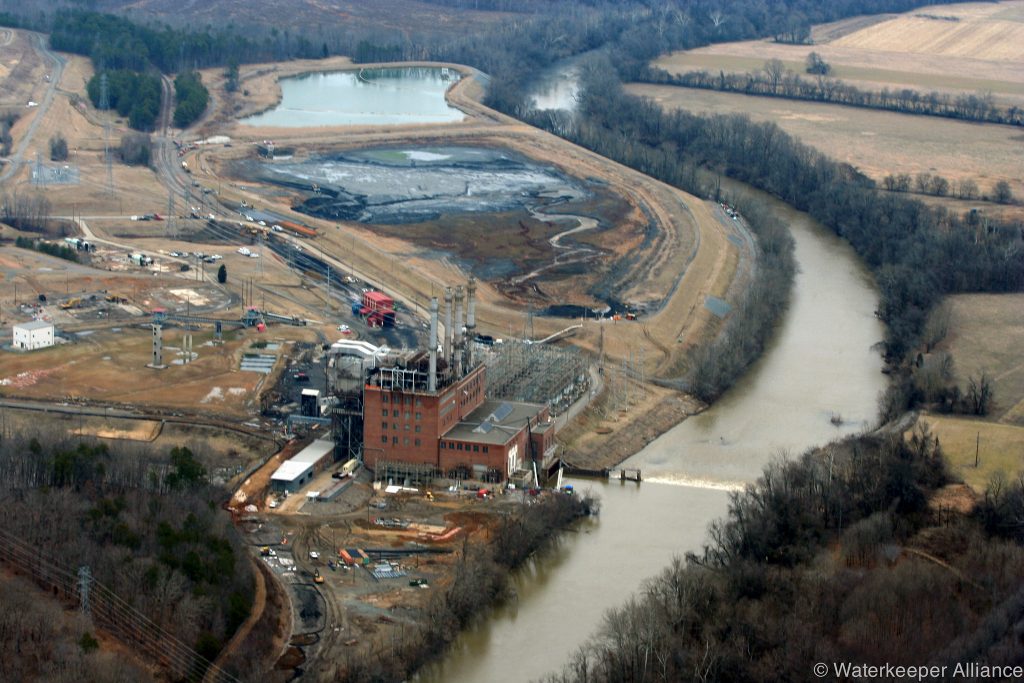
For how large coal ash impoundments can be, they are sure hard to spot.

For example, there are two large earthen dams full of coal ash just north of Charlotte near Mountain Island Lake. Can you spot them?

(Answer: They’re on that long ridgetop to the left of the plant.)

Since Duke Energy is probably not going to place yellow neon signs near the impoundments to alert the public to the dangers that these dams may cause to groundwater or public safety anytime soon, we did the next best thing. Working with Southern Alliance for Clean Energy and other partner organizations like Southern Environmental Law Center and NC Conservation Network, we have helped create Southeastcoalash.org. With just five key strokes (your zip code) you can see where coal ash impoundments are hiding in plain sight near you. (more…)

Singin’ the Catawba River Blues After Commission’s Decision On Coal Ash

Thursday, December 6th, 2012 - posted by Hallie

North Carolina, we have a problem.

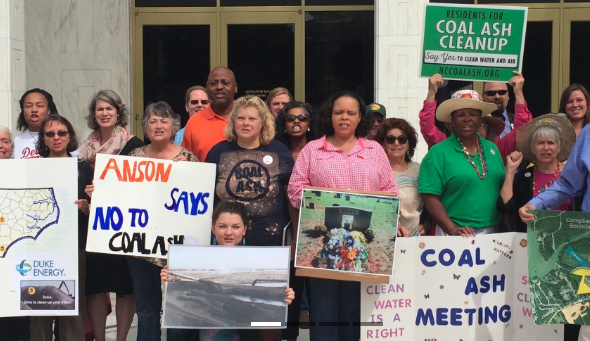
The waste from burning coal, known as coal ash, continues to threaten our state’s water supply. Seepage from coal ash impoundments is contaminating North Carolina’s water at various sites throughout the state. Unaddressed in the past and denied in the present, this pollution demands a stronger fight to protect clean water, and advocates are putting up that fight.

Unfortunately, advocates for N.C.’s clean water recently lost a battle on the coal ash front. This past Monday, the Environmental Management Commission (EMC) ruled against a petition to require Duke Energy to clean up contamination resulting from 14 of their coal ash pits.

Monday’s hearing ended in a 9-2 decision that the company’s coal ash sites are exempt from the requirements of the state’s groundwater standards and therefore do not require immediate clean up.

In October, the Southern Environmental Law Center filed a formal complaint on behalf of four organizations (Cape Fear River Watch, Sierra Club, Waterkeeper Alliance, and Western N.C. Alliance) against Progress and Duke Energies to clean up the contamination from their coal ash ponds.

(more…)

Coal Industry Employment Remains in Flux and other shorts

Wednesday, December 5th, 2012 - posted by meghan

On Nov. 27, Southern Coal announced it would recall 650 laid-off miners after entering into a multi-year contract with American Electric Power. The deal will allow Southern Coal to reopen mines that were closed earlier this year and will prevent the layoffs of another 500 workers.

Much of the complaints about a political “war on coal” during the recent election cycle were predicated on using layoff figures from Appalachian coal mines, however, the industry has kept mostly quiet about new sites and expansions.

According to the West Virginia State Journal, mining employment in the state remains far higher than most of the past decade. During the third quarter of 2012, coal employment dropped 5 percent nationwide, but remained higher than at the start of the recession. During the first three years of President Obama’s first term, the number of miners working in Appalachia rose due to increased scrutiny of mountaintop removal permits by the U.S. Environmental Protection Agency.

The Lowdown on Coal Ash

By Matt Grimley

On Nov. 19, a federal judge ordered mediation between the Tennessee Valley Authority and the 872 Roane County, Tenn., residents suing over the December 2008 coal ash spill that released more than a billion gallons of the waste into the Emory and Clinch rivers.

U.S. District Judge Tom Varlan already found TVA liable in the failure of the coal ash dam, writing that the spill could have been prevented. The federal utility has estimated that the cleanup project, which is expected to continue through 2015, will cost about $1.2 billion.

Recently, testifying on proposed Senate Bill 3512, which would regulate how coal ash is stored, mine safety and environmental specialist Jack Spadaro said he is certain that the bill in its present form “will result in a catastrophic failure of a coal ash dam containment structure that will result in extensive loss of life and severe environmental damage that will be irreversible.”

The U.S. Environmental Protection Agency is still considering a rule to regulate coal ash either as hazardous waste or as solid waste. Despite pressures from environmental and other advocacy groups, the EPA has indicated that the rule is unlikely to be decided until 2014.

According to the EPA, coal-fired power plants create 136 million tons of coal ash every year.

Report Makes the Case for Coal Plant Retirements

Nearly 300 of the oldest coal-fired power plants in the United States have been scheduled for closure. A new report by the Union of Concerned Scientists identified up to 353 additional plants that are uneconomical to continue operating. In “Ripe for Retirement: The Case for Closing America’s Costliest Coal Plants,” the cost of operating individual coal-fired units is compared to alternative forms of electricity generation, including natural gas and wind generation. According to the report, Southern Co., Tennessee Valley Authority and Duke Energy are operating the most uncompetitive coal plants. Read the report at www.ucsusa.org

Kentucky Cabinet Settles in Wrongful Termination Suit

A former Kentucky state official dropped the wrongful termination lawsuit he filed against Gov. Steve Beshear in 2009 after settling with the Kentucky Energy and Environment Cabinet. Ron Mills was the head of the cabinet’s Division of Mine Permits before being terminated in November 2009 after refusing to sign permits for what he called “illegal practices.” Mills claimed that, despite his objections, the Beshear administration skipped legal documentation procedures and issued permits to coal companies that were unable to demonstrate rights to the entire parcels they planned to mine. The settlement provides Mills $270,000 in exchange for dropping the lawsuit.