Follow Us on Twitter: Appalachian Voices | iLoveMountains.org

Posts Tagged ‘energy’

Appalachia & the World

Thursday, December 13th, 2012 - posted by molly

The Appalachian Voice typically looks inward, exploring the intricacies of our region.

This time, however, we looked out at the rest of the world to see what Appalachia’s global ties could tell us about the life, history and struggles that take place within these mountains.

Take a moment to flip through the print version or visit our webpage, and let the latest issue of The Appalachian Voice take you around the world and back again.

Our features begin with Global Connections, an introduction by our editor, Jamie Goodman, that showcases Appalachia’s worldly history and busts the myth of the region’s isolation. On the facing page, Finding a Common Language examines how Appalachia’s growing Latino population is striving for, and attaining, integration with mountain communities.

Realizing that Appalachia’s energy future is closely tied to the pulse of the planet, we consider the best available energy forecasts in A Clean(er) World, which looks at how America fits into the future of electricity generation. Our centerspread, Uncharted Waters, features a global map that highlights some of the trends and hot spots in the international energy trade.
(more…)

A Clean(er) World

Wednesday, December 5th, 2012 - posted by meghan

Forecasting America’s Role in the Energy Future

By Molly Moore

No country is an energy island.

In the face of a European Union sanction that bans steel imports, Iran is using roundabout trading methods to secure metallurgical coal, used in steel manufacturing, from Ukraine. A state-backed firm in Abu Dhabi plans to invest in Saudi Arabia’s growing renewable energy efforts. And in May, a state-owned Chinese company disclosed plans to buy Triple H Coal Company, which operates in Campbell County, Tenn., marking the first time a Chinese company invested in American coal.

That America and Appalachia’s energy consumption and output are tied to international forces should come as no surprise. Immigrants from the British Isles and Eastern Europe who came to Central Appalachia to work in the coal mines knew that in the 19th and 20th centuries. Today, as nations develop, technology advances and policies shift, the international energy landscape is changing, as is America’s place in it.

Like sea level and human population, the world’s appetite for energy is rising. Without significant changes in policy, such as a worldwide push towards energy savings, global electricity demand will increase over 70 percent from current levels by 2035, the International Energy Agency projects. Renewable sources of power are expected to account for half of new worldwide energy capacity. Coal’s share of overall electrical generation is projected to decline from two-fifths to about one-third, putting it on par with the amount of power expected to come from renewables.

The percentage of U.S. electricity coming from coal is already close to that one-third prediction, a record low, but the country will need to make significant gains in renewable energy in order to fall in line with the projected global average by 2035. In 2011, America derived about 9 percent of its energy from renewables, while Germany used renewable sources to produce 20 percent of its energy.

Looked at another way, however, America doesn’t seem so far behind. At the end of 2011, the United States was second after China in total renewable energy capacity, according to a report by public research and advocacy organization The Pew Charitable Trusts.

Follow the Clean Money
“I don’t think [the United States] gets enough credit for leading in many, many ways in renewable energy,” says Richard Caperton, director of clean energy investment for think tank Center for American Progress. He notes that the field of renewable energy is diverse and encompasses manufacturing, project development, deployment and financing. Compared to other nations, the U.S. is strong on some of those fronts and falls behind in others.

Caperton says America is great at “getting concrete and steel in the ground” by planning and installing wind turbines and solar farms. Compared to China, America also does well at integrating alternative energy sources with utilities. Though it’s difficult to track information on China’s power system, he says, the country continues to build wind farms and solar arrays that aren’t connected to the grid.

“Our banks and venture capital investors and private equity investors are, I think, world leaders in their knowledge of the field and in their willingness to finance renewable energy projects both domestically and abroad,” he says.

The U.S. invested $48.1 billion in clean energy in 2011, more than any other nation. The Pew Charitable Trusts attribute that dramatic increase in clean energy investment to the fact that entrepreneurs and financiers were making the most of government policies that expired at the end of that year.

Following that boom, growth in clean energy investment slowed in both America and around the world. In the third quarter of 2012, those investments were 20 percent lower than they were a year ago, reports research company Bloomberg New Energy Finance. Bloomberg attributed the global drop to uncertain clean energy policies in countries such as the U.S. and United Kingdom.

Caperton says most countries at the forefront of the clean energy field benefit from policy certainty — dependable tax incentives, loan guarantees and state renewable energy goals. “[Those countries] have a general commitment to low-carbon power sources that feeds into every decision they make in the power sector,” he says. “If they know they want to have a zero-carbon fuel mix by 2050, they’re able to plan today for that future and that really helps their investments.”

Making and Trading the Energy Future

One of those areas where the U.S. is doing fairly well but could improve is renewable energy manufacturing — making the photovoltaic cells, wind turbine blades and countless other building blocks of clean energy technology. With the International Energy Agency projecting that the amount of power generated from renewable sources will be three times greater than 2010 levels by 2035, manufacturers see a big opportunity.

China currently leads the world’s solar and wind energy industries. Of the top ten wind manufacturers in 2011, four are Chinese companies and one, GE Wind, is American, reports international organization Renewable Energy Policy Network for the 21st Century.
“Where China does really well is a strong national commitment to providing financial incentives for manufacturing,” Caperton says. “Every country, eventually, will be transitioning to low-carbon power and China wants to manufacture that for the rest of the world. So they’re making strong commitments today to set themselves up to be the future manufacturing leader.”

That support is so strong that the U.S. brought a trade case against China to the World Trade Organization alleging that the Asian country provided unfairly large subsidies to its solar manufacturing industry, allowing Chinese solar companies to sell their product abroad below the cost of production. The U.S. recently imposed tariffs on Chinese-made solar panels to help protect domestic companies.

John Smirnow, vice president of trade and competitiveness for the Solar Energy Industries Association, says the best estimates show a nearly equal trade balance between Chinese and American solar companies. The trade case is beginning to have a negative ripple effect on American manufacturers, he says, since the Chinese government is now more receptive to trade complaints against the U.S. And because the bulk of U.S. exports go to China, Smirnow says anything that harms their economy can hurt U.S. companies that depend on Chinese buyers.

He hopes the two powerful governments can resolve the issue through negotiations instead of further litigation or allowing the situation to escalate into a trade war. “Solar is one of the more global industries that we have; it really is a global supply chain,” Smirnow says. Two U.S. companies manufacture some of the best solar products available on the world market, he says, so customers looking for solar panels with the most efficiency and greatest longevity will seek out American goods.

Much of the solar supply chain also has roots overseas, in the naturally occurring elements known as rare earths. Most photovoltaic solar panels include the element indium, which the U.S. typically sources from China and Canada. That reliance is changing, however, as solar developers find new technologies — such as innovative uses of mirrors and molten salt — to complement conventional solar panels.

Buying Time With Energy Savings

Regardless of where green technology is manufactured, the International Energy Agency forecasts that worldwide growth in clean energy is a certainty. Despite booms in renewable sources of power, however, the agency’s calculations show that under current policies, emissions of heat-trapping greenhouse gases will lead to a long-term temperature increase of 3.6 degrees C (roughly 6.5 degrees F). Climate scientists and international bodies such as the World Bank and United Nations Environment

Programme say even a 2 degree C (3.6 degrees F) increase will lead to dire climate consequences; dry regions will become drier and wet areas will become wetter on a scale that risks food production and water availability while increasing the frequency of intense storms.

Based on the agency’s projections, the amount of greenhouse gas emissions necessary to reach that dangerous 2-degree climate cliff will be “locked in” by 2017 unless nations around the world dramatically change course.

The report finds that if countries around the world invest in measures to decrease energy use, thereby decreasing the amount of pollution ejected into the air, that would give governments five more years to come up with an effective climate plan before temperatures increase to even more dangerous levels. Under this scenario the agency estimates that overall demand between now and 2035 will increase only half as much as it would without policies to promote energy savings. And those gains in efficiency will boost countries’ overall economic situation as well, the report projects.

Averting catastrophic climate change by upgrading energy infrastructure might be a worldwide task, but Caperton believes America’s energy economy can play a significant role. “I’m optimistic about the U.S. being able to deal with every technical challenge that’s out there. I think that my concern would be, ‘Are we taking [climate change] seriously enough and are we going to actually do enough to address it?’”

The Dirty Money Dozen

Wednesday, April 18th, 2012 - posted by Madison

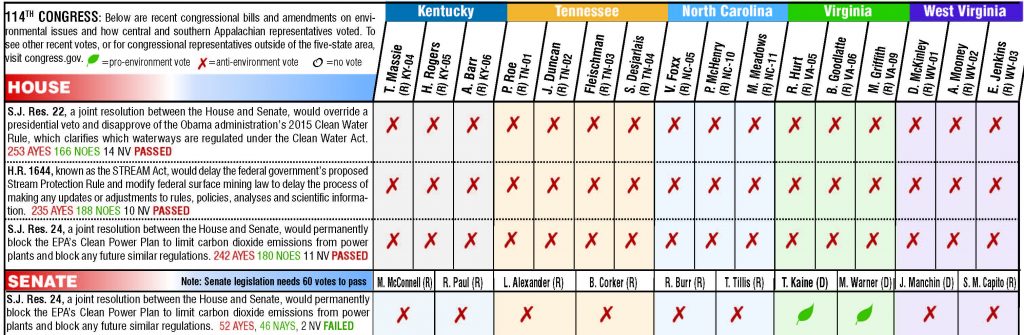
According to both the Center for Responsive Politics and Oil Change International, contributions from oil, gas and other energy industries skyrocketed in the past five years, with the coal industry alone contributing more than $8 million in 2009-2010 — more than twice what the industry had contributed in any previous election cycle. And during 2011, an unprecedented amount of legislation was introduced to undermine environmental protections and undo existing laws (see “The Dirtiest Congress Money Could Buy” on page 13). We took a look at Appalachian legislators from Virginia, West Virginia, Tennessee, Kentucky and North Carolina to see where they stacked up on the energy contribution spectrum. Here are the top three senators and nine representatives who received the highest contributions from the fossil fuel industry thus far in the 112th Congress.

Rep. Geoff Davis (R-KY)
Rep. Davis received $38,500 from fossil fuel industries in the 112th Congress, which is just a fraction of the $427,500 energy companies have contributed to his coffers since 2005. He’s held a firm position against environmental interests, siding with industry on the majority of bills to weaken clean air and water protections this Congress. Davis’ anti-regulation stance isn’t limited to environmental issues — he introduced the REINS Act, which would require Congress to pass any major regulation. The Gallup-Healthways Well-Being Index ranked Davis’ district as one of the bottom 5 percent nationally for physical and emotional well-being.

Sen. Rand Paul (R-KY)
A self-described “constitutional conservative,” Paul is ideologically opposed to government regulation of business; the freshman senator has also received over $226,500 from the energy industry. During his 2010 campaign, Paul notoriously said of mountaintop removal, “I don’t think anyone’s going to be missing a hill or two here and there.” He recently introduced a bill to significantly restrict the EPA’s ability to stop even the most egregious mountaintop removal mines from moving forward, and shows no signs of changing his ardent anti-regulation stance through the remaining four years of his term.

Sen. Mitch McConnell (R-KY)
The current U.S. Senate Minority Leader and the longest-serving U.S. senator in Kentucky history, McConnell has received $1.6 million dollars in fossil fuel industry donations since 1999, including large contributions from energy giants such as Exxon Mobil and Koch Industries. According to Oil Change International, during his tenure McConnell has sided with fossil fuel interests and against the environment on nearly every occasion. In 2011, along with fellow Kentucky Sen. Rand Paul, McConnell introduced S. 468, a bill that would amend the Clean Water Act to ensure that coal mines and some of the nation’s largest polluters are immune to meaningful regulatory scrutiny.

Rep. Hal Rogers (R-KY)
There is more mountaintop removal mining in Kentucky Congressman Hal Rogers’ district than any other district in the United States. Unfortunately, his district also has the seventh highest poverty rate in the nation, with more than 37 percent of the children living below the poverty line, and his constituents ranked dead last in physical and emotional well-being in Gallup’s 2008, 2009, 2010 and 2011 well-being surveys of all 435 congressional districts in the country. Since 1999, Rogers has received more than $430,000 of industry contributions, including significant sums from some of the nation’s largest polluters such as Alpha Natural Resources and Arch Coal. In 2010, he sponsored a bill to defund the EPA’s efforts to protect Appalachian citizens from the toxic valley fills associated with mountaintop removal.

Rep. Chuck Fleischmann (R-TN)
Fleischmann gained the support of a number of coal and oil companies during his freshman run for the 112th Congress, to the tune of $46,900. He represents Tennessee’s 3rd district, which made national headlines when the Tennessee Valley Authority’s Kingston Fossil Plant spilled more than 1 billion gallons of toxic coal ash into the Emory and Clinch rivers. Fleischmann took an uncharacteristically pro-environment stance on an amendment to the House budget bill that would prohibit the EPA from spending money on regulations that identify fossil fuel combustion waste (like coal ash) as hazardous. Yet Fleischmann sided in favor of another anti-environmental coal ash bill introduced by West Virginia Rep. David McKinley and sponsored his own bill to repeal weatherization assistance that improves the energy-efficiency of low-income residents’ homes.

Rep. Scott DesJarlais (R-TN)
In terms of political contributions from the fossil fuel industry, Tennessee Representative Scott DesJarlais is last on our list of top recipients. Including pre-term contributions before the 2010 election, DesJarlais brought in $29,000, including $16,000 from Pilot Oil Corp. However, when it comes to anti-environmental votes, DesJarlais fits right in. According to Oil Change International, Rep. DesJarlais has voted against the environment 100 percent of the time, including key votes that would undermine the EPA’s authority to enforce the Clean Water Act and deny the science related to global warming.

Rep. Nick Rahall (D-WV)
Congressman Nick Rahall has represented southern West Virginia in Congress since 1977. Although he has received more than $250,000 in industry donations, he casts pro-environment votes nearly half the time, according to Oil Change International. As a freshman, he helped draft and pass the 1977 Surface Mine Control and Reclamation Act, and rose through the ranks to become chairman of the Natural Resources Committee. Additionally, Rahall is the ranking Democrat on the House Transportation and Infrastructure Committee, which has jurisdiction over the Clean Water Act. But, during the 112th session, Rahall sided against clean water legislation more than a dozen times, including attempts to defund citizen protection programs, weaken
mountaintop removal regulations and block meaningful legislation on coal ash.

Sen. Joe Manchin (D-WV)
A self-described “friend of coal,” the former West Virginia governor has received more than $740,000 from the energy industry since he took office in 2009 — second only to Kentucky Senator Mitch McConnell in total amount of fossil fuel contributions received by senators in Southern Appalachian states. At his first congressional committee hearing, Senator Manchin erroneously claimed that the coal industry receives “not one penny of taxpayer subsidies,” and shortly after the 112th began he sponsored S. 272, a bill that would amend the Clean Water Act and remove the authority of the EPA to prohibit discharges of materials into U.S. waters at sites designated for waste disposal.

Rep. Shelley Moore Capito (R-WV)
Representing West Virginia’s 2nd District, Rep. Shelley Moore Capito has received more than $850,000 over her congressional career from energy giants such as Dominion Resources, Chesapeake Energy and CONSOL Energy. Capito sided with polluters on nearly every piece of legislation during the first session of the 112th Congress, voting significantly worse on environmental legislation than in previous terms. At the beginning of 2011, she joined Reps. Nick Rahall and David McKinley in sponsoring H.R. 199, a bill that would have suspended any action taken by the EPA under the Clean Air Act to regulate carbon dioxide for two additional years.

Rep. David McKinley (R-WV)
Freshman Rep. McKinley has received more fossil fuel money than almost any other representative or senator from Central and Southern Appalachia, accepting nearly $400,000 from fossil fuel industries. In McKinley’s district, Little Blue Run, the nation’s largest coal ash pond, has been leaking for years. While McKinley has announced plans to visit the site with the West Virginia Department of Environmental Protection, he introduced a bill last fall to prevent the EPA from regulating coal ash. McKinley also introduced an amendment to another bill that would have prevented the EPA from using its Clean Water Act authority to prohibit or restrict projects that would have an “unacceptable adverse effect” on water, fish and wildlife. But environmental advocates might have reason for hope — McKinley sponsored bipartisan legislation to provide rebates to homeowners who invest in energy efficiency improvements.

Rep. Robert Hurt (R-VA)
A freshman representative in Virginia’s 5th congressional district, Hurt received $78,600 from the energy sector before he was even elected, including substantial contributions from utilities such as Richmond, Va.-based Dominion Resources. In 2011, the House of Representatives passed a bill co-sponsored by Hurt to prevent the EPA from regulating farm dust, a pollution the agency had not intended to regulate in the first place. Including his pre-term contributions, Hurt has received $102,300 from fossil fuel industries during the 112th Congress.

Rep. Morgan Griffith (R-VA)
This freshman representative from southwest Virginia is well-known in energy industry circles, receiving the second-highest amount ($152,300) of fossil fuel money of any Appalachian representative. Griffith has also made a name for himself as one of the EPA’s most aggressive foes — he introduced a bill to shelter polluters by stalling the EPA’s proposed limits on the amount of mercury and other pollutants released by boilers and incinerators. Griffith also sponsored an amendment to the 2011 budget bill to block the EPA and other agencies from protecting navigable waters from mountaintop removal coal mining waste. A member of the House Subcommittee on Energy and Environment, he took an anti-environmental stance on 100 percent of bills evaluated by Oil Change International.

Additional Mentions

Although North Carolina does not have the environmental issues that mountaintop removal coal mining and other resource extraction brings to the other four Appalachian states profiled here, congressional representatives from the Tarheel State still receive substantial contributions from the fossil fuel industry and energy corporations — with two Congressmen coming in just below the top 12 energy money earners from coal-bearing states to earn a mention on the Dirty Money Dozen list.

Rep. Patrick McHenry (R-NC)
Coming in at 13th on the list, Representative Patrick McHenry represents North Carolina’s 10th district in the foothills of the Blue Ridge Mountains. He ranks first in campaign contributions from the fossil fuel industry for federal representatives in North Carolina during the 112th Congress, receiving $17,500, including $10,000 from Koch Industries.

Sen. Richard Burr (R-NC)
While Burr, a member of the Senate Subcommittee on Energy, received only $1,000 in fossil fuel money in the 112th Congress (less than almost all of his peers), he received an estimated $452,000 during the 111th Congress — second only to Senator Manchin of West Virginia — and has collected a total of $1.1 million in contributions since 1999 from sources like Duke Energy and Dominion Resources. An opponent of offshore drilling regulation, Burr pushed to reopen the Gulf to oil drilling only months after the Deepwater Horizon spill, and in 2011 introduced a bill that sought to eliminate the EPA by folding it into the Department of Energy.

Too Big to Fail, But Not to Change

Wednesday, April 18th, 2012 - posted by Madison

When “pink slime” hit the headlines in March, Americans were rightfully disgusted. The thought of being poisoned for profit by beef-product filler treated with ammonia sparked national outrage. Grocery stores and even mega-fast food restaurants such as McDonald’s and Taco Bell were quick to publicly shun the slimy substance. Over the course of just a few days, and a lot of bad publicity pointed at the beef industry, business practices radically changed.

However, there are even more toxic industries that are continuing business as usual. The fossil fuel interests and the financial institutions that help fund them don’t need our consent to poison our bodies and contribute to the growing curse of climate change. They don’t respond to scrutiny the way Taco Bell might either. They don’t need to — they’re the most profitable entities on Earth.

Names like J.P. Morgan Chase, Goldman Sachs and Bank of America might not have the negative connotations that Massey Energy or Exxon Mobil bring to mind, but in some ways they’re one and the same. Without these financial institutions mobilizing capital funding for electric utilities and fossil fuel companies, multi-billion dollar power plants would never be built.

The “too big to fail” institutions operate under the guise of corporate responsibility. J.P. Morgan Chase, the largest investor in coal-fired electricity, claims on its website that they are “Helping the world transition to a low-carbon economy.” Bank of America, the third-largest investor, hypocritically acknowledges that “The most formidable challenge we face is global climate change.”

Both the financial and fossil fuel industries continue to victimize Americans. One fraudulently forecloses on families and even got off scot-free after creating a global financial crisis in a futile attempt to satisfy its insatiable greed. The other enjoys unnecessary subsidies in times of record profit while polluting the air and water. These corporations and their political allies support cuts to essential social programs but complain that closing tax loopholes is “socialism” and “un-American.”

The bottom line is that, while the financial and energy sectors are essential to a functioning economy, they’ve irresponsibly wielded the power we’ve given them by believing that we work for them, not the other way around.

Whether it’s “pink slime,” the financial crash of 2008, the BP oil spill of 2010 or the ongoing destruction of Appalachia by mountaintop removal, millions are voicing their disgust at the lack of corporate responsibility, accountability and foresight. Yet somehow, in a severe case of cognitive dissonance, energy giants and the monoliths of Wall Street think that less government oversight and “self-regulation” is the solution.

In our society’s hunger for endless economic growth, we’re beginning to forget who we really work for — future generations and their inalienable right to every opportunity afforded to us.

Lieutenant Governor Ron Ramsey recently helped kill a bipartisan bill in the Tennessee state senate that would have banned mountaintop removal coal mining in the state. Ramsey recieved more than $195,000 in contributions from coal interests during his 2010 campaigns.

Coal-fired Generation Falls to 40 Percent

Monday, March 12th, 2012 - posted by Madison

This just in: Despite the coal industry’s misleading commercials, coal no longer provides 50 percent of all energy in the U.S.!

The U.S. Energy Information Administration recently released data showing that coal’s share of total monthly generation fell below 40 percent in November and December 2011 and the combination of a mild winter and a decrease in natural gas prices might be the leading contributors.

Photo Credit: U.S. Energy Information Administration

Due to the warm trend in this year’s winter, natural gas prices have significantly dropped, which is allowing generators in many states to increase the share of natural gas-fired generation and cut coal’s share of electricity generation.

(more…)

EPA Issues First-Ever National Mercury and Air Toxic Standards

Tuesday, February 21st, 2012 - posted by Jamie G. -- AV Communications Coordinator

In December 2011, the U.S. Environmental Protection Agency issued the Mercury and Air Toxic Standards, the first-ever national standards to protect families from mercury and toxic air pollutants emitted by power plants.

Pollutants from coal-fired power plants include arsenic, acid gas, nickel, selenium and cyanide. The standards will cut these emissions with proven pollution controls used by more than half of the nation’s coal-fired plants.

Hailed as a victory by environmentalists and public health advocates, the EPA estimates that as many as 11,000 premature deaths and 4,700 heart attacks will be prevented and that the new standards will eliminate more than 130,000 cases of childhood asthma symptoms and 6,300 cases of acute bronchitis among children each year.

Mercury and other toxic pollutants have been shown to harm the nervous system, cause cancer, and impair thinking and early development. As mercury enters local waterways, it bio-accumulates at levels dangerous for human consumption.

Power plants are the largest remaining source of these toxic air pollutants. They are responsible for more than half of the mercury and 75 percent of the acid gas emissions in the United States. More than half of the power plants in the country use some sort of pollutions control, which the EPA used as a basis when creating the Mercury and Air Toxic Standards.

The standards are accompanied by a Presidential Memorandum that directs the EPA to use tools provided in the Clean Air Act to implement the Mercury and Air Toxic Standards in a cost-effective manner that ensures electrical reliability. The standards also ensure that benefits to public health will outweigh costs of implementation.

The EPA estimates that for every dollar spent on reducing pollution, the American public will see $9 in health benefits. Annually, the total health and economic benefits of these standards are estimated to be as much as $90 billion.

The Mercury and Air Toxic Standards and the final Cross-State Air Pollution Rule are the most significant steps in cleaning the air since the Acid Rain Program of the 1990s.

Constellations Ahead of New Rules

At least one energy company in the country was looking forward to the new emissions and cross-state air pollution rules.

Baltimore, Md.,-based Constellation Energy spent $885 million in 2009 to install emissions controls for sulfur and nitrogen, anticipating new rules by the EPA. The company has already drastically reduced emissions at their Brandon Shores plant.

The Cross-State Air Pollution rule was originally to take effect on Jan. 1, but a federal court issued a temporary stay of regulations to evaluate how much time coal companies would need to implement the retrofits.

Constellation argued that other plants should have to implement these emission limits or shut down completely.