


Get Our RSS Feed!
Front Porch Blog

Nathan Jenkins


Dominion Power is Living in the Moment — and We’re Paying the Price


Monday, June 10th, 2013 | Posted by Nathan Jenkins


Relying on quick returns, Dominion Virginia Power is unable to act in the long-term interests of consumers.

Relying on quick returns, Dominion Virginia Power is unable to act in the long-term interest of consumers.

On June 4, Dominion Virginia Power hosted Appalachian Voices, the Sierra Club, and the Southern Environmental Law Center at the second stakeholder meeting in an ongoing series designed to increase the information shared between the utility and environmental groups.

The meeting was held in downtown Richmond, Va., on the banks of the James River, and adjacent to Belle Isle Park – the urban oasis that offers trails and river recreation for tens of thousands. It was an ironic meeting place for a utility that leaves heaps of toxic coal ash near communities and spews mercury and climate disrupting gases into our air.

We were ushered into a windowless conference room adorned with an expansive painting of power lines and received multiple apologies that we were unable to meet in the sprawling suburbs west of the city. Clearly, we value some things differently, and perhaps that is the purpose of these meetings – not to agree, but to understand.

And maybe I understand them a bit better now.

Dominion appears to believe in the now – not the potential. When the utility asked last year to build natural gas plants, it was because the fuel was cheap. A year later, however, Dominion is asking for a fuel factor rate increase based on its poor foresight of rising natural gas prices, a shift that it presents as being a complete surprise.

Read more
...


Advancing Energy Efficiency in Virginia


Wednesday, May 1st, 2013 | Posted by Nathan Jenkins


Learn about the electric membership cooperatives that serve Virginians and communities across the region on our Energy Savings for Appalachia page.

When it comes to energy efficiency, Virginia’s policymakers could do more, a lot more. The commonwealth came in 37th place on the American Council for an Energy-Efficient Economy’s (ACEEE) most recent state scorecard, which ranks states by energy efficiency policies.

The scorecard follows up on a report the group published in 2008, stating that Virginia could meet 31 percent of projected demand by 2025 with “cost-effective” energy efficiency initiatives.

The report defines cost-effective measures as those that would cost less to implement than what the average resident currently pays for electricity. In Virginia, that is slightly over 10 cents per kilowatt hour meaning that for less than 10 cents per kilowatt-hour, Virginia could avoid 31 percent of projected electricity demand. In fact, 85 percent of the recommendations would cost less than eight cents per kilowatt hour.

Contrasting what is possible with what would have a chance in the Virginia legislature, the report also looked at a less aggressive option of 19 percent efficiency by 2025. The costs for these measures would all be less than 8 cents per kilowatt hour and many would be under three cents — or less than one-third of what it would cost to fill that gap by burning coal and natural gas.

Read more
...


A Week of Education and Action


Wednesday, March 13th, 2013 | Posted by Nathan Jenkins


As part of Mountain Justice Spring Break, students acted out a skit demonstrating how banks directly support mountaintop removal. Photo by Nathan Jenkins

Last week, more than a hundred college students from around the country spent their spring break in Appalachia, Va., to learn about mountaintop removal coal mining, involve themselves in nonviolent actions, and volunteer for social projects that benefit a community that all too many choose to ignore.

By the time I arrived on Friday, the students had already learned about mountaintop removal coal mining. They had toured several mine sites in Wise County, learned how to test water for contaminants, and studied the ecosystems of Appalachia’s incredibly diverse forests.

They had worked on a full day of trail maintenance on Pine Mountain and volunteered much needed manpower to a mobile health services group that provides essential care to impoverished residents forgotten by the coal industry.

Earlier in the week, the students learned about banks that invest in mountaintop removal and how to use nonviolent action to effect change. By Friday, they were ready to make a statement. After a hot breakfast, we loaded up a caravan of cars and set out for a peaceful protest on the sidewalks outside of UBS Bank in Kingsport, Tenn.

Once there, I had my first glimpse of handcrafted props for the planned skit as they were pulled out of pickups and station wagons. The group marched around the block drawing cheers and honks of support from passing motorists. The students then sat on the sidewalk singing songs and chants, as well-dressed bankers peered out from the windows above and sent secretaries to lock doors despite a significant presence from the local police force.

For their part, the officers were incredibly polite and a few even asked me for more information about mountaintop removal. I walked the officers through the narrative of the skit as we watched a giant “fat cat” banker slip dinner plate sized coins into a 4-foot wide piggy bank while a dragon inspired dragline chewed through our mountain resources.

Read more
...


Renewed Resolve: Pushing for Energy Reform in Virginia


Wednesday, March 6th, 2013 | Posted by Nathan Jenkins


Appalachian Voices remains committed to achieving a more robust renewable energy policy that brings clean energy and good jobs to the commonwealth.

Reform of Virginia’s renewable energy law was in the spotlight on both sides of the political spectrum in the General Assembly this year. In the end, only a few adjustments were made to the law, none of which encourage the vibrant solar and wind industries that Virginians want, nor support a market for small businesses promoting renewable technologies.

But the shortcomings of Virginia’s latest legislative session have only strengthened Appalachian Voices’ resolve to achieve a more robust renewable energy policy that actually brings clean energy and good jobs to the commonwealth.

Laws have been enacted in 38 states to encourage the development of the renewable energy industry – and they have ushered in cleaner air and job growth. In some of those states, the industry is growing exponentially, in thousands of jobs and tens of thousands of clean megawatts.

Virginia has had a renewable energy law since 2007, but utilities have purchased credits rather than investing in Virginia jobs. At times, state law has been interpreted so that utilities cannot invest in renewable energy despite the enactment of renewable energy goals.

Appalachian Voices hoped to fix that during this year’s legislative session by advocating for a requirement that Virginia utilities could only use new wind and solar power built in Virginia to satisfy the law. Instead, a law spawned by Virginia Attorney General Ken Cuccinelli simply removed financial incentives for renewable energy and ignored our fix, despite support from the utilities.

Read more
...


Virginia Transportation Board OKs Coalfields Expressway Project


Thursday, February 21st, 2013 | Posted by Nathan Jenkins


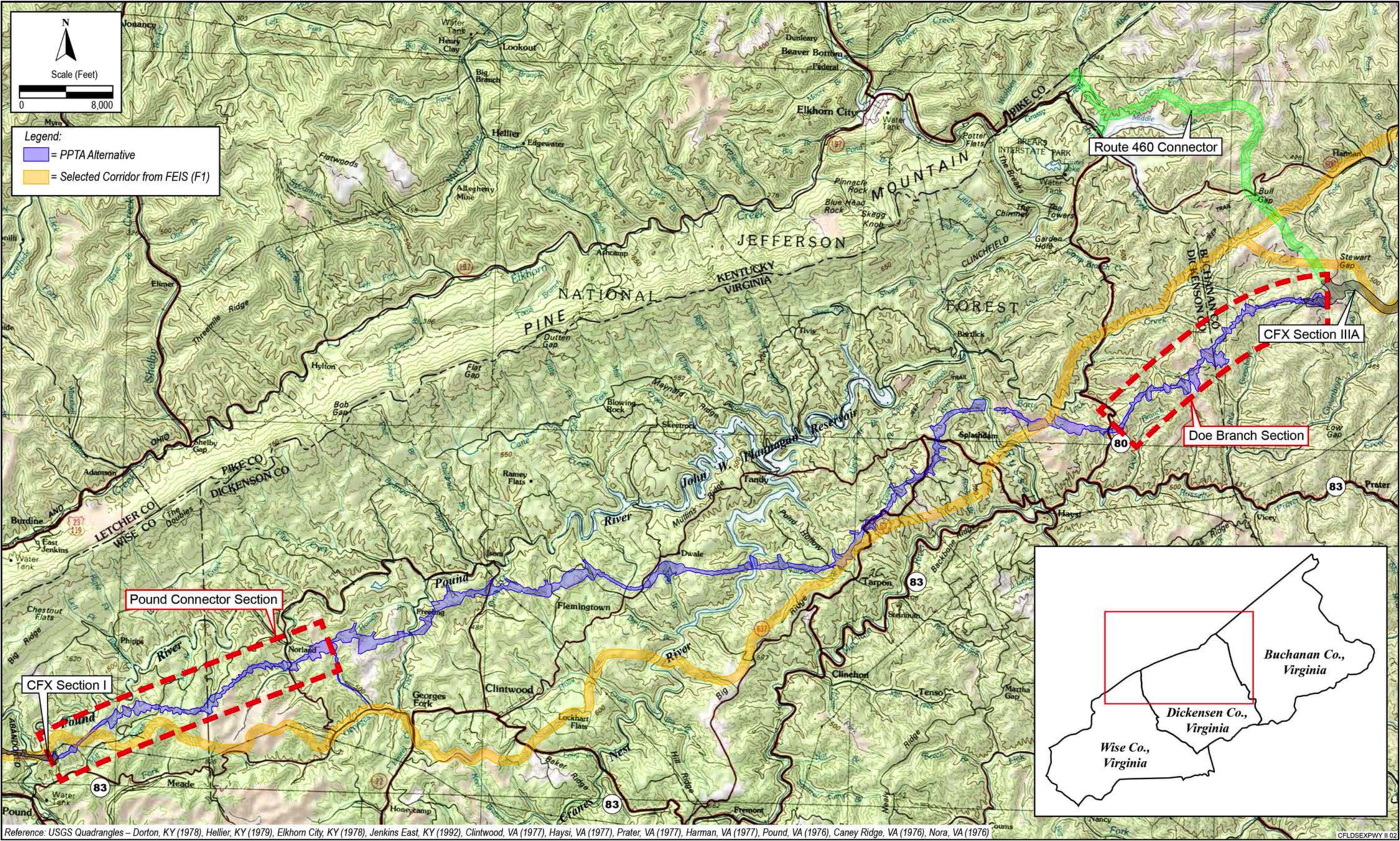
Approved on Wednesday by the Commonwealth Transportation Board, the redrawn route prioritizes Alpha Natural Resources' access to coal, not travelers' access to local communities. Click to view the full-size map.

Yesterday, Virginia’s Commonwealth Transportation Board approved a four-lane divided highway that will flatten steep mountain ridges in southwest Virginia along a route proposed by Alpha Natural Resources — the largest coal company operating in Appalachia today.

The proposed 26-mile Coalfields Expressway is only a few miles off of several less destructive routes studied by the Virginia Department of Transportation in 2001 when it conducted a detailed environmental review of the area. The difference is that VDOT looked for a suitable place to build a highway. Alpha and other coal companies such as Rapoca Energy, on the other hand, selected the most profitable route for surface mining, using the highway as justification for the environmental toll they would inflict along the way.

This difference in purpose of the proposed routes is apparent when you look at the estimated impacts. The route VDOT selected in 2001 would have a 750-foot right of way that would disturb about 1,100 acres of land, four miles of streams and 720 acres of forest. Those impacts alone are daunting, but they pale in comparison to the redrawn route. Alpha’s path of destruction, with its 2,200-foot right of way, would flatten more than 2,100 acres, bury 12 miles of streams and clear-cut more than 2,000 acres of forest — not to mention destroy two churches and three cemeteries.

Nevertheless, VDOT sees this “coal-synergy” project as beneficial because it will cost taxpayers $2.8 billion to build, as opposed to the projected $5.1 billion without collaboration from the coal industry. The savings are disputable, however, and do not factor in the environmental cost of the road’s relocation. VDOT’s rush to make this project a reality has led them to disregard recommendations from the U.S. Army Corps of Engineers, the U.S. Environmental Protection Agency and the U.S. Fish and Wildlife Service — all of which are asking for a full environmental review of the new route.

Read more
...


Turning a Win-Win into a Lose-Lose: Virginia Senate Kills Renewable Energy Bill


Wednesday, February 6th, 2013 | Posted by Nathan Jenkins


Rather than fixing a problem, Virginia lawmakers prolonged it when they killed legislation to reform the state's renewable energy portfolio standard.

Last fall, Virginia Attorney General Ken Cuccinelli latched on to the idea that Dominion Virginia Power and Appalachian Power did not deserve huge bonuses for buying cheap renewable energy credits without actually building wind and solar projects in Virginia, and released an unsolicited report on the issue.

Appalachian Voices and our partners in the Wise Energy for Virginia Coalition have long advocated that the bonuses were failing to develop the renewable energy industry in the state and that a legislative fix is in order. The Senate Commerce & Labor Committee reached the same conclusion and tasked Cuccinelli and the utilities to work out an agreement, which they did.

The problem is that Cuccinelli, while claiming to resolve concerns from the environmental community, failed to invite us to the table. The result was a bill that simply dropped the bonuses, but did not replace those incentives with a mandate to build renewable energy in Virginia or even a preference for better quality credits.

The Wise Energy coalition worked with Senator Donald McEachin and Delegate Alfonso Lopez on legislation that requires credits purchased by utilities to be from the newest and cleanest sources of renewable energy. The proposal was carefully crafted with the singular goal of picking up where the attorney general’s bill left off, but it actually solves the problem of misplaced incentives and the lack of investment in Virginia wind and solar power.

It was a reasonable measure. However, despite strong supporting testimony from our unlikely ally — even Dominion said it was the “best solution” for solving the credits problem — it failed in a House Commerce and Labor subcommittee last week. The Republican chairman, Delegate Terry Kilgore, and his colleagues refused to address the problem.

Read more
...


Renewing the Push for Renewable Energy in Virginia


Thursday, January 24th, 2013 | Posted by Nathan Jenkins


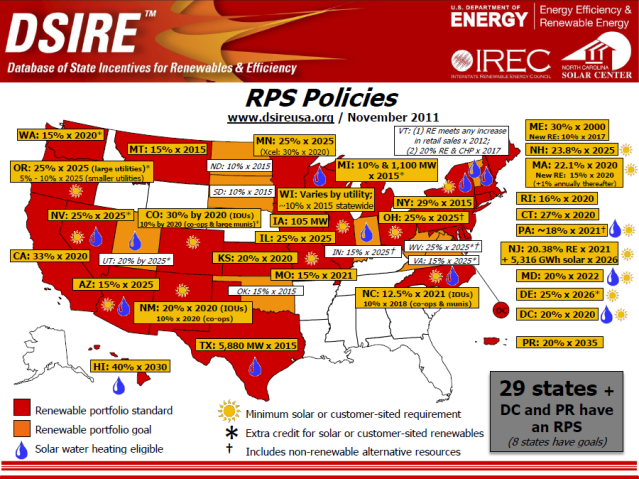
State-by-state Renewable Portfolio Standards. Map from Database of State Incentives for Renewables & Efficiency.

Each year, as Virginia’s General Assembly convenes, lawmakers are confronted with hundreds of proposals running the gamut from education to energy. Many involve complicated issues, and many are distorted by corporate interests and political posturing.

This year the legislature is grappling with a key renewable energy law, known as the Renewable Portfolio Standard (RPS), which it passed in 2007. An RPS sets a certain percentage of a utility’s power that comes from renewable sources; the intent is to spur modern technologies such as wind turbines or solar panels.

Twenty-nine states and the District of Columbia have a mandatory RPS with strict standards. In those states, thousands of megawatts of wind and solar energy is powering homes and businesses, and the renewable energy industry is producing thousands of new jobs every year.

In Virginia, the RPS is voluntary – and has not led to the construction of a single wind turbine or solar panel in the commonwealth. The RPS law provides significant financial rewards – paid for by ratepayers – as a way to encourage utilities to use renewables. It also has a very loose definition of what constitutes renewable energy, making it easier for utilities to meet the goal, and get their reward. Which they’ve done handily. Dominion Virginia Power has received $77 million in RPS bonuses, and Appalachian Power Company has received $15 million. They relied almost entirely on existing hydro-power dams, most built before WWII, and credits purchased from renewable facilities in other states, to meet the goal.

Read more
...


Time to End Corporate Welfare for King Coal in Virginia


Wednesday, December 12th, 2012 | Posted by Nathan Jenkins


Expenditures on the coal industry dramatically outweigh benefits to the economy of Virginia, according to a new report by Downstream Strategies. Click to enlarge.

Virginia taxpayers have been boosting profits for the coal industry with tens of millions of dollars in tax breaks every year. That’s not big news – but what’s astounding is that, due to the structure of the subsidies, the Commonwealth is not only foregoing revenue, it is actually paying cash to the industry.

According to a report released today from the research firm, Downstream Strategies, the coal industry in Virginia got $37 million in subsidies in 2009. Factoring in the subsidies as well as all costs and revenues directly and indirectly tied to the industry, the report shows that the net cost to Virginia that year was $22 million dollars. Read the press release and fact sheet here.

And what are Virginians getting for that? Not much.

Read more
...


Political winds shifting for renewable energy in Virginia?


Friday, December 7th, 2012 | Posted by Nathan Jenkins


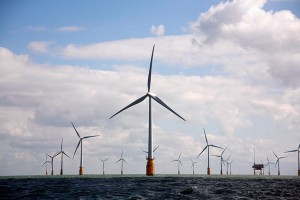
Late last week, the U.S. Department of Interior announced plans to sell leases for the development of wind energy 27 miles off of Virginia’s shores and another lease block off of Rhode Island and Massachusetts. If constructed, these would be the first offshore wind generation facilities in the United States.

English offshore wind farm

September 2010: Vattenfall opened the world’s largest offshore wind farm, Thanet Offshore Wind Farm, off England’s southeast coast. Photo by Nuon

While Virginia is far from a frontrunner in the wind energy industry, or renewables in general, we have an undeniably perfect location for offshore wind. We have a unique combination of strong steady winds and shallow waters far beyond the visual horizon. Along with these physical attributes, the historically coal-focused political climate is also beginning to warm to the economic and environmental benefits of renewable energy.

In fact, both likely gubernatorial candidates – Ken Cuccinelli on the Republican side and Terry McAuliffe for the Democrats — have expressed an interest in making changes to the law that has failed to spur development of the renewable energy industry in Virginia over the past five years.

Read more
...


Showing Faith in Appalachia’s Future


Friday, November 2nd, 2012 | Posted by Nathan Jenkins


Last Saturday, the Office of Justice & Peace of the Catholic Diocese of Richmond and Hollins University in Roanoke, Va., hosted an “Eco-Evening” to discuss how environmental issues in Virginia influence poverty and human health.

I was invited to relate the devastation caused by mountaintop removal coal mining. Many attendees were seeing photos of the desecrated mountains and sludge ponds in their state and other parts of Appalachia for the first time. Groans filled the room when I said that over 25 percent of Wise County, Va. has already been leveled.

Proponents of mountaintop removal have long promised that the practice would bring economic development to the region. Instead, we’ve been left with flattening mountains, polluted air and water. Fewer than 11 percent of abandoned mountaintop removal mines sites have been developed, and many that have been are publicly funded projects such as jails and community colleges. Occasionally a Wal-Mart or strip mall take root on the rocky soil.

Read more
...


A Chance to Learn and Share at Weekend in Wise


Thursday, October 18th, 2012 | Posted by Nathan Jenkins


The annual Weekend in Wise County event, hosted by the Southern Appalachian Mountain Stewards, is more than an opportunity for people to witness mountaintop removal coal mining and what it leaves behind for the people of Appalachia. It is an opportunity to meet an amazing community trying to raise their families in an environment where the land and water are under attack from the very industry that claims to sustain them.

Coal is a fact of life in southwestern Virginia and it has been for more than a century. The problem now is that the industry is taking far more than they are giving back. The coal industry has found a cheaper way to mine coal: use giant machinery, employ fewer miners and leave behind more problems.

Members of the artists group, the Beehive Collective, presented their intricate portrait of "The True Cost of Coal"

The whole issue – the past, present, and future of coal – was presented in an intricate piece of art from the Beehive Collective. The artists collected people’s stories from all over Appalachia to capture this struggle. Weekend in Wise is just one of many events where the artists present the “True Cost of Coal” and tell the story behind the work.

Read more
...


Welcome to Virginia’s Energy Conference, with your host King Coal


Thursday, October 11th, 2012 | Posted by Nathan Jenkins


Last week, Appalachian Voices and members of the Wise Energy for Virginia Coalition attended the Virginia Governor Bob McDonnell’s Energy Conference. Looking at the agenda, we were prepared for what would surely be a biased conference. But we didn’t know it would be this bad.

At every stage of the conference, the coal companies and electric utilities that survive on dirty energy completely suppressed the arguments for investment in energy efficiency and renewable generation. The state’s largest utilities, Dominion Virginia Power and Appalachian Energy, along with mountaintop removal giant Alpha Natural Resources, were the conferences top sponsors. Those sponsorships influenced the agenda, just as they influence in the Virginia General Assembly.

Virginia's energy policy is so concerned with how to keep coal relevant, Gov. McDonnell might as well wear his sponsors on his sleeve.

Dominion spent more than $5.5 million during the last decade in exchange for a hand in writing the laws under which it is regulated. That investment has proven worthwhile considering that Dominion stands to take in a $76 million bonus for spending less than $8 million on “clean” energy from other states, while building no new wind or solar in Virginia. This is just one of examples of corporate influence on energy policy reported in a white paper written by Appalachian Voices, the Sierra Club, and the Chesapeake Climate Action Network.

Use of coal for electricity generation is declining in the Southeast, largely due to market forces. While there is a lot of natural gas coming out of some of our neighbor states, we do not have much in Virginia. What we do have is a vast potential for energy efficiency and renewable generation, yet this conference refused to acknowledge this or take the rapidly growing wind and solar industries seriously.

Read more
...


Why the New Route?


Friday, August 17th, 2012 | Posted by Nathan Jenkins


Early this week, hundreds of citizens of southwest Virginia attended two Virginia Department of Transportation (VDOT) information sessions to learn more about changes to the proposed route for a project called the “Coalfields Expressway.” The divided highway was originally conceived by VDOT but considered too costly to build across the mountainous terrain.

The coal industry saw this fiscal challenge for VDOT as an opportunity to mine coal that would otherwise be untouchable. If approved, this 50-mile long road would use eminent domain to take ownership of privately owned mountains and hillsides along the new route. The coal company would then blast off the ridge tops, burying 12 miles of streams and destroying over 2,000 acres of forest, all to scrape off the thin but lucrative seams of coal.

Read more
...