
The Appalachian Voice
Climate Action Plan has Major Implications for Coal
By Brian Sewell In late June, President Obama announced his administration’s climate action plan. The speech at Georgetown University signaled to Congress that the president was keeping his promise to come up with executive actions to address the threat of climate change, and reignited claims of a “war on coal” in Central Appalachia and nationwide.…
Read MoreOil and Gas Boom Straining America’s Energy Infrastructure
By Brian Sewell The United States is experiencing a natural gas boom largely due to advances in drilling and extraction technologies. And in recent years, some have celebrated the fuel as a bridge to a clean energy and carbon-free future. But according to a report by the Center for American Progress, the other side of…
Read MoreNative Bivalves “Musseling” Their Way Back into Appalachian Streams
By Matt Grimley Waterways are sometimes disturbed by humans, and mussels are often the first to feel the pain. Thankfully, conservationists are working to repair native Appalachian populations of the bivalve. In West Virginia, the state Division of Natural Resources is using fish to restore pollution-damaged populations of pink heelsplitter mussels, and they’ve found an…
Read MoreARC Develops New Community Capital Bank to Invest in Appalachia
By Chelsey Fisher The Appalachian Regional Commission opened a new bank called Appalachian Community Capital in June to increase loans and other capital that small businesses in Appalachia receive. Industry analyses have shown that over the past several years, banks across the nation have instituted tighter credit requirements for small-business lending and reduced their risk-taking…
Read MoreSolar Leasing: Crediting Electric Bills with the Sun
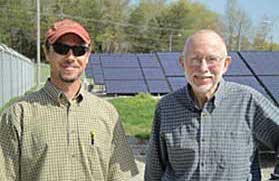
By Davis Wax Energy distribution for the people, by the people. That was the founding principle of electric cooperatives and municipal utilities as they sprang up in the United States throughout the twentieth century. Today, any profits made by these member- or city-owned utilities go back into infrastructure, operation, or payments towards their member-investors. Seldom…
Read MoreRunning on Reality: A Conversation with Anthony Flaccavento
An abridged version of this interview was published in the print edition of our June/July 2013 issue. Here’s the full transcript. For more than 20 years, Anthony Flaccavento has worked to build bridges between small-scale organic growers like himself and farmers markets, grocery stores and public schools. He founded Appalachian Sustainable Development in 1995, a…
Read MoreAddressing Food Insecurity
Finding New Ways To Feed Families Story by David Brewer The welcome arrival of spring and summer in Appalachia represents that magical time of year when, instead of bundling up for a trip to the grocery store, we toss on a pair of sandals and head to the farmers markets to peruse the colorful and…
Read MoreNew Rules Stoke Fear of Fracking on Public Lands
By Brian Sewell When the U.S. Department of the Interior released updated draft rules to regulate hydraulic fracturing on public and Indian lands, environmental advocates responded much as they did when the initial draft was released in 2012 — with disappointment. In the days following the Interior’s announcement, federal officials and Secretary Sally Jewell were…
Read MoreVirginia Teacher and Landowner Faces Energy Extraction

Landowner and teacher Gail Marney resides on an inter-generational family farm in the south. Her great-great grandfather moved here in the early 1800s and served in the Civil War. Now she finds her home threatened by natural gas extraction.
Read More6,000 Acres of Blue Ridge Preserved
By Chelsey Fisher Nearly 6,000 acres of land in the Appalachian region were purchased or donated for conservation purposes in the same month Environment North Carolina released 10 reasons why the state General Assembly should restore conservation funds in the state. In Transylvania County, the new Headwaters State Forest, developed through a deal with former…
Read More