Get Our RSS Feed!
Front Porch Blog


Tenn. Tuesday: TVA’s Nuclear Nuisance


Tuesday, June 18th, 2013 | Posted by JW Randolph


Welcome to Tennessee Tuesday! We’ve been searching across the state, patrolling the web and scouring our inboxes (as has President Obama, of course) in order to bring you the latest on the state-est that’s the greatest! Let’s get right to it.

First of all, we’ve seen a brief clip from this morning on Fox News on the opposition to mountaintop removal in Tennessee. The controversial practice of mountaintop removal has all the me’s, we’s, and them’s across the state up in arms. A longer piece is scheduled to air this evening, and we’ll be on the lookout for that.

Now, besides the fact that most of our coal companies are owned out-of-state, we’ve gone over the fact that TVA didn’t use any Tennessee coal last year, and that a weakening Central Appalachian coal market is increasingly reliant on sending its product overseas. The New York Times recently did an excellent piece on what more coal exports could mean for American coal, export terminals in the Pacific Northwest and impoverished extraction communities. According to the NYT piece:

Last year, American coal exports set a record of 125 million tons in sales, roughly double the volume in 2009, with most of that going to Europe. Exports fell this spring because of slower Chinese demand for steelmaking coal. But energy experts say the big potential market for American coal remains in Asia, and several proposed Pacific Northwest export terminals would have the capacity to nearly double current exports.

125 million tons in exports last year! That’s more coal than the amount mined in West Virginia and Tennessee combined. And — in what is apparently the new standard for the United State’s coal industry — it’s “better than something happening in China®.”

Read more
...


UPDATE: Clean Water Protection Act Gains Support


Tuesday, June 18th, 2013 | Posted by Melanie Foley


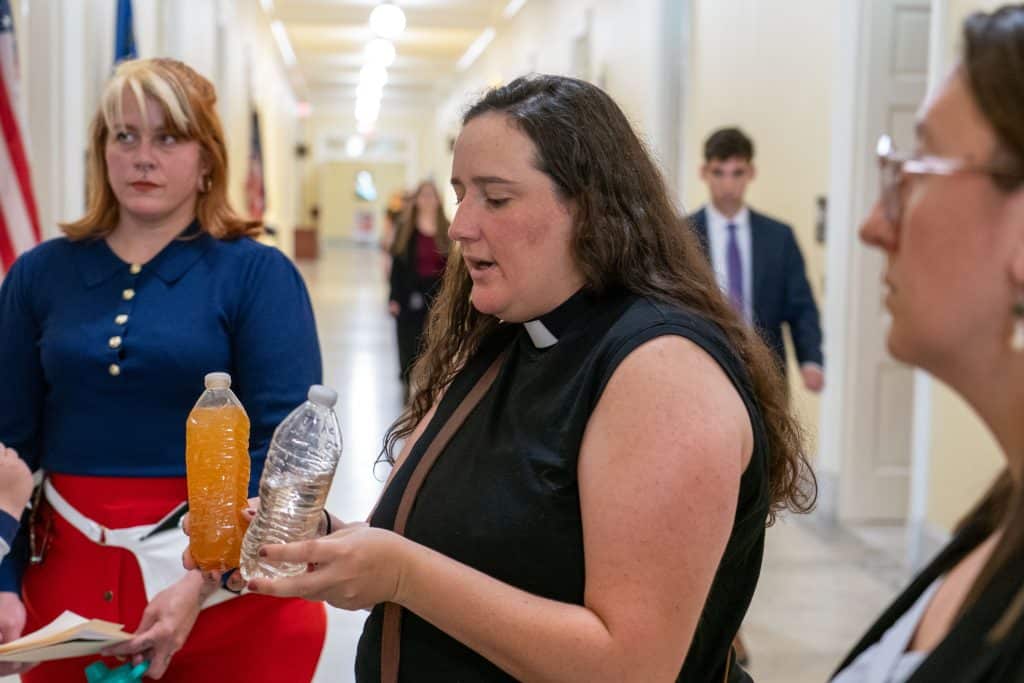
Rep. Frank Pallone (D-NJ), sponsor of the Clean Water Protection Act, with Appalachian Voices and citizens lobbyists at the 8th annual End Mountaintop Removal Week in Washington.

Rep. Frank Pallone (D-NJ), sponsor of the Clean Water Protection Act, with Appalachian Voices and citizens lobbyists at the 8th annual End Mountaintop Removal Week in Washington.

The Clean Water Protection Act, HR 1837, was introduced last month with 45 original cosponsors.

Since then, more than two dozen additional members of Congress have recognized the need to protect our communities and rivers from pollution caused by mountaintop removal. The bill, which restores a key protection of the Clean Water Act, now has 71 cosponsors.

On the bill are returning cosponsors and first-time supporters, Democrats and Republicans, freshmen and senior representatives. 71 cosponsors is great progress, but it’s not enough. We need to keep up this momentum and beat our past record of 172 cosponsors.

Is your member of Congress a cosponsor? Write your Rep. now and urge them to cosponsor the Clean Water Protection Act!

Tenn. Tuesday: Haslam Pumps up Coal! Whitewater Industrial Complex! Cashing in on Efficiency!


Tuesday, June 4th, 2013 | Posted by JW Randolph


Welcome to Tennessee Tuesday, where Governor Haslam Refuses to Meet with Mountain Advocates, TVA Stays the Same More than it Changes, and our New Energy Secretary is Totally into the World’s Premier Spallation Neutron Source!

Governor Bill Haslam is generally not aligned with the plentiful far-right fringe voices in the state of Tennessee. His business background and family ties have led him to deliberately cultivate an image as “cerebral” on policy, while being a competent manager rather than a fire-breathing gut-speaking revolutionary — although it’s a little humorous to imagine what might have been had he chosen the latter.

Opinion is fluid, of course, as to how successful he has been in living up to his preferred billing as Mr. Manager. Rumors that Haslam is interested in national office are swirling and he’s being called everything from “The GOP Star You’ve Never Heard of to an “amiable squish,” as people seem unsure what to make of this sometimes unsure governor.

Consider the issue of mountaintop removal, where he has been of two minds. First, as a candidate, Gov. Haslam opposed mountaintop removal. Buuuuuut, now he ignores the voices of affected citizens and he pays un-disclosed amounts to consultants who are also coal industry lobbyists, advocating to let Tennessee sell off our protected public lands to private coal companies. So, theres that.

It was perhaps little surprise then, when Haslam was out last week touting the fact that “ coal keeps businesses in Tennessee running!

It reminded me of the soon-to-be-immortal words of former Presidential speechwriter Jon Lovett’s commencement speech at Pitzer College where he opined: “We are drowning in partisan rhetoric that is just true enough not to be a lie.”

Is Haslam wrong? Well, no. But Haslam’s lofted platitudes towards what is left of the Tennessee coal industry are just true enough. We’ve been very kind, and very patient with the Governor, and will remain so for at least the next one, maybe two paragaphs.

Read more
...


Tenn. Tuesday: Energy Savings! Victories!


Tuesday, May 21st, 2013 | Posted by JW Randolph


…HaslamConnectedLobbyistSellingPublicLandstoCoalCompanies! OH MY!!

Good morning, and welcome to your Tennessee Tuesday, our weekly holler from your Tennessee hills.

Drop us a note in the comments to say hello, let us know a bit about yourself, what you’re interested in and what stories we might be missing. It’s been a busy couple of weeks for the Volunteer State in the world of energy, TVA and Congress, so let’s get right to it.

Victories!
Believe it or not, both houses of Congress, with support from both parties, are moving on important pieces of legislation to protect our mountains, and to promote energy efficiency.

As several Appalachian Tennesseans came to Washington, D.C., the bi-partisan Clean Water Protection Act was introduced by Congressmen Frank Pallone (D-NJ) and Dave Reichert (R-WA), and already has more than 50 cosponsors from both parties and from all across the nation. The Clean Water Protection Act is a simple bill that would make it illegal for coal companies to perform the “valley fills” associated with mountaintop removal coal mining. Congressman Cooper (D-TN-05) and Congressman Cohen (D-TN-09) are both original cosponsors of the bill! You can call them using the Congressional switchboard at 202-224-3121 to say “thanks for cosponsoring the Clean Water Protection Act, and for protecting our mountains.”

We had a fantastic victory in the U.S. Senate, where the Senate Energy Committee passed a bipartisan Energy Savings Bill (S 761) by a vote of 19-3. Senator Alexander sits on this panel and voted AYE, and you can call his office at 202-224-4944 to say “thanks for supporting S 761 and promoting energy efficiency for our country.” This bill, introduced by Senators Shaheen (D-NH) and Portman (R-OH), would save energy by improving building codes, while incentivizing industrial energy efficiency and promoting energy savings at federal buildings. That bill now moves on to the Senate floor while the House counterpart (HR 1616) awaits committee action.

Read more
...


Appalachian Voices and Partners Challenge Kentucky’s Backroom Deal With Coal Company


Friday, May 17th, 2013 | Posted by Eric Chance


Watercolors by Frasure Creek. State inspector's photos show a variety of colors of water at Frasure Creek mines.

Yesterday, Appalachian Voices and our partner organizations filed a “petition for review”, essentially an appeal of a settlement between Frasure Creek Mining and the Kentucky Energy and Environment Cabinet. This settlement lets Frasure Creek off the hook for thousands of water quality violations over the past two years, while doing little to ensure that the company fixes its water quality problems.

Our challenge of this settlement focuses on the way in which it came about. But first, a bit of background.

We have a separate case that is ongoing against Frasure Creek for submitting false water monitoring data (entire reports were duplicated and only the dates were changed). After we uncovered this problem the company began turning in more accurate reports, which for the first time showed lots of pollution problems. We then filed a second suit against Frasure Creek for thousands of these pollution problems (which had been hidden by reporting problems before our first suit). Then the cabinet also filed a complaint for these pollution violations and more like them in state administrative court (a court run by the cabinet itself).

We intervened in that case and became full parties to it, but were then shut out of it completely. In fact the settlement was entered despite our previous objections, and there is no evidence that our objections were even considered. The cabinet and Frasure Creek negotiated a settlement completely without us. The law and common sense both dictate that an agreement is not valid unless all the parties involved agree to it, and that is the basis for our challenge of this settlement yesterday.

Read more
...


Permit to Mine one of America’s “Most Endangered Mountains” Denied


Wednesday, May 8th, 2013 | Posted by Brian Sewell


Ison Rock Ridge was one of the "most endangered mountains" in America, that is, until the Virginia Department of Mines, Minerals and Energy denied a permit that would have obliterated nearly 1,300 acres of mountainous terrain.

Appalachian residents in Virginia are breathing a sigh of relief with the news yesterday that the state Department of Mines, Minerals and Energy has denied a permit for a massive strip mine on Ison Rock Ridge in Wise County.

Although the coal company, A&G Coal Corp., has appealed the decision (no surprise there), local citizens and opponents of mountaintop removal stand ready to continue defending Ison Rock Ridge, and the citizens of Wise County.

“Preserving our clean mountain water, protecting our productive forests and making this a place businesses want to move to is a key part of building an economy built to last the next 100 years. Stopping the destruction of Ison Rock Ridge is an important first step,” said Sam Broach, president of Southern Appalachian Mountain Stewards (SAMS), a Wise County-based group of local citizens, including former miners.

A&G had proposed a 1,200-acre mountaintop removal coal mine on the ridgetop, behind the town of Appalachia. The mine would have buried about 14,000 feet of streams with more than 11 million cubic yards of rock and dirt in nine separate valley fills, posing tremendous harm to the citizens and the environment.

The good news about the permit denial is due to the passion and perseverance of SAMS, Sierra Club and Appalachian Mountain Advocates. These groups have fought the project for going on five years now. (See this post from Sierra Club with a press release from SAMS.)

Read more
...


Clean Water Protection Act Introduced with 45 Cosponsors


Tuesday, May 7th, 2013 | Posted by Thom Kay


Yesterday, Rep. Frank Pallone (D-NJ) and Rep. Dave Reichert (R-WA) introduced the Clean Water Protection Act in the 113th Congress with 45 original cosponsors.

The Clean Water Protection Act, H.R. 1837, is a bill in the U.S. House of Representatives which would sharply reduce mountaintop removal coal mining by making it illegal to dump mining waste into valleys and streams. To date, more than 2,000 miles of streams have been buried or severely polluted.

As the bill sponsors point out in their Dear Colleague letter to other members of Congress:

An EPA scientific study in 2008 shows that more than 63% of the streams sampled below mountaintop removal coal mining operations exhibited long-term impairments to aquatic organisms. In some large watersheds, more than half of the streams are impaired.

Last Congress, more than 130 representatives, from Kentucky to Hawaii, took a stand against mountaintop removal coal mining by cosponsoring the Clean Water Protection Act.

It is crucial that we carry over the momentum we built during the last Congress by having a large group of cosponsors. For your Representative to sign onto the bill, they need to hear from you.

Take action now and tell your Congressperson you expect their support of this important legislation.

Mountaintop Removal 101: Congressional Research Service Updates Report


Thursday, May 2nd, 2013 | Posted by Brian Sewell


An updated report by the Congressional Research Service provides a look at the current legal and legislative challenges to mountaintop removal.

Every day, more Americans become concerned with the threat of mountaintop removal in Appalachia. Just yesterday, I was made aware of a website called “What About Mountains?” created by a fourth grade class at the Episcopal School of Knoxville. These students may just be learning about the issue, but they know that “mountaintop removal coal mining is not OK,” and seeing a photo of lush mountains reduced to “ugly blobs of land” is as fine a place to start as any.

Whether you’re in fourth grade or in your forties, it’s helpful to have a convenient compendium on the issue of mountaintop removal, especially considering the ever-evolving legal battles, status of bills on Capitol Hill, and state and federal level regulations. An updated report from the nonpartisan Congressional Research Service called Mountaintop Mining: Background on Current Controversies acts as a CliffsNotes for anyone concerned with the situation and interested in catching up.

The report summarizes the legal challenges, agency and congressional actions related to mountaintop removal and points out that, despite two recent court rulings underscoring the need for greater protections, few people on either side are please with the U.S. Environmental Protection Agency’s record on the issue. Mountaintop removal supporters complain of onerous rules that hamper employment and opponents point to poisoned water, unhealthy communities and shortened lives.

Read more
...


Kentucky’s Lab Certification- Is it strong enough?


Wednesday, May 1st, 2013 | Posted by Eric Chance


Yesterday, Appalachian Voices submitted public comments on a proposed wastewater lab certification program in Kentucky. To discharge polluted water, coal companies must receive a permit under the Clean Water Act. This permit that requires companies to test wastewater and report the data to ensure it falls within the limits of the permit. In Kentucky, there are currently no standards for labs that do this type of testing.

The proposed certification program is a direct result of the lawsuits for falsified water monitoring data we filed against three of the state’s largest coal mining companies. Our investigation revealed that many coal companies were repeatedly submitting the same data and knowingly leaving out reports of any violations of their permits. After we filed these lawsuits, the Kentucky Energy and Environment Cabinet inspected the labs being used for this monitoring and found that in many cases they were not even capable of correctly performing the required tests.

This graph shows some of the inaccurate data submitted by Frasure Creek Mining before our lawsuits lead them to start using a new lab. Click to enlarge.

We believe that enforcing standards on labs used by coal companies will help ensure that labs report accurate data, and that the regulations meant to protect water and those that depend on it from dangerous pollution are effectively enforced. This proposed rule will be a big step forward and we have applauded the cabinet for its efforts to fix these problems. However, there are several weaknesses in the rule that we hope are fixed before it is finalized.

All too often the cabinet has failed to live up to its obligations to protect the people and environment in Kentucky. That is why our comments suggest that discretionary duties given to the cabinet in this rule be made mandatory. Appalachian Voices will continue to work to require the state agencies to actually enforce these standards.

>>Click here to see our comments
>>Click here to read the proposed lab certification rule
>>Click here to read the draft lab manual

Tennessee Tuesday: What Do We Do Now?


Tuesday, April 30th, 2013 | Posted by JW Randolph


This is a post about how we can improve life for Tennesseans, protect an American culture that has endured for centuries, and promote our beloved Appalachian Mountains that once stood higher than the Himalayas, and are now threatened by mountaintop removal coal mining.

Tennessee Tuesdays is a new weekly feature on the Appalachian Voices Front Porch blog. While our main goal is to end mountaintop removal, we also hope to spread the gospel of hope, bring light to issues facing Tennesseans, and offer solutions on how we can move our state toward a cleaner and more energy efficient future.

Are you from Tennessee or nearby? Introduce yourself in the comments and let us know what you’d like to hear about. For now, welcome! Have a cup of coffee and take a minute to enjoy your Tennessee Tuesday.

What’s been happening in Tennessee lately?

Tennessee Legislature 2013
My home state has been in the national news a lot the last few months and not for the greatest reasons. Our legislature was constant fodder for late night comedians (catch Daily Show and Colbert’s greatest Tennessee hits here, here, and here) and was generally considered a bumbling embarrassment for most Tennesseans who don’t respond to “Senator.”

Read more
...


A Good Week for Mountains – Multiple Court Rulings Favor Science and Enforcement


Tuesday, April 23rd, 2013 | Posted by Brian Sewell


Earth Week is off to a good start after two major rulings in two days mean we may start seeing less of this.

We’re only two days into Earth Week — if we must limit it to one week out of the year — but it sure is getting off to a great start. In the past two days, two major court rulings have underscored the need for increased scrutiny from the federal agency responsible for evaluating environmental impacts of mountaintop removal coal mining according to the National Environmental Policy Act and issuing permits under the Clean Water Act.

Yesterday, the 6th U.S. Court of Appeals revoked the U.S. Army Corps of Engineers use of Nationwide Permit 21 (NWP 21), a streamlined and inadequate process that has contributed to the expansion of mountaintop removal in Appalachia since 1992. Kentucky and West Virginia residents, with the support of groups including Kentuckians for the Commonwealth, Kentucky Waterways Alliance and the Kentucky Riverkeeper, have challenged the legality of NWP 21 in state and federal court for a decade.

In its ruling, the three-judge panel called the Corps’ actions “arbitrary and capricious” and found that the agency did not follow the applicable Clean Water Act (CWA) and National Environmental Policy Act (NEPA) regulations, which require it to document its assessment of environmental impacts and examine past impacts before issuing new permits. From the ruling:

Though we generally give greatest deference to an agency’s “complex scientific determination[s] within its area of special expertise,” we may not excuse an agency’s failure to follow the procedures required by duly promulgated regulations.

After opting for streamlined nationwide permitting, the Corps took the easier path of preparing an environmental assessment instead of an environmental impact statement. Having done so, it needed to follow the applicable CWA and NEPA regulations by documenting its assessment of environmental impacts and examining past impacts, respectively. Failing these regulatory prerequisites, the Corps leaves us with nothing more than its say-so that it meets CWA and NEPA standards.

According to the Corps, approximately 70 surface mining permits authorized under NWP 21 qualify for a five-year accommodation to “provide and equitable and less burdensome transition” for coal operators. Whatever its impact on existing mountaintop removal permits, the ruling acknowledges that when it comes to protecting Appalachia, the Corps “say-so” is insufficient.

Read more
...


“War on Coal” Claims are a War on Reality


Wednesday, April 10th, 2013 | Posted by Melanie Foley


A national average of 88,152 coal mining jobs under President Obama represents a 15 percent increase from the average under the Bush administration of 76,470. Graph by Appalachian Voices

The coal industry and the members of Congress who depend on its support have accused President Obama and the U.S. Environmental Protection Agency of waging a “war on coal.” Industry supporters argue that limits on emissions from coal-fired power plants and increased scrutiny of mountaintop removal mining permits are killing jobs. But the numbers show that, aside from being a tired rhetorical trope, the “war on coal” is also a myth.

This week, Appalachian Voices released an analysis of the latest data from the Mine Safety and Health Administration that reveals the fallacy behind “war on coal” claims. An average of 88,152 coal mining jobs under Obama represents a 15 percent increase from the Bush average of 76,470. Employment in 2011 and 2012 was the highest two-year period in 15 years. Each of the top 10 coal-producing states have seen more jobs on average under Obama than under Bush, and nine of those states saw higher employment in 2012 than at any point during the Bush years.

One of the main factors contributing to the employment increase is a decrease in productivity. Coal is growing scarce and difficult to reach, especially in Appalachia, and it takes more miners than it once did to mine the same amount of coal. Since its peak in 2000, productivity has declined 30 percent. Increased underground mining explains some of this decline since it requires more workers than large-scale surface mining methods such as mountaintop removal.

Read more
...


America’s “Sadness Belt”: Appalachian States Worst in U.S. for Health and Happiness


Monday, March 25th, 2013 | Posted by Melanie Foley


Gallup and Healthways recently released their annual Well-Being Index for 2012, and Appalachia was found once again to be home to some of the least healthy and happy Americans. The most striking result of last year’s Well-Being Index is that while the happiest states are spread throughout the country, the lowest ranking states are all clustered in Central and Southern Appalachia, and the region’s neighboring states.

The Well-Being Index compiles surveys taken from all over the country all throughout the year and organizes them by state, community and congressional district. Participants are asked to evaluate their lives according to six categories:

- Life Evaluation: how a person’s current life compares with their expectations

- Emotional Health: deals with the respondent’s experiences and feelings on a given day

- Physical Health: encompasses diseases, physical pain, sick days, body-mass index, etc.

- Healthy Behavior: addresses both positive behaviors (e.g., exercise) and negative (e.g., smoking)

- Work Environment: questions for workers on job satisfaction, treatment from superiors, etc.

- Basic Access: includes access to food, housing, healthcare, etc.

Read more
...


What We Weren’t Allowed to Say


Thursday, March 21st, 2013 | Posted by JW Randolph


In this legislative session, Tennesseans’ voices were silenced. Here’s what I would have said.

Yesterday, I was honored to be called to testify before the Tennessee State Senate Committee on Energy, Agriculture, and Natural Resources, along with a friend, hero and colleague, Ann League. Ann is a property owner and resident of coal-bearing areas in Tennessee, who has lived in the shadow of Zeb Mountain. After Ann and I were called to the bench, Chairman Steve Southerland cut us off before we could sit down and say a word. The committee killed the bill on a procedural mechanism without ever allowing for discussion or taking a vote on its substance. This was despite the fact that thousands of Tennesseans from across the ideological spectrum have called for the passage of this bill. We have prayed, pleaded and lobbied on behalf of our mountains and mountain communities. Yesterday our voices were shut out, and our bill was ignored. If allowed to speak, here’s what I would have said:

“Good morning, my name is JW Randolph and I’m the Tennessee Director for Appalachian Voices.

I grew up outside of Birchwood, Tenn., in a log cabin my father built on the shores of the Tennessee River. Walking the hills and hollows of our state is how I learned what home means. Hiking and fishing out in the woods and waters is how I got to know the best of what our country has to offer, the best of what our state has to offer, and its how I got to know my family. These experiences taught me about freedom, self-reliance and responsibility.

Later in life I learned that not too far away, these same mountains were being filled with ammonium nitrate fuel oil and being brought down, poisoning the streams we ran through. These streams are no different than the one in Hamilton County where I proposed to my high school sweetheart, and where I now take our two year old daughter to learn how to skip stones.

Although she doesn’t quite yet understand, I try to explain to her the fact that when I was her age, there were 500 mountains in Appalachia that are no longer standing.

Read more
...


Protecting Tennessee’s mountains? Not worth the Senate’s time.


Wednesday, March 20th, 2013 | Posted by JW Randolph


Despite broad citizen and political support for a bill protecting Tennessee’s mountains, the state Senate Energy, Agriculture and Natural Resources Committee today decided to not even allow public testimony on the measure and instead killed the bill.

SB99, the Scenic Vistas Protection Act, was slated to be heard by the committee during its usual meeting time at 9:30 (CST) this morning. The bill would prohibit mountaintop removal coal mining from ridges above 2,000 feet on the Cumberland Plateau.

Along with our good friend Ann League, a resident and property owner in Tennessee’s coal-bearing region, I had been scheduled to testify before the committee. But just as we were called up to speak, the chairman stopped us short. Several Members had left the room, and when none of the committee members offered a motion on the bill, the Chairman declared the bill dead, and we were not allowed to speak.

Despite the fact that Tennesseans from the left, right and center, and from a broad array of interests have come together to protect our mountains, our voices were silenced.

Instead, the senators chose to side with the coal industry whose political influence has long outlasted its ability to grow jobs in our state or protect the health and well-being of citizens in the coal region.

Two senators who have generally supported mountain protection, Ophelia Ford and Jim Summerville, didn’t come to the meeting, and a third, Charlotte Burks, who has voted for the bill in the past, left.

Update: We’ve posted my prepared statement here, and a powerful speech by Representative Gloria Johnson (D-Knoxville) here. The news has been picked up by outlets worldwide including Chinese television, Switzerland, Singapore, Businessweek, NBC News in states from coast-to-coast, and in dozens of outlets across Tennessee. Local blog Nooga.Com has a great summary

Stop Brushing off the Bad Stuff


Tuesday, March 19th, 2013 | Posted by Brian Sewell


However complex the causes of the ongoing health crisis in Appalachia, denial accomplishes nothing but the perpetuation of the status quo. Yet every time claims that could negatively impact the coal industry surface, Appalachian legislators throw up a black sheet.

West Virginia University professor and public health researcher Dr. Michael Hendryx’s latest article, “Personal and Family Health in Rural Areas of Kentucky With and Without Mountaintop Coal Mining,” appeared in the online Journal of Rural Health a couple of days ago. The study immediately gained the attention of Kentucky media, and supporters of the coal industry have been quick to write off Hendryx’s methods and conclusions — they just haven’t gotten around to reading it yet.

Hendryx has published more than 100 peer-reviewed articles. He’s the director of the West Virginia Rural Health Research Center and after receiving a Ph.D. in psychology, he completed a post-doctoral fellowship in Methodology at the University of Chicago. Little of that seems to matter, however, because much of his research is concentrated on poor health in Appalachian coal-mining communities, especially those where mountaintop removal takes place.

Like other studies Hendryx has conducted, the eastern Kentucky-focused article relies on comparing data gathered in counties with mountaintop removal to data from counties without it. More than 900 residents of Rowan and Elliott counties (no mountaintop removal) and Floyd County (mountaintop removal) were asked similar questions about their family health history and incidents of cancer to those that the U.S. Center for Disease Control uses in gathering data.

After ruling out factors including tobacco use, income, education and obesity, the study found that residents of Floyd County suffer a 54 percent higher rate of death from cancer, and dramatically higher incidences of pulmonary and respiratory diseases over the past five years than residents of Elliott and Rowan counties.

These results should surprise no one, least of all the families in Floyd County that participated in the study. Yet somehow, supporters of the widespread use of mountaintop removal still refuse to consider that blowing up mountains might impact human health.

Read more
...


A Week of Education and Action


Wednesday, March 13th, 2013 | Posted by Nathan Jenkins


As part of Mountain Justice Spring Break, students acted out a skit demonstrating how banks directly support mountaintop removal. Photo by Nathan Jenkins

Last week, more than a hundred college students from around the country spent their spring break in Appalachia, Va., to learn about mountaintop removal coal mining, involve themselves in nonviolent actions, and volunteer for social projects that benefit a community that all too many choose to ignore.

By the time I arrived on Friday, the students had already learned about mountaintop removal coal mining. They had toured several mine sites in Wise County, learned how to test water for contaminants, and studied the ecosystems of Appalachia’s incredibly diverse forests.

They had worked on a full day of trail maintenance on Pine Mountain and volunteered much needed manpower to a mobile health services group that provides essential care to impoverished residents forgotten by the coal industry.

Earlier in the week, the students learned about banks that invest in mountaintop removal and how to use nonviolent action to effect change. By Friday, they were ready to make a statement. After a hot breakfast, we loaded up a caravan of cars and set out for a peaceful protest on the sidewalks outside of UBS Bank in Kingsport, Tenn.

Once there, I had my first glimpse of handcrafted props for the planned skit as they were pulled out of pickups and station wagons. The group marched around the block drawing cheers and honks of support from passing motorists. The students then sat on the sidewalk singing songs and chants, as well-dressed bankers peered out from the windows above and sent secretaries to lock doors despite a significant presence from the local police force.

For their part, the officers were incredibly polite and a few even asked me for more information about mountaintop removal. I walked the officers through the narrative of the skit as we watched a giant “fat cat” banker slip dinner plate sized coins into a 4-foot wide piggy bank while a dragon inspired dragline chewed through our mountain resources.

Read more
...


Tennessee Votes on Scenic Vistas Tomorrow. CALL TODAY!


Tuesday, March 12th, 2013 | Posted by JW Randolph


Call today and Urge Tennessee Legislators to Protect the Beauty and Economic Vitality of the Cumberland Plateau.

Tennessee legislators are scheduled to take up a critical vote tomorrow on the Scenic Vistas Protection Act — a good bill with broad, bipartisan support that would help one of Tennessee’s most important assets – our mountains.

Representative Gloria Johnson (D-Knoxville) will be carrying the bill (HB 43 / SB 99) in the House Subcommittee on Agriculture and Natural Resources, and Senator Lowe Finney (D-Jackson) in the Senate Committee on Energy, Agriculture, and Natural Resources.

Appalachian Voices urges you to call committee members and ask them to support the common sense “Tennessee Scenic Vistas Protection Act (HB 43 / SB 99)“.

House:
Chairman Ron Lollar (R-Bartlett) / 615-741- 7084
Curtis Halford (R-Dyer) / 615-741-7478
Andy Holt (R-Dresden) / 615-741-7847
Judd Matheny (R-Tullahoma) / 615-741-7448
Billy Spivey (R-Franklin) / 615-741-4170
John Tidwell (D-New Johnsonville) / 615-741-7098
Ron Travis (R-Dayton) / 615-741-1450
Brenda Gilmore (D-Nashville) / 615-741-1997 [This is a “Thank you!” as Representative Gilmore is a cosponsor of the Scenic Vistas bill.]

Senate:
Chairman Steve Southerland (R-Morristown)/615-741-3851
Mae Beavers (R-Mt Juliet)/ 615-741-2421
Jim Summerville (R-Dickson) / 615-741-4499
Mike Bell (R-Riceville) / 615-741-1946
Charlotte Burks (D-Monterey) / 615-741-3978
Ophelia Ford (D-Memphis) / 615-741-1767
Todd Gardenhire (R-Chattanooga) / 615-741-6682
Dolores Gresham (R-Somerville) / 615-741-2368
Frank Niceley (R-Knoxville) / 615-741-2061

Tell these legislators your name and let them know you are a Tennessean who cares about protecting our mountains. And please pass this along, so that legislators hear from as many Tennesseans as possible.

Talking points and bill information below…

Read more
...


Help Protect Kentucky’s Fish from Toxic Selenium


Wednesday, February 27th, 2013 | Posted by Eric Chance


Two headed trout, a result of selenium pollution. Courtesy of USFWS.

The Kentucky Energy and Environment Cabinet is currently attempting to significantly weaken the state’s water quality standards for selenium.

Selenium is a pollutant common at some coal mines that deforms and kills aquatic life. It bioaccumulates, increasing in concentration as it moves up the food chain, affecting larger fish and aquatic birds. At higher levels, selenium is toxic to people. Humans can be exposed to selenium through the water they drink and the fish they eat. Long-term exposure can damage the liver, kidneys, nervous system, and circulatory system.

Selenium pollution is expensive to prevent and to treat. By loosening standards, the cabinet is trying to protect the bottom line of polluters at the expense of the health of the state’s waterways and those that depend on them.

To learn more about selenium and why it is a problem in Kentucky, click here to read our selenium fact sheet (PDF).

Public comments are being accepted through Friday, March 1. Please help protect Kentucky’s fish from the toxic effects of selenium. Take a minute to make your voice heard by submitting a comment.

Even The Daily Show has taken note of the problem of selenium pollution in our nation’s waterways. The clip focuses on pollution from phosphate mines in Idaho, but the similarities between what happened there and what is going on in Kentucky are striking.

Lesson Learned: The Buffalo Creek Flood


Tuesday, February 26th, 2013 | Posted by Brian Sewell


Inspecting the Aftermath: Residents of Buffalo creek worried constantly about the stability of the slurry dams upstream. Nothing was done. Photo courtesy of West Virginia State Archives.

I woke up this morning to a frozen world. Fog and ice descended on the hills above Boone, N.C., last night and are still waiting around for the thaw. It was silent other than the periodic crack of a branch and the following echo that bounced around the hills. Stepping outside after reading Ken Ward Jr.’s remembrance of the Buffalo Creek Flood, I wondered if this stillness was similar to what the residents of communities in Logan County, W.Va., felt that morning 41 years ago today.

To contain the refuse of a coal preparation plant operated by Buffalo Mining Co., a series of three dams were built upstream from the communities along Buffalo Creek in the 1950s and 60s, as Logan County continued to grow into one of southern West Virginia’s prolific coal-producing counties. Dam No. 3, the largest, stood 60 feet above the pond and downstream dams below. When it gave way on the cold morning of Feb. 26, 1972, the others collapsed instantly.

The poor construction and regulation of coal waste impoundments that precipitated the Buffalo Creek Flood intensified during boom times when coal preparation plants used more water and produced more slurry just to keep up with coal production. As Jack Spadaro, a former superintendent at MSHA’s Mine Health and Safety Academy, told me for a story last year, “All along, as these dams were being built, they weren’t really constructed using any engineering methods. They were simply dumped, filled across the valley.”

Read more
...


Facebook Twitter FlickR YouTube
Front Porch Bloggers Tags
Show/Hide list (-)

15th Anniversary 112th Congress 113th Congress A & G A & G Coal Corporation Acid Mine Drainage Across Appalachia Agriculture Air Pollution air quality Alabama ALEC Alexadra Cousteau Alliance for Appalachia Alpha Natural Resources American Chestnut american dream appalachia Appalachian Appalachian Culture Appalachian history Appalachian Identity Appalachian Legislators Appalachian politics Appalachian Quilt Trail Appalachian Regional Commission Appalachian State University Appalachian Streams Appalachian Sustainable Agriculture Project Appalachian Transition Appalachian Treasures Appalachian Voices Appalachian Voices board of directors Appalachian Water Watch Appalachia Restoration Act Appalachia Water Watch Appalshop arch coal Arsenic Art Asheville Athens County Avian wildlife Bank of America bark Batson Creek Battle of Blair Mountain Bearwallow Mountain Beyond Coal campaign biodiversity black bears blair mountain blood mountain Blue Ridge Commons: Environmental Activism and Forest History in North Carolina Blue Ridge Escarpment Book Club Boone buffalo creek cancer carbon capture Carolina Mountain Land Conservancy Center for Appalachian Studies Central Appalachia Charlottesville Chattanooga China citizens united Clean Air Clean Air Act clean energy Clean Water Clean Water Act Clean Water Act 40th Anniversary Clean Water Protection Act Climate Climate Change climate change denial Coal Coal Ash coal ash health effects coal ash ponds coal decline coal electricity coal employment Coal generation Coal mining coal plants coal production Coal Report Coal Waste conductivity Congress Connestee Falls constellation Creation Care Cross-State Air Pollution Rule Cumberland Plateau Cypress creek d.c. Daniel Martin Moore David Brewer David McKinley Democracy dnc Documentaries Don Blankenship Downstream Strategies duke Duke Energy DuPont State Recreation Forest Earth Day EarthJustice Eastern Band of Cherokee Economic Transition Economy editorial Education efficiency electricity Electric Utilities Elk Knob State Park Emory River Endangered species end mountaintop removal energy Energy Efficiency Energy Information Administration Energy Saving Energy Savings Environment environmental education Environmental Justice environmental literacy Environmental Protection Agency EPA Expedition Blue Planet extinction FArCES of Coal FERC Fish Kill Florence Nature Preserve fly ash Folktales Fontana Lake Foothills Trail forest Forestry Fox Squirrels fracking Frasure Creek Frasure Creek Mining and International Coal Group friends of smokies Gallatin game species gas gas emissions Georgia Georgia Power ghost stories globalization Golden-winged warbler Google Earth Gov. Steve Beshear grandfather mountain Great Smoky Mountains National Park green green-collar green building green economy green energy future Greenhouse Gases Greenpeace Green River Preserve Hal Rogers Hampton Roads Hampton Roads Coal Plant HB 710 headquarters Health Heifer USA Hidden Treasures High Falls hiking Hiking the Highlands hiking trails home improvement and remodeling Hooker Falls houses Hunting hydraulic fracking hydroelectricity ICG iLoveMountains Inside Appalachian Voices Interior Department Ison Rock Ridge Jay Rockefeller Jeff Goodell Jeff Goodell Jr. Jim Justice Jim Rogers jobs Joe Manchin Joseph Pizarchik Jr. Kathryn Newfont Kathy Mattea Kentuckians for the Commonwealth Kentucky Kentucky Energy and Environment Cabinet Kentucky Litigation Kentucky Riverkeeper Kudzu kudzu bug land Land Conservation Land management land protection LEAF lobbying local farming Marcellus Shale Massey Energy Matt Wasson membership spotlight Mercury Mercury and Air Toxics Standard mercury and air toxic standards Michael Johnathon microhydro mine Mine Safety and Health Administration Mining Jobs Molly McGinn mountains Mountaintop Removal Mountaintop removal permits MSHA Mussels N.C. Politics Nally & Hamilton Nantahala National Forest National Mining Association National Resources Defense Council Natural Gas Naturalist's Notebook nature New River Nick Rahall North Carolina North Carolina State University NRDC nuclear ODEC Office of Surface Mining offshore wind Ohio Operation Medicine Cabinet opportunities Outdoor Recreation Patriot Coal Pennsylvania Photography Pine Mountain Park Pisgah Forest Politics pollution Possum Jenkins Powder River Basin Prescribed burns President Obama progress Progress Energy Property Rights public lands re-zoning recycling recycling building materials Red Red White and Water Renewable Energy Renewable Portfolio Standards Rick Boucher Riverkeeper Rivers Robert F. Kennedy Rural Energy Savings Program Same Sun Here scenic vistas Scenic Vistas Protection Act Science and Nature science education SELC Selenium selenium pollution Senate settlement sewanee coal seam shale gas Sharyn McCrumb Shelley Moore Capito Sierra Club Silver Slip sludge sludge safety project Solar Solar Energy Solar Homestead Project South Carolina South Cumberland Plateau Southern Appalachian Mountains Southern Appalachian Mountain Stewards Southern Environmental Law Center SouthWings spirituality Sportsman’s Heritage Act spruce pine state environmental policy Stone Mountain stop mountaintop removal Stream Buffer Zone Stream Protection Rule summer camps Sundance Power Systems surface mining Surface Mining Control and Reclamation Act Surry Surry Coal Plant sustainability sustainable agriculture sustainable alternatives sustainable building sustainable farming tax credits and incentives Tennes Tennessee Tennessee Scenic Vistas Protection Act Tennessee State legislature Tennessee Valley Authority The American Chestnut Foundation The American Legislative Exchange Council The Appalachian Voice the human cost The Voice This Green House Tom Cormons Tom Hansell Tom Kilgore TRAIN Act Transylvania County treasures Triple Falls TVA TVA Kingston coal ash spill U.S. Department of Agriculture U.S. Department of Energy U.S. Environmental Protection Agency U.S. Representatives from North Carolina U.S. Representatives from Tennessee U.S. Representatives from Virginia U.S. Representatives from West Virginia UMWA Uncle Falls United Mine Workers of America United Mountain Defense united states Upper Big Branch mine disaster Upper Watuaga Riverkeeper uranium mining US Forest Service Viewpoint Virginia Virginia General Assembly Virginia ODEC virginia state parks Virginia Tech Wales War on Coal washington Washington DC Watauga Water Waterkeeper Waterkeeper Alliance Water Pollution Water quality weatherization Week in Washington West Virginia White Squirrel Hiking Challenge Wilderness Society Wildlife Williamson wind energy Wind Power wind turbine Wise County Wise Energy for Virginia Wise Energy for Virginia Coalition wvdep

Tags