Get Our RSS Feed!
Front Porch Blog


June is “Solar Energy Month” in North Carolina


Wednesday, June 12th, 2013 | Posted by Chelsey Fisher


North Carolina Gov. Pat McCrory recently deemed June "Solar Energy Month," despite attempts by the General Assembly to repeal the state's renewable portfolio standard.

North Carolina Gov. Pat McCrory recently deemed June “Solar Energy Month,” despite attempts by the General Assembly to repeal the state’s renewable portfolio standard.

On the heels of Republican-led legislative threats to environmental protection and renewable energy in North Carolina, Republican Governor Pat McCrory deemed June “Solar Energy Month” at a solar farm in Wake County on June 4.

This acknowledgment is definitely deserved, considering North Carolina ranked fourth in the nation for new clean energy projects and jobs during the beginning months of 2013. Clean energy has grown tremendously in the state over the past five years and has saved 8.2 million megawatt-hours, according to a study by Research Triangle Institute.

“We think the energy business, alongside with agriculture, will help North Carolina get out of this recession,” McCrory said at the declaration, according to the News & Observer.

Strata Solar CEO Markus Wilhelm, who owns one of the largest solar companies in the country, said to the News & Observer that he considered McCrory to be a “friend” of the solar industry.

Wilhelm also said that the growth in solar power usage in North Carolina is due to the state’s support of renewable energy.

Read more
...


Canvassing Against Coal Ash


Friday, March 15th, 2013 | Posted by Matt Grimley


The Red, White & Water team hit the streets near Belmont, N.C., to speak with residents who live near Duke Energy's G.G. Allen Steam Station about the threats of coal ash pollution.

Last Saturday, the Red, White and Water team traveled to Belmont, N.C., to the G.G. Allen Steam Station for a day of canvassing. Walking door-to-door, we asked residents of the communities near the coal-fired power plant if they had been impacted by water pollution.

I met Archie Dixon, who was featured in the Gaston Gazette a few months ago. Dixon had complained to Duke Energy, which owns the power plant, about coal ash staining his property and getting into his drinking water. I spoke with him while he and his grandson (also named Archie, or “Lil’ Arch”) waited for a plumber for a broken pipe on their property. In his garage sat a waist-high stack of bottled water. Mr. Dixon said that he still refuses to drink his own home’s water.

The pollution near the plant happens in two ways. One is through coal ash ponds. Coal ash is the waste byproduct from burning coal and it contains contaminants such as arsenic, mercury and chromium. Because the one active coal ash pond at G.G. Allen is an unlined impoundment, these toxics can seep into groundwater. Tests near the plant have revealed exceedances in manganese, iron and nickel in the groundwater.

Effluent is the other form of pollution at G.G. Allen — the plant wastewater that discharges directly into the surface waters of nearby Lake Wylie. Under the Clean Water Act, permits are issued for each of the plant’s discharge points. These permits, however, only set limits for traditional pollutants, including oil and grease, “total suspended solids” and pH. They rarely limit pollutants such as mercury, selenium, and arsenic. And with a lack of federal guidelines, many states don’t set their own permit limits for these toxic chemicals.

Read more
...


N.C. State Rep. Harrison: Let the EPA Do Its Job


Wednesday, February 20th, 2013 | Posted by Davis Wax


Watch N.C. Rep. Pricey Harrison testify before the U.S. House Subcommittee on Environment and Economy.

What should the role of the states be in protecting human health and the environment?

Last Friday, the U.S. House Energy and Commerce Subcommittee on Environment and Economy held a hearing to untangle that complex question. North Carolina Rep. Pricey Harrison testified to the committee on the need for increased oversight and regulatory enforcement by the U.S. Environmental Protection Agency.

“The question is not whether states or the federal government have a role in environmental protection,” she told subcommittee members, “but whether each is playing its appropriate role under current law.”

Harrison highlighted the growing concerns of North Carolinians’ surrounding coal ash pollution from disposal ponds owned by Duke Energy as an example of how states are failing to protect citizens. The state began requiring more extensive groundwater monitoring a few years ago. But even now, with known instances of groundwater standards violations, no action has been taken by the state to get Duke Energy to address the contamination.

Another emerging issue is the reckless push to bring hydraulic fracturing to the state. State Senate Bill 76 would allow fracking in the state in two years, no matter the status of the state’s regulatory development, resources or staffing.

Read more
...


Duke CEO Could Be New Energy Guru || N.C. Round-Up


Friday, February 8th, 2013 | Posted by Davis Wax


Over the past few weeks there has been a spurt of environmental and energy news in North Carolina and its capital, Raleigh. The developing issues include departing Charlotte-based Duke Energy CEO Jim Rogers being considered for the President’s cabinet, a new bill looking to end state environmental and health rules, and the governor’s endorsement of offshore wind power.

Jim Rogers in Energy Spotlight, Mixed Record and All

With Department of Energy Secretary Steven Chu officially resigned, who will become the DOE’s new chief? The business world has speculated that Jim Rogers, the outgoing CEO of Duke Energy, is a likely candidate.

Duke Energy, the company Rogers is leaving, opened three new N.C. plants in December.

GreenTech Media cited his experience with coal, gas and nuclear industries and Bloomberg Businessweek highlighted his solar and wind experience as well as his potential to bring an energy policy that “sharply reduces carbon emissions”. Rogers’ role in bringing the Democratic National Convention to Charlotte last year may also improve his chances of becoming President Obama’s head adviser on energy.

While Rogers has repeatedly stated his disinterest in joining the president’s cabinet, John Downey at the Charlotte Business Journal has pointed to Rogers’ recent Bloomberg Television interview as a sign that the out-the-door CEO has considered what he would do in such a position. When asked what he would bring to the DOE job, writes Downey, Rogers cited his years of experience in the energy sector and being able to get “the balance right between cheap, affordable energy and meeting our environmental goals.”

Under Rogers, however, Duke Energy has had a mixed reputation in supporting renewable energy in North Carolina. The company is still a paying member of the American Legislative Exchange Council, or ALEC, which creates model state laws that frequently roll back health and environmental protections in favor of promoting industry.

Read more
...


Rebranding Bank of America’s Responsibility


Wednesday, May 2nd, 2012 | Posted by Brian Sewell


————————————————————————————————————————————–
Join us in Charlotte on May 9 to remind Bank of America, the largest financier of the U.S. coal industry, of their responsibility to citizens and the environment. Visit our action page for more info and to sign up.
————————————————————————————————————————————–

BREAKING: Daring Action at Bank of America Stadium,” read the first email in my inbox this morning. Immediately, I thought what a crazed football fan might be capable of — in the offseason no less — if they were to break into the complex.

Turns out my imagination had taken the wrong course. The “daring action” at Bank of America Stadium targeted the bank itself. This morning, five activists from the Rainforest Action Network scaled the stadium walls before unfurling a banner suggesting a more appropriate name for the corporation. The “Bank of Coal” banner is a reminder to shareholders, board members and thousands on their daily commute, that the Charlotte-based bank cannot hide its long-standing relationship with coal industry under fluffy pronouncements of corporate responsibility.

Read more
...


Activists Stage Protest, Attempt to Shut Down Operations at Coal Plant in Arden, N.C.


Monday, February 13th, 2012 | Posted by Jamie Goodman


Activists attached signs to the coal loader at the Progress Asheville Power Station early this morning

Please note: Community Meeting Being Held About The Dangers Of Coal This Wednesday at 6p.m. in Asheville at Posana’s Cafe. Click here to learn more.

GreenPeace is bringing the protest on coal pollution to North Carolina today (aka the #1 user of mountaintop removal mined coal), staging a protest at Duke Energy’s Lake Julian power plant in Arden, N.C.

Activists have reportedly secured themselves to the coal loader and conveyer to prevent coal from entering the facility and are planning to scale the 400-foot smoke stack to “send a message to both Progress Energy and Duke Energy that communities and the climate can’t wait for a renewable energy revolution.”

Our Red, White and Water Team is currently on the way to Asheville, so stay tuned for updates!

UPDATE 12:24 p.m.: According to an article by the Asheville Citizen-Times, as of 11:15 three climbers had reached two-thirds of the way up the 400-foot* smokestack. Sixteen activists are involved in the action, and according to a Greenpeace spokesperson some protestors have already been arrested.
(*note, 400ft number comes from Greenpeace Citizen-Times estimates the height at 300-feet)

UPDATE: Photos from Greenpeace’s action today include shots of the enormous banner hung from the 400-foot smoke stack at the Lake Julian power plant. According to an article by Mountain Xpress (which also has a great stop-action photo collage of the banner going up the smokestack), all activists have been arrested and the banner removed. See more pics on Greenpeace’s FlickR feed of the action.

In the meantime…

Read more
...


Duke Energy Raises Rates in NC


Monday, February 6th, 2012 | Posted by Molly Moore


On Jan. 27, the North Carolina Utilities Commission approved a 7.2 percent rate increase for North Carolina ratepayers.

The North Carolina Attorney General Roy Cooper and a coalition of state public-interest groups filed legal briefs detailing their opposition to the rate hike.

The 7.2 percent increase is the result of an agreement between Duke Energy and the N.C. Utilities Commission’s Public Staff, which represents ratepayers. Duke Energy originally sought a 17 percent increase for residential customers. The Public Staff accepted comments on the matter and held hearings across the state before negotiating a lower figure with Duke Energy.

Duke Energy said the $309 million in annual revenue from the rate increase will pay for capital improvements in power plants and pollution controls. But opponents of the rate hike, such as Al Ripley, Director of the North Carolina Justice Center’s Housing and Consumer Project, said that raising utility bills in the current economic climate will increase the number people who have a hard time paying.

“We believe that in the past Duke has unfairly administrated their programs for collecting on rate payments,” Ripley said. “We’re asking the Commission to not only reject this increase but to make certain that Duke’s collection and electricity shutoff practices are fair.”

The North Carolina Justice Center filed a brief with two other state advocacy groups opposing the 7.2 percent rate hike.

“By investing in energy conservation, weatherization programs and increased efficiency you can do what’s better for the environment and what’s better for people’s financial situations,” Ripley said.

The brief filed by Attorney General Ray Cooper said that the 10.5 percent return on equity agreed upon in the current settlement is too high, and noted that the experts Duke used to justify the 10.5 percent rate of return did not consider the effect of current economic conditions on ratepayers.

Read more about the finalized rate increase here.

Check out a video of the Marion public hearing here and read about the High Point hearing here.

Duke Energy’s Tough Times, Rate Hike Hearings Continue in Marion


Thursday, October 27th, 2011 | Posted by Brian Sewell


On Tuesday Oct. 25, at the McDowell County courthouse in Marion, the N.C. Utilities Commission heard a succession of voices all proclaiming the same message: Do not approve the 17 percent rate hike proposed by Duke Energy Carolinas. Public hearings for feedback on the rate hike continue this week and Duke Energy’s customers are coming out, demanding to be heard. The commission is also accepting public comments by e-mail. Submit yours here.

The dozens of speakers at the Marion hearing, including local residents, retirees, environmental advocates, members of the faith community, school officials and the mayor of the city, proved further that Duke Energy’s 1.8 million customers in North Carolina come from all walks of life. And though everyone had their own reasons for opposing the rate increase, the reactions heard were unequivocal.

A Marion resident testifies before the NC Utilities Commission

Click on the photo for a video of public testimony against the proposed rate hike.

There could not be a worse time to raise rates.

If the increase is approved, Duke Energy Carolinas claims it can close unproductive plants, invest in renovations on operating facilities such as the controversial Cliffside Power Plant, and pay for several completed projects.

Dr. Richard Fireman was the first invited to speak. His calm testimony retreated from blaming Duke Energy. Instead, he shed light on the larger problems we as a society face.

“All government rights are instituted solely for the good of the whole,” Fireman said, quoting from the constitution of the state of North Carolina. “But corporate power has taken over the halls of government, which is now protecting the business of business.”

Dr. Fireman agrees, as many supporters of the Occupy Wall Street movement have claimed, that campaign finance and the enormous amount of corporate dollars spent in financing campaigns and election efforts pose a risk to the people who should be served by their elected officials.

“In 2010, 115 of the 117 members of the general assembly received over half a million dollars in donations from Duke and Progress Energy in the 2010 elections,” Fireman said. “With power like that we, the people, are desperate for a voice that has our welfare as the foundations of its activity.”

Members and staff of Appalachian Voices were present at the hearing to give testimony opposing the rate hike. North Carolina Campaign Coordinator Sandra Diaz spoke about the illusion that Duke Energy’s utmost concern is their customers.

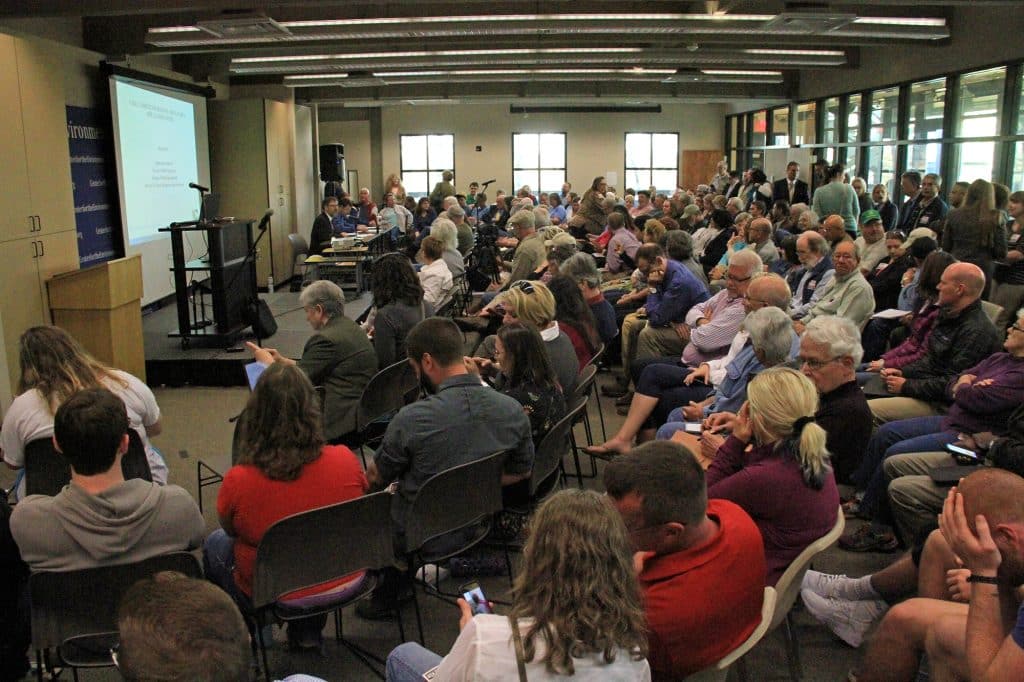
The N.C. Utilities Commission heard from dozens of speakers opposing Duke Energy's proposed rate hike.

“Duke Energy says their core mission is to provide their customers with affordable, reliable and cleaner energy,” Diaz said. “But if Duke Energy was really concerned about ratepayers, their investment portfolio would look very different. The lack of action on energy efficiency suggests that Duke Energy’s real mission is to maximize profit for their shareholders with little regard for their ratepayers.”

“Luckily, we have the North Carolina utilities commission and the public staff.” Diaz said to those in attendance. “They’re responsible for providing fair regulation of utilities in the interest of the public, promoting least cost energy planning an providing just and reason rates and charges for utility services.”

Mayor Steve Little began his remarks by stating he was present not only to represent himself but everyone of the 8,000 residents of Marion.

“This is far, far, far too much,” Little said to the commission. He mentioned that in a part of North Carolina as economically depressed as McDowell County, people are lucky to still have their jobs.

“I don’t know of anybody who got a raise of 17.4 percent,” he said.

Others appealed to the idea that the rate hike is simply bad business. Katie Baird, a small business owner and environmentalist from Asheville, shared her thoughts with the commission.

“I understand when things are good for people, for customers, for finances and when they’re not and in my opinion Duke Energy demanding that their customers pay for failed investments is bad business,” Baird said. “I would not do that to my customers and I’m asking as a business person and as a customer that Duke Energy to do the same.”

Even after rates increases were approved on South Carolina customers last year and North Carolina customers in 2009, the company calls this a “reasonable request.” In 2010, Duke Energy walked away with record profits of $1.3 billion and its CEO, Jim Rogers earned $6.9 million in dividends.

Before public testimony began, Robin Nicholson, a Duke Energy employee in the Marion and Hickory area, spoke on behalf of her company.

“It is no secret this region has been significantly impacted by the economic downturn,” she said. But she insisted that Duke Energy, which will become the largest utilities provider in the United States if its merger with Raleigh-based Progress Energy is approved, is also facing tough times.

Somehow it just doesn’t seem the same.

Public hearings continue before a final wrap-up hearing in Raleigh on Nov. 28:
· Thursday, Oct. 27: High Point
· Wednesday, Nov 2: Durham

Visit our action page if you can’t attend but would like to submit a comment to the Utilities Commission.

You can read more coverage of the Marion hearing from The McDowell News.

Facebook Twitter FlickR YouTube
Front Porch Bloggers Tags
Show/Hide list (-)

15th Anniversary 112th Congress 113th Congress A & G A & G Coal Corporation Acid Mine Drainage Across Appalachia Agriculture Air Pollution air quality Alabama ALEC Alexadra Cousteau Alliance for Appalachia Alpha Natural Resources American Chestnut american dream appalachia Appalachian Appalachian Culture Appalachian history Appalachian Identity Appalachian Legislators Appalachian politics Appalachian Quilt Trail Appalachian Regional Commission Appalachian State University Appalachian Streams Appalachian Sustainable Agriculture Project Appalachian Transition Appalachian Treasures Appalachian Voices Appalachian Voices board of directors Appalachian Water Watch Appalachia Restoration Act Appalachia Water Watch Appalshop arch coal Arsenic Art Asheville Athens County Avian wildlife Bank of America bark Batson Creek Battle of Blair Mountain Bearwallow Mountain Beyond Coal campaign biodiversity black bears blair mountain blood mountain Blue Ridge Commons: Environmental Activism and Forest History in North Carolina Blue Ridge Escarpment Book Club Boone buffalo creek cancer carbon capture Carolina Mountain Land Conservancy Center for Appalachian Studies Central Appalachia Charlottesville Chattanooga China citizens united Clean Air Clean Air Act clean energy Clean Water Clean Water Act Clean Water Act 40th Anniversary Clean Water Protection Act Climate Climate Change climate change denial Coal Coal Ash coal ash health effects coal ash ponds coal decline coal electricity coal employment Coal generation Coal mining coal plants coal production Coal Report Coal Waste conductivity Congress Connestee Falls constellation Creation Care Cross-State Air Pollution Rule Cumberland Plateau Cypress creek d.c. Daniel Martin Moore David Brewer David McKinley Democracy dnc Documentaries Don Blankenship Downstream Strategies duke Duke Energy DuPont State Recreation Forest Earth Day EarthJustice Eastern Band of Cherokee Economic Transition Economy editorial Education efficiency electricity Electric Utilities Elk Knob State Park Emory River Endangered species end mountaintop removal energy Energy Efficiency Energy Information Administration Energy Saving Energy Savings Environment environmental education Environmental Justice environmental literacy Environmental Protection Agency EPA Expedition Blue Planet extinction FArCES of Coal FERC Fish Kill Florence Nature Preserve fly ash Folktales Fontana Lake Foothills Trail forest Forestry Fox Squirrels fracking Frasure Creek Frasure Creek Mining and International Coal Group friends of smokies Gallatin game species gas gas emissions Georgia Georgia Power ghost stories globalization Golden-winged warbler Google Earth Gov. Steve Beshear grandfather mountain Great Smoky Mountains National Park green green-collar green building green economy green energy future Greenhouse Gases Greenpeace Green River Preserve Hal Rogers Hampton Roads Hampton Roads Coal Plant HB 710 headquarters Health Heifer USA Hidden Treasures High Falls hiking Hiking the Highlands hiking trails home improvement and remodeling Hooker Falls houses Hunting hydraulic fracking hydroelectricity ICG iLoveMountains Inside Appalachian Voices Interior Department Ison Rock Ridge Jay Rockefeller Jeff Goodell Jeff Goodell Jr. Jim Justice Jim Rogers jobs Joe Manchin Joseph Pizarchik Jr. Kathryn Newfont Kathy Mattea Kentuckians for the Commonwealth Kentucky Kentucky Energy and Environment Cabinet Kentucky Litigation Kentucky Riverkeeper Kudzu kudzu bug land Land Conservation Land management land protection LEAF lobbying local farming Marcellus Shale Massey Energy Matt Wasson membership spotlight Mercury Mercury and Air Toxics Standard mercury and air toxic standards Michael Johnathon microhydro mine Mine Safety and Health Administration Mining Jobs Molly McGinn mountains Mountaintop Removal Mountaintop removal permits MSHA Mussels N.C. Politics Nally & Hamilton Nantahala National Forest National Mining Association National Resources Defense Council Natural Gas Naturalist's Notebook nature New River Nick Rahall North Carolina North Carolina State University NRDC nuclear ODEC Office of Surface Mining offshore wind Ohio Operation Medicine Cabinet opportunities Outdoor Recreation Patriot Coal Pennsylvania Photography Pine Mountain Park Pisgah Forest Politics pollution Possum Jenkins Powder River Basin Prescribed burns President Obama progress Progress Energy Property Rights public lands re-zoning recycling recycling building materials Red Red White and Water Renewable Energy Renewable Portfolio Standards Rick Boucher Riverkeeper Rivers Robert F. Kennedy Rural Energy Savings Program Same Sun Here scenic vistas Scenic Vistas Protection Act Science and Nature science education SELC Selenium selenium pollution Senate settlement sewanee coal seam shale gas Sharyn McCrumb Shelley Moore Capito Sierra Club Silver Slip sludge sludge safety project Solar Solar Energy Solar Homestead Project South Carolina South Cumberland Plateau Southern Appalachian Mountains Southern Appalachian Mountain Stewards Southern Environmental Law Center SouthWings spirituality Sportsman’s Heritage Act spruce pine state environmental policy Stone Mountain stop mountaintop removal Stream Buffer Zone Stream Protection Rule summer camps Sundance Power Systems surface mining Surface Mining Control and Reclamation Act Surry Surry Coal Plant sustainability sustainable agriculture sustainable alternatives sustainable building sustainable farming tax credits and incentives Tennes Tennessee Tennessee Scenic Vistas Protection Act Tennessee State legislature Tennessee Valley Authority The American Chestnut Foundation The American Legislative Exchange Council The Appalachian Voice the human cost The Voice This Green House Tom Cormons Tom Hansell Tom Kilgore TRAIN Act Transylvania County treasures Triple Falls TVA TVA Kingston coal ash spill U.S. Department of Agriculture U.S. Department of Energy U.S. Environmental Protection Agency U.S. Representatives from North Carolina U.S. Representatives from Tennessee U.S. Representatives from Virginia U.S. Representatives from West Virginia UMWA Uncle Falls United Mine Workers of America United Mountain Defense united states Upper Big Branch mine disaster Upper Watuaga Riverkeeper uranium mining US Forest Service Viewpoint Virginia Virginia General Assembly Virginia ODEC virginia state parks Virginia Tech Wales War on Coal washington Washington DC Watauga Water Waterkeeper Waterkeeper Alliance Water Pollution Water quality weatherization Week in Washington West Virginia White Squirrel Hiking Challenge Wilderness Society Wildlife Williamson wind energy Wind Power wind turbine Wise County Wise Energy for Virginia Wise Energy for Virginia Coalition wvdep

Tags