

ASHEVILLE GO: Green Opportunities
By Maureen Halsema

Young adults get training in the green industry. Photos by Dan Leroy, co-founder of Asheville GO.
There is much ado about green collar jobs, but who is qualified to work them?
An Asheville-based program called Asheville Green Opportunities (Asheville GO) is ready to fit the bill, training unemployed young adults to launch careers in this growing industry.
Asheville GO provides training, education and services to help enhance and restore the environment through lowered greenhouse gas emissions, increased efficiency, ecological restoration, and sustainable agricultural methods.
“We’ve worked on a great diversity of projects including community gardens, habitat
restoration, invasive species control, storm water management, weatherization and green construction,” said Dan Leroy, co-founder of Asheville GO.
According to the United States Department of Labor, as of August, 17,500 people in Asheville are unemployed.
Asheville GO teaches technical job skills through hands-on experience. Students work directly in their own communities, positively impacting the environment and the quality of life. This semester the program has 12 members learning the skills necessary to thrive in a green economy.
“We have a really solid group of members this cycle,” Leroy said. “All of the members came to us during recruitment really needing an opportunity and they are all taking the program very seriously.”
The program began in 2008 with a successful pilot year, placing six of the eight apprentices in green jobs in the Asheville community.
Asheville GO is divided into two semesters—a four-month pre-apprenticeship phase followed by a five-month apprenticeship with local businesses, government agencies or nonprofits in the green economy. Participants are prepared for jobs in the green economy while earning a stipend during the training cycle.

“Members will apply to businesses according to their interest,” Leroy said. “…We try to ensure that the members are motivated and excited about their placements.” Some participating groups include the Bountiful Cities Project, the Southern Appalachian Highlands Conservancy and Conservation Pros.
In addition to job skills, apprentices learn life skills such as team building, money management, effective communication and leadership training. Asheville GO participants can also work with tutors to prepare for the GED or to assist with college coursework.
GO members’ service work is supplemented by classroom work at Asheville-Buncombe Technical Community College. The program works with members to design a course plan that suits each of their specific goals. Members are also certified in Occupational Safety and Health Administration Construction Safety.
As a supplement to the apprenticeship program, they have created the GO Energy Team. “The GO Energy Team is a microenterprise we started to provide low-cost energy audits and weatherization services to the community, while providing hands-on training opportunities,” Leroy said. “This allows us to hire Asheville GO members directly as apprentices rather than relying on local businesses to do all of it. It serves a critical need in this community.”
Energy Efficiency Jobs: Hope for the Appalachian Economy
By Maureen Halsema
Energy efficiency policies have an enormous potential for creating jobs in the Appalachian region, stated a report commissioned by the Appalachian Regional Commission (ARC).
In November, the Environmental and Energy Study Institute held a briefing to discuss “The Energy Efficiency in Appalachia: How Much More is Available, at What Cost, and by When,” a report which studied the economical impacts their energy efficiency policies and programs could have on the Appalachian region.
“We are interested in energy not for energy’s sake, but for its potential for economic development,” said Anne Pope, federal co-chair of the ARC.
According to the report, increased energy efficiency policies and programs can potentially create more than 77,000 jobs by 2030 in the 13-state Appalachian Region. In addition, the policies would facilitate a $27 billion reduction of energy use to the consumer. Within the first year, consumers could save a collective sum of $800 million in energy costs.
The report was prepared by the Southeast Energy Efficiency Alliance (SEEA), in partnership with Georgia Institute of Technology, the American Council for an Energy-Efficient Economy, and the Alliance to Save Energy.
The researchers designed 15 efficiency policies for the study.
“Many of these policies are not overreaching, they are pretty realistic and they can actually be relatively achieved at a pretty easy level,” said Ben Taube, executive director of SEEA.
The top five policies that had the highest impact on the region were: efficient commercial HVAC and light and retrofit incentives; expanding industrial assessment centers; commissioning existing buildings; raising fuel efficiency standards for vehicles; and doing residential retrofit incentives on the resale of properties.
Related Articles
Latest News
More Stories

Neighbors Help Neighbors
A photo essay that celebrates the volunteer spirit of the grassroots group Hurricane Helene WNC and speaks to the resourcefulness, collaboration and hard work embodied by thousands and thousands of volunteers, first responders and aid workers across the region after Hurricane Helene.

Halloween Approaches, and Night School Is in Session
The House of Art in Bluefield, West Virginia, looks like a haunted tower, making it the perfect location for its sixth annual haunt event: Night School. The Night School will be open every Friday and Saturday night through Oct. 31.

‘The Most Perfect Act of Love’
Hundreds of people attended the second annual Affirming Sumner Pride celebration on a 24-acre farm dubbed “Fruity Farm” in Bethpage, Sumner County, Tennessee.

Signs of Life: Endangered Bats Found in Nantahala for First Time in More Than a Decade
In the Nantahala National Forest, a team of biologists spotted Indiana bats, an endangered species that hasn’t been seen in North Carolina for the last 11 years.

‘First Line of Defense’
During Hurricane Helene and its aftermath, rural fire departments and other first responder hubs played critical roles in keeping their communities safe, even without power and cut off from outside support for days or weeks after the storm. Two years later, plenty of work remains to ensure these hubs have the resources they need to operate day to day and be ready when emergencies or natural disasters strike.
The Rocky Road — and Bridge — to Recovery
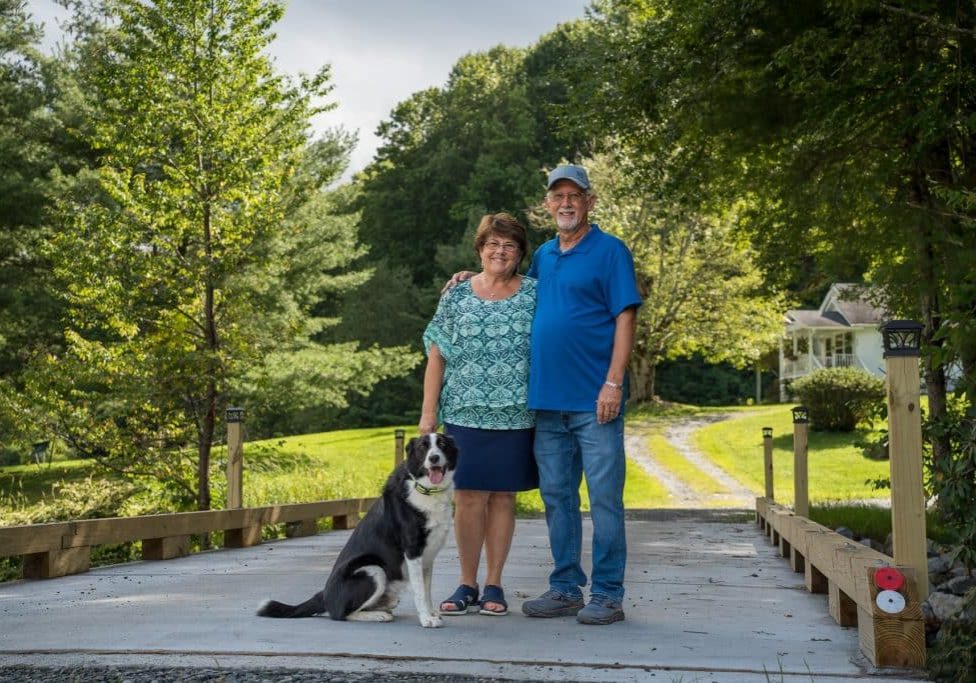
Hurricane Helene is estimated to have damaged nearly 7,000 private roads and bridges in Western North Carolina. Two years later, many restoration projects are complete, but the journey hasn’t been easy — and isn’t over for others.

Leave a comment
Your email address will not be published. Required fields are marked *
Leave a Comment