

Halloween Approaches, and Night School Is in Session
Art, historic buildings, recovery and a whole lot of fun

In the opening paragraph of her classic horror novel, “The Haunting of Hill House,” Shirley Jackson described the cursed Hill House as a place of “absolute reality,” where “doors are sensibly shut” and “silence lay steadily.” Gary Bowling’s House of Art, home to one of the most fun annual Halloween attractions in the Appalachian Mountains, is the total opposite of Hill House. It’s a towering behemoth of a building where every nook and cranny bursts forth with a loud, manic and absolutely entrancing energy that refuses to be silent, inviting even the most serious cynic into a state of childlike wonder and imagination.
The House of Art is housed in the old Ramsey School, which looms over downtown Bluefield, West Virginia, on a hill overlooking the small mountain city’s commercial district and railyard. It looks like a haunted tower, making it the perfect location for its sixth annual haunt event: Night School.
A historic building with a creative new life
The massive brick building, built in 1926, is a unique piece of architecture, recognized by Ripley’s Believe It or Not for having seven floors with exits to the street outside on each level. Historical figures including seven presidents, John D. Rockefeller and Andrew Carnegie are among those who have spoken in its auditorium. Eerie, colorful lights gleam through the windows, while a sign on the front entrance door reads “Art, History, Magic, Mystery,” promising what lies inside.
The House of Art was founded by Appalachian artist and Vietnam War veteran Gary Bowling, who spent time working for Disney in California before returning home to West Virginia. It was founded as a nonprofit organization to offer resources, space and networking opportunities to Appalachian artists.
Since 2018, Night School has drawn on the historic school setting and the combined creativity of artists, volunteers and community members to create a truly memorable event that goes beyond the typical Halloween season pop-up haunted attraction. The Night School is housed in a large portion of the building’s first floor, including the large auditorium as well as additional rooms and areas behind the auditorium stage.
Promise Sloan serves as creative director of the Night School and handles social media and marketing for the event. She also oversees the build each year, working with a crew of volunteers to bring the vision to life. She first got involved with the annual event in 2023 after being one of the artists featured in the House of Art’s gallery spaces, explaining that the event has grown in size and production value each year. Over the last three years, the haunt has grown from nine rooms to 20 rooms full to the brim with a complex and eclectic mix of handmade and recycled props to create the spooky spectacle.
“There’s about nine of us that actually work on the build, and we just put it all together, and we go from there,” Sloan says, sharing that each year’s build develops as the team collaborates and experiments to see what works best. “We make changes as we go. But I mean, it’s always evolving. That’s the amazing thing about this haunt.”
Being part of the Night School production has helped Sloan come out of her shell. “When I first started, I was kind of shy to scream really loud,” she says. “Now, I scream at the top of my lungs, and I come here, and I’m like a child all over again.”
Recovery and connection through creativity

This year’s Night School includes 25 community volunteer cast members. Of the cast, 15 are residents and clients of Recovery Point, a West Virginia-based nonprofit that offers long-term recovery facilities and behavioral health services to individuals with substance abuse disorders at no cost. According to its website, its “goal is to help individuals find lasting recovery and a new healthy way of life.”
Jeremy Geiger, a Recovery Point client and Night School volunteer, shared that Recovery Point has given him needed structure, supported his personal growth and helped reawaken his spirituality. He looks forward to volunteering with the haunt every weekend.
“I’ve always wanted to work at a haunted house just to see what it was like, but this experience is just lighting my mood up, the experience here,” Geiger says. “Since last week when we started, I was like, ‘Oh man, come on Friday and come on Saturday! Come on, let’s do this!’”
Vicki Queen, director of Gary Bowling’s House of Art, explains that working with Recovery Point has been rewarding for her and for the residents.
“They get to develop their characters and become part of the team, and I absolutely love it,” says Queen.
Recovery Point residents first became involved with the House of Art when some of the residents started visiting the galleries a few years ago and became interested in the building and the art. Queen shared that she thought that the residents felt accepted and that she always encouraged them to come in. Recovery Point residents do volunteer work in the community as part of their road to recovery, but the work is often labor-intensive construction, landscaping and clean-up.
The Night School haunt gives clients who are far along in recovery an opportunity to have a fun way of fulfilling community service program requirements, while also impacting the community in a positive way.
“The guys who are working the Haunt have reached a pretty high level in their recovery, and I love that they are interacting with community members and Haunt guests,” Queen wrote in an email. “They love it, and I know it really impacts them in a positive way. Many of our former Haunt guys come back every year to see us — not just for the Haunt, but throughout the gallery season. They bring their families; they tell us that working with us in the Haunt really impacted their lives.”
Night School volunteers also include community members who sign up just for the fun of it, like Bluefield High School student James Crist, who is returning for his second year as a Night School actor. Crist remarked on the welcoming environment Queen has created at the House of Art for him and his friends.
“We love it here,” Crist says. “This place became like our second home. Vicki’s treated us good. She’s made food for all of us every single day, no matter what. Anytime we were down or needed someone to talk to, she was always here. That’s how it’s been for all of us, no matter what.”
Queen explained that the creativity of the haunt and its location within the House of Art sets it apart from other Halloween-themed attractions across the region. Visitors to the Night School may want to arrive early in order to look around the galleries and exhibits throughout the rest of the Ramsey School building.
Sensory overload: What’s happening and what’s next for the House of Art

“This entire building is truly sensory overload,” Queen says. “All told, we probably have about 20 different artists in the building, and some of them have studios. Some of them, just some of their work is here. Some of them just come and hang out and work a little bit. I mean, it’s kind of a place to come and be an artist, and it’s just the vibe. The vibe here is really neat.”
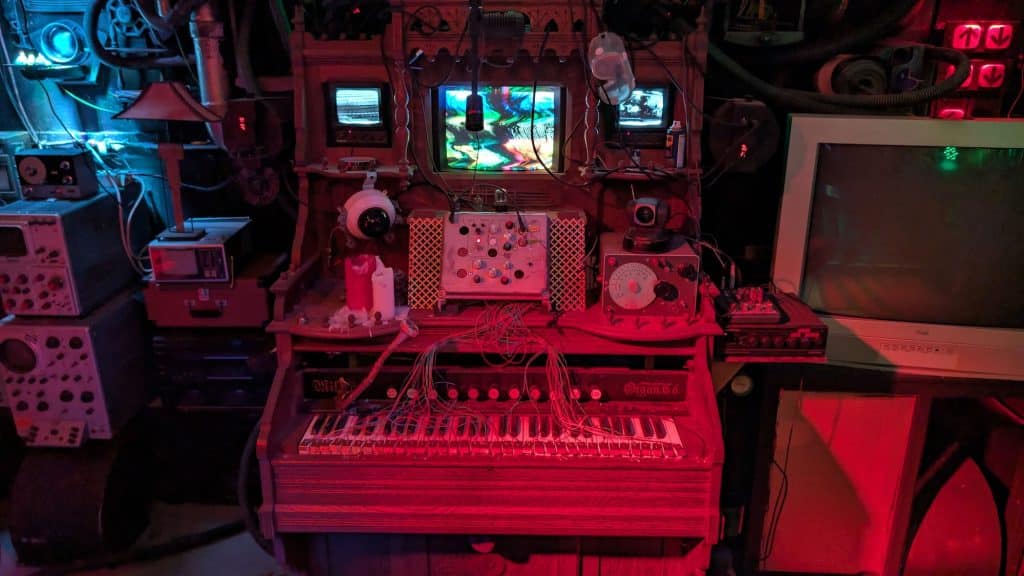
In addition to the individual artist showcases and art galleries, the building includes several themed exhibits, which include The Resonator, a gothic post-apocalyptic scene which features a 125-year-old modified steampunk-inspired pump organ, a circus-themed area complete with a miniature mirror maze, an area based on ancient Egypt, and a room displaying a collection of hand-crafted model trains and carriages that pay homage to Bluefield’s history.
This year, Night School opened on Sept. 25, with proceeds and food donations benefiting the Mercer County Animal Shelter. Subsequent nights this season will serve as the House of Art’s biggest annual fundraiser, helping pay utility bills for the massive Ramsey School building while keeping the organization’s mission alive.
Jody Queen, Vicki Queen’s husband and the nonprofit’s vice president, shares that they still have even bigger plans for the future of the site.
“Our long-term plan is to have rentable studio spaces here,” he says. “Eventually we talked about having artist retreats here where artists could come and stay for an extended stay, and maybe study art or pick up a class, and they’d have a place to stay while they’re here. That’s ultimately where we’d like to be.”
The Night School will be open every Friday and Saturday night through Oct. 31. A “scare-free” version runs from 7 to 8 p.m., where attendees can walk through the haunted house portion without jump scares.
Related Articles
Latest News
More Stories

‘The Most Perfect Act of Love’
After losing its rural pride celebration, hundreds of people attended the second annual Affirming Sumner Pride celebration on a 24-acre farm dubbed “Fruity Farm” in Bethpage, Sumner County, Tennessee.

Signs of Life
In the Nantahala National Forest, a team of biologists spotted Indiana bats, an endangered species that hasn’t been seen in North Carolina for the last 11 years.

‘First Line of Defense’
During Hurricane Helene and its aftermath, rural fire departments and other first responder hubs played critical roles in keeping their communities safe, even without power and cut off from outside support for days or weeks after the storm. Two years later, plenty of work remains to ensure these hubs have the resources they need to operate day to day and be ready when emergencies or natural disasters strike.

The Rocky Road — and Bridge — to Recovery
Hurricane Helene is estimated to have damaged nearly 7,000 private roads and bridges in Western North Carolina. Two years later, many restoration projects are complete, but the journey hasn’t been easy — and isn’t over for others.

After 20 Years, Letcher County Prison Proposal Is Still Alive, Though Obstacles Remain
A $605 million proposal for a federal prison on a former strip mine site in Letcher County, Kentucky, championed by U.S. Rep. Hal Rogers, refuses to die, despite local opposition, a lack of support from the executive branch and numerous other obstacles.
The Washout and Rebuild
For nearly two years, residents of Unicoi County, Tennessee, have had to make do without a hospital after Hurricane Helene destroyed the rural hospital. Ballad Health, which owns the hospital, broke ground on a new location — in another floodplain — in August 2026.

Leave a comment
Your email address will not be published. Required fields are marked *
Leave a Comment