
Front Porch Blog
Years in the making, TVA’s long-term energy plan misses the mark
The Tennessee Valley Authority’s new Integrated Resource Plan calls for more polluting methane gas plants to serve massive data centers without meaningfully incorporating public input

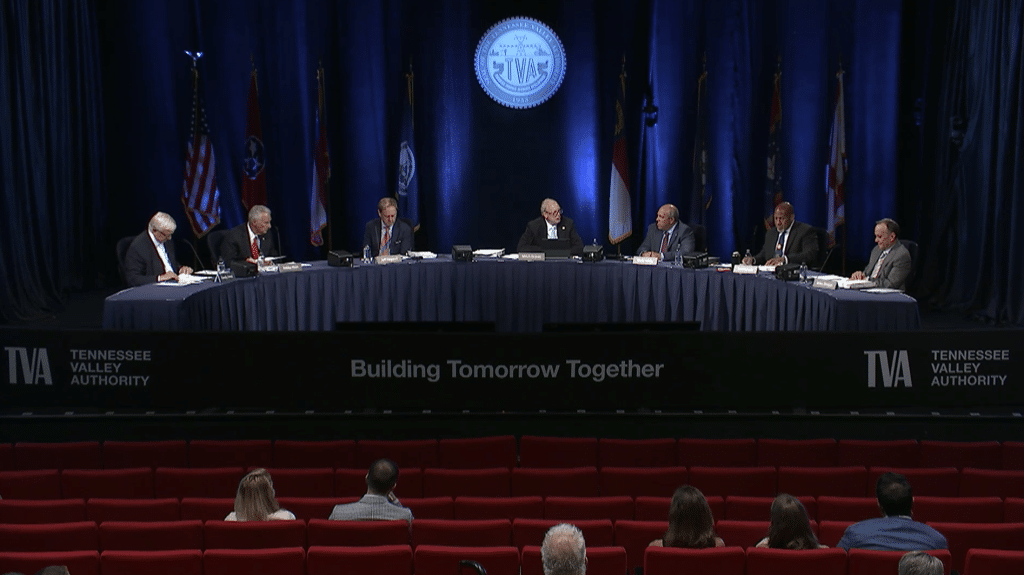
The Tennessee Valley Authority Board of Directors meets on Aug. 20, 2026.
The Tennessee Valley Authority, the nation’s largest federally owned utility, says it’s preparing for an unprecedented surge in electricity demand from massive data centers. The answer? A long-term energy plan that calls for more fossil-fuel generation, leaving open questions about who will pay and who gets a say.
After years of delays and several drafts, TVA finalized a new long-term energy plan at its August board meeting. This plan, known as the Integrated Resource Plan, outlines how the utility will meet the Valley’s energy needs for the next 25 years. Both the process leading up to this plan and the final IRP show that politics and industry interests have influenced the utility and its board more than the voices of household electric customers.
Flaws in TVA’s 2026 IRP
The TVA Board of Directors approved the 2026 IRP in August, nearly two years after it first considered input from impacted ratepayers and communities for its 2024 draft, and after a brief public comment period in July for the updated 2026 version (see a timeline of that winding process at the end of the blog).
Compared to TVA’s initial 2024 IRP draft, the new version moves the region backward on energy affordability and clean air and water for all. The final long-term energy plan outlines a significant increase in electricity demand and leaves the door open to build a massive amount of new methane gas power to meet it — potentially 26 gigawatts of new methane gas by 2040, up from 19 gigawatts by 2035 in the 2024 draft. Clean energy additions were slashed significantly from the 2024 version, stymying affordable power options that could help make TVA’s grid more resilient and less polluting.
Meanwhile, in February, the newly appointed board of directors unanimously reversed its decision to retire the Kingston and Cumberland coal plants, while bringing new methane gas power plants online at the same sites. The 2026 IRP indicates TVA’s plans to keep aging, dirty coal power plants operational until at least 2039. TVA’s records indicate that keeping these power plants open will require $636 million in investments at the Kingston Fossil Plant and $738 million at the Cumberland Fossil Plant. Previously, the utility insisted it had to build out methane gas infrastructure to retire its coal plants, claiming that keeping them online would raise reliability concerns and increase customer costs. We’re taking legal action at Kingston and Cumberland because TVA did not follow the law in approving the Kingston gas plant and is violating the Clean Air Act at both sites.

TVA points to data centers as a major contributor to anticipated load growth. The IRP’s ranges for new power capacity additions through 2040 show the utility will meet this increase by expanding major fossil-fuel power plants, putting the public at risk of higher electricity costs and more local pollution. In August, the TVA board voted to charge data centers and other large industrial customers higher electric rates — around 10% more than they had previously been charged — for the power they use. These rates are still lower than what residents and small businesses pay.
But what if data center demand fails to materialize as TVA expects? Or computing efficiencies reduce data centers’ load requirements? This new data center power-plant fleet could become obsolete, and TVA customers could end up paying for these stranded, 30-year assets.
“Data centers must pay their fair share, but that doesn’t mean they should be allowed to pollute our communities with the burden of more gas and coal emissions to power their operations,” said Leah McCord, Tennessee projects coordinator at Appalachian Voices, in a statement about TVA’s 2026 IRP and approach to data center development. “Data centers that want to come into the Valley need to show that they are invested in benefiting the people here, including by improving our power grid and keeping our air and water clean with renewable power and battery storage.”
Persistent problems with TVA’s IRP process
Across the country, power companies must conduct transparent planning processes that invite ratepayer input and outside expert analysis to develop IRPs. For utilities regulated by state public service or utility commissions, public and expert input plays a crucial role in IRP development, generally through an administrative procedure in which impacted companies or nonprofits file formal interventions. Judges determine what information must be made public or available to impacted parties.
Current federal law requires TVA to give electric distributors an opportunity to make recommendations on rate structures, energy conservation or alternative energy proposals. It does not require TVA to work with any impacted stakeholders. More broadly, TVA is required to provide an opportunity for public review and comment related to any “major new energy resource,” but this term is not defined. TVA is not required to — and does not —provide underlying data, assumptions or modeling information to impacted parties or other external stakeholders that might have feedback or corrections to TVA’s information. Furthermore, a 2026 Energy Futures Group report prepared for the Southern Environmental Law Center found TVA’s IRP assumptions outdated and inaccurate.
The process that now unfolds means TVA makes decisions about new energy resources without meaningful input from the people those decisions affect and without oversight from a utility commission or other experts. TVA has an IRP Working Group and opportunities for public input, but much of the underlying data is still not transparent to the public. The committee meetings at which these decisions are discussed are also not open to the public.
This is important because TVA’s energy decisions have had extraordinary impacts on human health and safety in the Tennessee Valley, such as keeping its Cumberland plant, one of the state’s most polluting facilities, online past its original retirement date of 2028. The energy planning process also doesn’t currently require consideration of harm to human health or extreme weather events, which climate change is making more frequent and intense, even though 10 of TVA’s methane gas plants failed during Winter Storm Elliott 2022.
Stacked on top of everything else, the TVA board has become increasingly politicized, with significant turnover, leaving it without TVA energy-planning expertise and with inadequate oversight of the IRP process. This lack of transparency fuels public distrust and creates opportunities for corruption.
What can we do?

The 2026 IRP process may be over, but more work remains. TVA is falling short of its responsibility to ensure every dollar is spent well and decisions reflect customer and expert input, delivering affordable, reliable electricity for everyone in the Valley. But thankfully, three bills in Congress could make TVA more transparent and accountable to the public while keeping rates low. These three bipartisan bills include:
- The TVA Transparency Act: This would require TVA to make its board committee meetings, where board vote recommendations are determined, more transparent. It requires committees to notify the public of their meetings, post agendas in advance and post meeting minutes.
- The TVA Increased Rate of Participation Act: This would make TVA’s energy planning process more transparent and inclusive by requiring TVA to make the underlying data available to the public, hold public hearings and establish an Office of Public Participation to ensure public engagement.
- The TVA Salary Transparency Act: This would require TVA to report the salaries of its high-paid federal employees to ensure executive pay isn’t increasing costs for ratepayers.

PREVIOUS
NEXT

Leave a comment
Your email address will not be published. Required fields are marked *
Leave a Comment