
Front Porch Blog
Abingdon’s ElderSpirit community celebrates going solar

Mae Humiston of Invest Appalachia, Linda Mashburn of ElderSpirit, Autumn Long of Appalachian Voices’ Appalachian Solar Finance Fund and Dan Conant of Solar Holler officially cut the ribbon on ElderSpirit’s new solar installation. Photo by Dina Hornbaker of Solar Holler
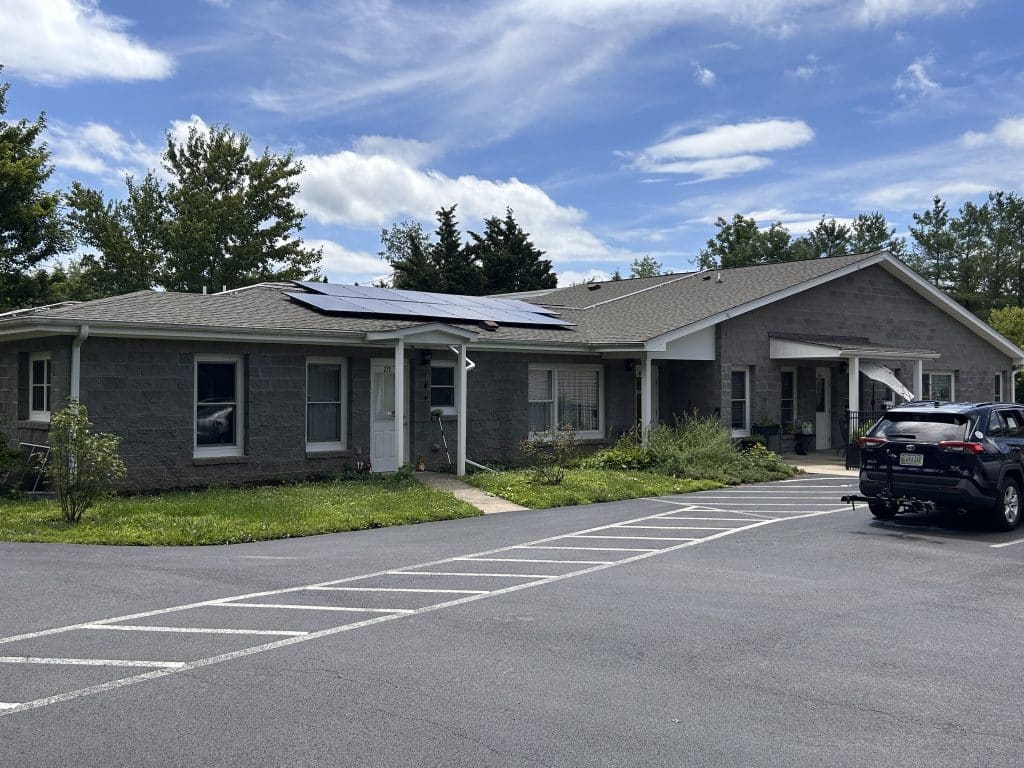
It was a bright week for clean energy earlier this month in Abingdon, Virginia, as residents of the ElderSpirit community gathered together with solar professionals and local leaders to celebrate the official ribbon-cutting of the community’s new solar arrays.
Located just a couple of minutes off the main strip of downtown Abingdon — home of regional landmarks like the Barter Theater and the Martha Washington Inn — ElderSpirit is more than just a senior living community. ElderSpirit defines itself as a “unique intentional, mixed-income, participatory, co-housing community of elders 55 and older.” Their core mission is “[to] be a participatory community of mutual support in which all spiritual paths are respected and encouraged.”
ElderSpirit includes government-subsidized multi-unit rental apartments and privately owned single-residence homes, as well as a shared commons building.
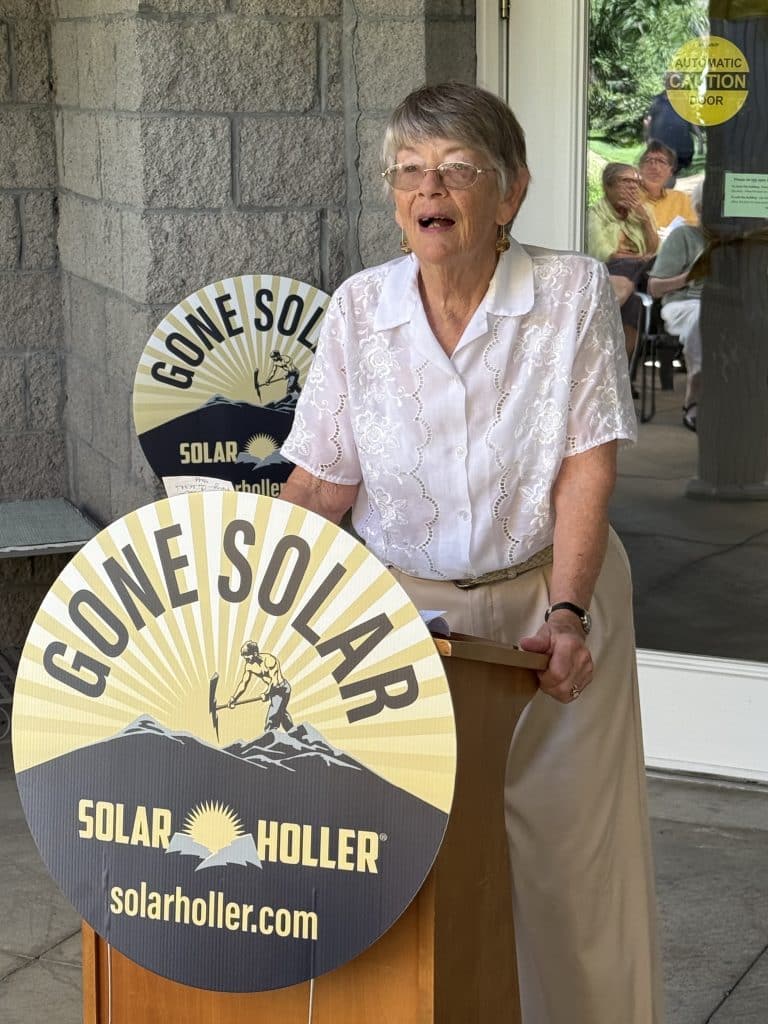
“The reason we are unusual is the fact that we are mixed-income and therefore very diverse, and part of the point of organizing was to nurture late-life spirituality, whatever that is for each individual,” said ElderSpirit Board President Linda Mashburn. “We don’t encourage uniformity in any way. On the other hand, we are a community, and so making joint decisions by consensus sometimes is a little bit of a struggle, but we keep trying to take care of each other.”
One big way the community is trying to honor that commitment to take care of each other is a decision to bring solar energy to ElderSpirit, which will help residents save money on monthly energy costs.
The new solar arrays were installed on the roofs of the commons building, as well as the apartment buildings and several of the single-residence houses, by Solar Holler, a full-service solar installer and developer that specializes in solar projects in the Central Appalachian region.
The new systems are expected to save the community around $685,000 over their lifetimes, according to Autumn Long, director of the Appalachian Solar Finance Fund. The fund provides financial and technical support for solar development in communities across Central Appalachia and is fiscally sponsored by Appalachian Voices.
Completing the project wasn’t easy.
“ElderSpirit really had to put together a pretty complicated capital stack to finance this project successfully,” said Long. The community began by raising funds internally, and then approached the Appalachian Solar Finance Fund to request grant money, which the fund was able to provide.
ElderSpirit also applied for a loan that didn’t materialize, so the Appalachian Solar Finance Fund connected them with Invest Appalachia, a closely aligned social impact investment organization that provided bridge funding to ensure construction could proceed while ElderSpirit awaited reimbursement of their federal tax credits.
Those bridge funds were crucial for completing the project.
“Clean energy incentives cover some of the cost through federal tax credits, but there’s a big timing gap, and that’s where projects like this one can stall,” said Mae Humiston, Director of Grants and Operations for Invest Appalachia. “Because tax credits are on a reimbursement basis, most community-led projects are forced to tap into their reserves, or give up on the project entirely. Invest Appalachia came in to fill that crucial timing gap through bridge funding, so that ElderSpirit can move forward with the project without draining their reserves.”

Invest Appalachia uses several financial products to help organizations like ElderSpirit bridge the gaps while waiting for reimbursement from federal tax credits. Through its Catalytic Capital program, Invest Appalachia provides recoverable grants, loan loss reserves, and other support for community-driven projects like ElderSpirit’s new solar arrays. The funding for ElderSpirit functions as a recoverable grant, and since there is no interest, the community repays only what was initially borrowed. That means the residents benefit from the immediate cost savings of the solar installation.
For many ElderSpirit residents, the best part about going solar is the savings on their household energy bills.
Huldah Warren, an ElderSpirit resident for three years, was shocked when she received her first bill after the installation was up and running.
“That first bill I got was down to three dollars and some odd cents. I was like, no, I can’t believe this!” she said, explaining that she used to pay up to $200 in monthly power bills throughout the winter.
Like most people living on a fixed income, energy costs made up a huge component of Warren’s monthly budget. Warren explained that she has received several power bills since the installation was completed, and they now average about $8 per month.
Donna Sotterquist, another ElderSpirit resident, also reported that her monthly energy bills have also been averaging around $8 per month, and that going solar has been a dream of the community for the nine years she has lived there.
“It’s just amazing. I mean, such a blessing. I’m just so incredibly grateful,” said Sotterquist.

PREVIOUS
NEXT

Leave a comment
Your email address will not be published. Required fields are marked *
Leave a Comment