Follow Us on Twitter: Appalachian Voices | iLoveMountains.org

Posts Tagged ‘Water’

Tenn. Tuesday: Energy Savings! Victories!

Tuesday, May 21st, 2013 - posted by jw

…HaslamConnectedLobbyistSellingPublicLandstoCoalCompanies! OH MY!!

Good morning, and welcome to your Tennessee Tuesday, our weekly holler from your Tennessee hills.

Drop us a note in the comments to say hello, let us know a bit about yourself, what you’re interested in and what stories we might be missing. It’s been a busy couple of weeks for the Volunteer State in the world of energy, TVA and Congress, so let’s get right to it.

Victories!
Believe it or not, both houses of Congress, with support from both parties, are moving on important pieces of legislation to protect our mountains, and to promote energy efficiency.

As several Appalachian Tennesseans came to Washington, D.C., the bi-partisan Clean Water Protection Act was introduced by Congressmen Frank Pallone (D-NJ) and Dave Reichert (R-WA), and already has more than 50 cosponsors from both parties and from all across the nation. The Clean Water Protection Act is a simple bill that would make it illegal for coal companies to perform the “valley fills” associated with mountaintop removal coal mining. Congressman Cooper (D-TN-05) and Congressman Cohen (D-TN-09) are both original cosponsors of the bill! You can call them using the Congressional switchboard at 202-224-3121 to say “thanks for cosponsoring the Clean Water Protection Act, and for protecting our mountains.”

We had a fantastic victory in the U.S. Senate, where the Senate Energy Committee passed a bipartisan Energy Savings Bill (S 761) by a vote of 19-3. Senator Alexander sits on this panel and voted AYE, and you can call his office at 202-224-4944 to say “thanks for supporting S 761 and promoting energy efficiency for our country.” This bill, introduced by Senators Shaheen (D-NH) and Portman (R-OH), would save energy by improving building codes, while incentivizing industrial energy efficiency and promoting energy savings at federal buildings. That bill now moves on to the Senate floor while the House counterpart (HR 1616) awaits committee action.
(more…)

Appalachian Voices and Partners Challenge Kentucky’s Backroom Deal With Coal Company

Friday, May 17th, 2013 - posted by eric

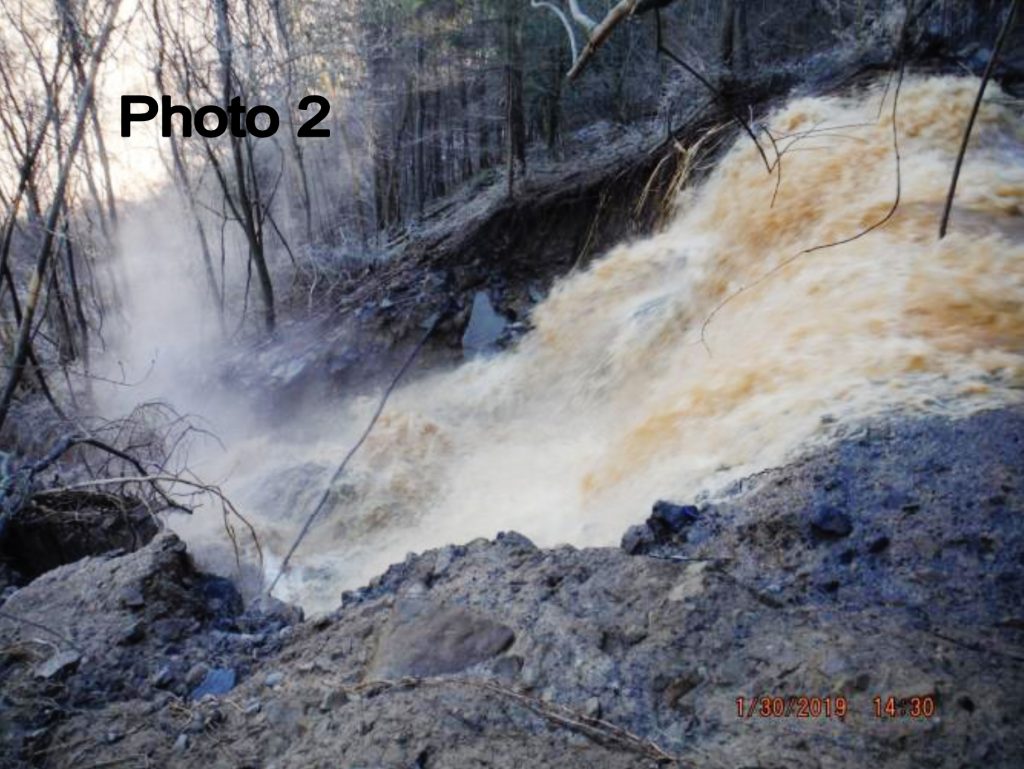
Watercolors by Frasure Creek. State inspector's photos show a variety of colors of water at Frasure Creek mines.

Yesterday, Appalachian Voices and our partner organizations filed a “petition for review”, essentially an appeal of a settlement between Frasure Creek Mining and the Kentucky Energy and Environment Cabinet. This settlement lets Frasure Creek off the hook for thousands of water quality violations over the past two years, while doing little to ensure that the company fixes its water quality problems.

Our challenge of this settlement focuses on the way in which it came about. But first, a bit of background.

We have a separate case that is ongoing against Frasure Creek for submitting false water monitoring data (entire reports were duplicated and only the dates were changed). After we uncovered this problem the company began turning in more accurate reports, which for the first time showed lots of pollution problems. We then filed a second suit against Frasure Creek for thousands of these pollution problems (which had been hidden by reporting problems before our first suit). Then the cabinet also filed a complaint for these pollution violations and more like them in state administrative court (a court run by the cabinet itself).

We intervened in that case and became full parties to it, but were then shut out of it completely. In fact the settlement was entered despite our previous objections, and there is no evidence that our objections were even considered. The cabinet and Frasure Creek negotiated a settlement completely without us. The law and common sense both dictate that an agreement is not valid unless all the parties involved agree to it, and that is the basis for our challenge of this settlement yesterday.
(more…)

Kentuckians Challenge Cabinet’s Order for Failing to Protect Clean Water from Coal Pollution

Friday, May 17th, 2013 - posted by eric

FOR IMMEDIATE RELEASE

Appalachian Voices * Kentuckians For The Commonwealth * Kentucky Riverkeeper * Waterkeeper Alliance

CONTACTS:
• Eric Chance, Appalachian Voices, 828-262-1500, eric@appvoices.org
• Pat Banks, Kentucky Riverkeeper, 859-200-7442, kyriverkeeper@eku.edu
• Peter Harrison, Waterkeeper Alliance, 828-582-0422, pharrison@waterkeeper.org
• Ted Withrow, Kentuckians For The Commonwealth, 606-784-6885 or 606-782-0998, tfwithrow@windstream.net

Frankfort Kentucky-Continuing their campaign to make sure Kentucky’s water is safe for everyone, several groups have challenged plans by the Beshear administration to let Frasure Creek Mining “off the hook” for repeated violations of the Clean Water Act.

Appalachian Voices, Waterkeeper Alliance, Kentuckians For The Commonwealth, Kentucky Riverkeeper and several individuals (the petitioners) asked the Franklin Circuit Court Thursday to vacate an Agreed Order signed in April by Environment and Energy Cabinet Secretary Len Peters that claims to resolve all recent water quality violations by the company.

They point out that the settlement “is inadequate to address Frasure Creek’s pollution problems and prevent such harms from occurring in the future.” They called the administration’s action “arbitrary and capricious, an abuse of discretion, contrary to law, and not supported by substantial evidence.”

“This settlement lets Frasure Creek off the hook for thousands of water quality violations,” explained Eric Chance, a water quality specialist with Appalachian Voices. “For years Frasure Creek had been submitting false monitoring reports. During that time they never reported any water quality problems. After we exposed these false reports, they began using more reputable labs and started showing hundreds of water quality violations every month.

“Over the past few years Frasure Creek’s water discharges haven’t really improved and I don’t expect there to be any improvements in the water coming off Frasure’s mines from this settlement,” Chance added.

“Clean water is not just a good idea. Clean water is critical to our health and well being,” said Pat Banks with Kentucky Riverkeeper. “We have learned that we cannot be complacent. The Clean Water Act enforces the notion that if companies are out of compliance and enforcement by the state fails, then citizens can and must step in to protect our waters. That’s what we are doing here.”

The petitioners also point out that they were granted full party status in the administrative enforcement case but were shut out of negotiations between the Cabinet and Frasure Creek that resulted in the final Agreed Order.

“The Cabinet has once again systematically excluded Kentucky citizens who are fighting to protect the water they use. After bringing Frasure Creek’s false reporting and pollution to the Cabinet’s attention, the Cabinet has tried, at every step, to sweep this matter under the rug and quickly settle with the company and exclude citizens from the process,” said Mary Cromer, with the Appalachian Citizens Law Center and one of the attorneys representing the petitioners. “We bring suit against the Cabinet for failing to do what’s necessary to ensure that Frasure Creek’s pollution is cleaned up and for excluding the citizens from their rightful roles as co-enforcers of the Clean Water Act.”

“We as citizens have the right to intervene and see and participate in this process,” explained Ted Withrow with Kentuckians For The Commonwealth. “Yet the Cabinet continues to ignore the law and shield another coal company from any meaningful enforcement. This Agreed Order was done behind closed doors shutting citizens out, even though we had full rights to be part of the process.”

BACKGROUND

In June 2011, the petitioners filed a 60-day Notice of Intent to Sue, documenting more than 2,800 violations of the Clean Water Act by Frasure Creek in the first three months of 2011. After conducting its own investigation, the Cabinet filed an internal administrative enforcement action alleging many of these same violations.

In November 2011, the petitioners were granted full intervention status.

However, the Cabinet conducted negotiations with Frasure Creek without notice to and participation by the intervenors, resulting in the Agreed Order signed by Peters. Kentucky law prohibits the entry of an Agreed Order without the consent of each and every full party to the Administrative Proceeding.

The violations in this case are similar to those in a 2010 lawsuit pending in Franklin Circuit Court, in that older case false reporting made it impossible to identify pollution problems like the ones at issue in this case. In the original lawsuit, the Cabinet filed an enforcement action against Frasure Creek in Franklin Circuit Court after the same petitioners made public thousands of Clean Water Act violations. In that case, the court granted the petitioners full intervention status. So in the 2011 case, the Cabinet took a different enforcement route to avoid public intervention. However, the administrative judge also granted full intervention status.

####

Kentucky’s Lab Certification- Is it strong enough?

Wednesday, May 1st, 2013 - posted by eric

Yesterday, Appalachian Voices submitted public comments on a proposed wastewater lab certification program in Kentucky. To discharge polluted water, coal companies must receive a permit under the Clean Water Act. This permit that requires companies to test wastewater and report the data to ensure it falls within the limits of the permit. In Kentucky, there are currently no standards for labs that do this type of testing.

The proposed certification program is a direct result of the lawsuits for falsified water monitoring data we filed against three of the state’s largest coal mining companies. Our investigation revealed that many coal companies were repeatedly submitting the same data and knowingly leaving out reports of any violations of their permits. After we filed these lawsuits, the Kentucky Energy and Environment Cabinet inspected the labs being used for this monitoring and found that in many cases they were not even capable of correctly performing the required tests.

This graph shows some of the inaccurate data submitted by Frasure Creek Mining before our lawsuits lead them to start using a new lab. Click to enlarge.

We believe that enforcing standards on labs used by coal companies will help ensure that labs report accurate data, and that the regulations meant to protect water and those that depend on it from dangerous pollution are effectively enforced. This proposed rule will be a big step forward and we have applauded the cabinet for its efforts to fix these problems. However, there are several weaknesses in the rule that we hope are fixed before it is finalized.

All too often the cabinet has failed to live up to its obligations to protect the people and environment in Kentucky. That is why our comments suggest that discretionary duties given to the cabinet in this rule be made mandatory. Appalachian Voices will continue to work to require the state agencies to actually enforce these standards.

>>Click here to see our comments
>>Click here to read the proposed lab certification rule
>>Click here to read the draft lab manual

EPA Releases Proposal To Update Clean Water Act Standards for Power Plant Pollution

Monday, April 22nd, 2013 - posted by sandra

The U.S. Environmental Protection Agency has finally proposed a range of options to regulate waste water from power plants which are responsible for half of the nation’s water pollution. While the public comment period has yet to begin, a public hearing is schedule for July 9th in Washington, DC.

More details on the rule itself, and how to submit your comments will be become available on appvoices.org/rww/power-plant-waste/

Below is a press statement from Appalachian Voices and a number of allied organizations.

After 30 years of inaction, EPA finally proposes plans for power plant water pollution includes options protecting waters from toxic pollution as well as weaker standards that maintain the status quo

Washington, D.C. – The Environmental Protection Agency proposed a number of regulatory options late last Friday night, known as steam electric effluent limitation guidelines for power plants, two of which will finally clean up water pollution from hundreds of power plants.

Power plant water discharges are filled with toxic pollution such as mercury, arsenic, lead, and selenium – heavy metals that can cause neurological and developmental damage, cause harm in utero, damage internal organs and cause cancer. Power plants are the biggest sources of water pollution in the country, yet the EPA has not reviewed regulations for this industry in more than 30 years. To address this unacceptable delay, environmental groups filed a lawsuit in 2010 to force the EPA to take action and regulate this dirty industry.
(more…)

North Carolina Cares About Clean Water

Thursday, March 7th, 2013 - posted by Ian Watkins

According to a recent report by Land for Tomorrow, 91 percent of residents in North Carolina and surrounding states believe it is “important” or “very important” to conserve and protect water and other natural resources. Additionally, a 2002 publication of the N.C. State Economist it was found that people are willing to pay more money in the form of travel expenses in order to enjoy higher levels of water quality. Based on an estimated 14.7 million water-related recreation trips each year by North Carolinians, annual economic savings from water improvements are estimated to be $11.9 million for the Neuse waterway, $14.7 million for Cape Fear improvements, and $6.5 for Tar-Pamlico. While protection of natural resources may sometimes be a divisive topic, residents of North Carolina share a common desire for clean water, with good reason. Clean water is good for the environment and the economy.

The benefits of clean water can also be understood by realizing the costs associated with water treatment. According to a report by the N.C. Division of Water Quality, costs to be considered include additional water treatment, developing new drinking water sources or providing emergency replacement water, public information campaigns when pollution incidents arouse public and media interest, and payment for consulting services and staff time. When Burlington, N.C., found contaminants in their source water that were not eliminated during treatment, city subsidies were used to eliminate it from source waters.

Perhaps a more important measurement of the economic benefits of clean water is the success of publicly funded solutions for addressing water pollution. The N.C. General Assembly established the North Carolina Clean Water Management Trust Fund in 1996 and its funding of resource conservation has strengthened the state’s economic vitality. According to a report by the Trust for Public Land, every dollar invested In the N.C. Clean Water Management Trust Fund returns four dollars to the state in the areas of drinking water protection, flood control, tourism and outdoor recreation.
(more…)

Help Protect Kentucky’s Fish from Toxic Selenium

Wednesday, February 27th, 2013 - posted by eric

Two headed trout, a result of selenium pollution. Courtesy of USFWS.

The Kentucky Energy and Environment Cabinet is currently attempting to significantly weaken the state’s water quality standards for selenium.

Selenium is a pollutant common at some coal mines that deforms and kills aquatic life. It bioaccumulates, increasing in concentration as it moves up the food chain, affecting larger fish and aquatic birds. At higher levels, selenium is toxic to people. Humans can be exposed to selenium through the water they drink and the fish they eat. Long-term exposure can damage the liver, kidneys, nervous system, and circulatory system.

Selenium pollution is expensive to prevent and to treat. By loosening standards, the cabinet is trying to protect the bottom line of polluters at the expense of the health of the state’s waterways and those that depend on them.

To learn more about selenium and why it is a problem in Kentucky, click here to read our selenium fact sheet (PDF).

Public comments are being accepted through Friday, March 1. Please help protect Kentucky’s fish from the toxic effects of selenium. Take a minute to make your voice heard by submitting a comment.

Even The Daily Show has taken note of the problem of selenium pollution in our nation’s waterways. The clip focuses on pollution from phosphate mines in Idaho, but the similarities between what happened there and what is going on in Kentucky are striking.

Lesson Learned: The Buffalo Creek Flood

Tuesday, February 26th, 2013 - posted by brian

Inspecting the Aftermath: Residents of Buffalo creek worried constantly about the stability of the slurry dams upstream. Nothing was done. Photo courtesy of West Virginia State Archives.

I woke up this morning to a frozen world. Fog and ice descended on the hills above Boone, N.C., last night and are still waiting around for the thaw. It was silent other than the periodic crack of a branch and the following echo that bounced around the hills. Stepping outside after reading Ken Ward Jr.’s remembrance of the Buffalo Creek Flood, I wondered if this stillness was similar to what the residents of communities in Logan County, W.Va., felt that morning 41 years ago today.

To contain the refuse of a coal preparation plant operated by Buffalo Mining Co., a series of three dams were built upstream from the communities along Buffalo Creek in the 1950s and 60s, as Logan County continued to grow into one of southern West Virginia’s prolific coal-producing counties. Dam No. 3, the largest, stood 60 feet above the pond and downstream dams below. When it gave way on the cold morning of Feb. 26, 1972, the others collapsed instantly.

The poor construction and regulation of coal waste impoundments that precipitated the Buffalo Creek Flood intensified during boom times when coal preparation plants used more water and produced more slurry just to keep up with coal production. As Jack Spadaro, a former superintendent at MSHA’s Mine Health and Safety Academy, told me for a story last year, “All along, as these dams were being built, they weren’t really constructed using any engineering methods. They were simply dumped, filled across the valley.”
(more…)

Virginia Transportation Board OKs Coalfields Expressway Project

Thursday, February 21st, 2013 - posted by nathan

Approved on Wednesday by the Commonwealth Transportation Board, the redrawn route prioritizes Alpha Natural Resources' access to coal, not travelers' access to local communities. Click to view the full-size map.

Yesterday, Virginia’s Commonwealth Transportation Board approved a four-lane divided highway that will flatten steep mountain ridges in southwest Virginia along a route proposed by Alpha Natural Resources — the largest coal company operating in Appalachia today.

The proposed 26-mile Coalfields Expressway is only a few miles off of several less destructive routes studied by the Virginia Department of Transportation in 2001 when it conducted a detailed environmental review of the area. The difference is that VDOT looked for a suitable place to build a highway. Alpha and other coal companies such as Rapoca Energy, on the other hand, selected the most profitable route for surface mining, using the highway as justification for the environmental toll they would inflict along the way.

This difference in purpose of the proposed routes is apparent when you look at the estimated impacts. The route VDOT selected in 2001 would have a 750-foot right of way that would disturb about 1,100 acres of land, four miles of streams and 720 acres of forest. Those impacts alone are daunting, but they pale in comparison to the redrawn route. Alpha’s path of destruction, with its 2,200-foot right of way, would flatten more than 2,100 acres, bury 12 miles of streams and clear-cut more than 2,000 acres of forest — not to mention destroy two churches and three cemeteries.

Nevertheless, VDOT sees this “coal-synergy” project as beneficial because it will cost taxpayers $2.8 billion to build, as opposed to the projected $5.1 billion without collaboration from the coal industry. The savings are disputable, however, and do not factor in the environmental cost of the road’s relocation. VDOT’s rush to make this project a reality has led them to disregard recommendations from the U.S. Army Corps of Engineers, the U.S. Environmental Protection Agency and the U.S. Fish and Wildlife Service — all of which are asking for a full environmental review of the new route.
(more…)

Kentucky Attempts to loosen Selenium Standards, Fish Attempt to Leave the State

Friday, February 8th, 2013 - posted by eric

Fish deformed by selenium pollution

The Kentucky Energy and Environment Cabinet is in the process of making the state’s water quality standard for selenium less stringent. Selenium is a metal that is especially toxic to fish, and is often released into streams through coal mining.

There will be a hearing before the Administrative Regulation Review Committee on Monday February 11, at 1 p.m. in Room 149 of the Capitol Annex, where, according to the Energy and Environment Cabinet website, the public “may” be able to speak out about this, but we still encourage concerned citizens to attend.

Selenium is a toxic nonmetal that is present in some coal and coal ash. Some of Kentucky’s mines release a lot of selenium because they are mining high-selenium coal seams, while others don’t release any.

Selenium is extremely toxic to fish in very low amounts because of its tendency to bioaccumulate. Selenium builds up in small fish and macro-invertebrates, and it accumulates even more in the fish that eat them. Toxic effects of selenium in fish include reproductive problems, deformities, damage to gills and organs, and death. The most obvious deformities are strangely curved spines, and “pop eye” — a buildup of fluid behind the eyes, causing them to bulge out. (more…)