

Celebrating Two Decades and Counting…

In February 2016, the Appalachian Voice publication turned 20 years old. Help us celebrate!
The first issue of The Appalachian Voice was published in the early months of 1996, initially a product of the Sierra Club’s Southern Appalachian Highlands Ecoregion Task Force. Started by Harvard Ayers, who headed the task force and acted as publisher, and Nathaniel “Than” H. Axtell, an experienced journalist who served as editor for eight years, the publication was immediately supported by a stable of freelancers and friends spread across the region from West Virginia to Georgia.
“It was just the two of us, me and Than,” Ayers says. “We would make long trips from Boone all the way up to Front Royal, Va., delivering papers. We would drop them off all along [Interstate 81] in many places, and then drive down south to Asheville. It was a lot of fun.”
Along with their editorial board, the pair devised a storyboard that not only celebrated the biodiversity and culture of Appalachia, but also shed light on injustices affecting the environment and people of the region — topics generally avoided in mainstream local media at the time, and still underrepresented today.
“I have to give Than the credit,” Ayers continues. “He really put in [massive amounts] of time to making it happen. He is the reason the paper is here today.”
In the first year, the publication established the model we use to this day — relying on science and facts to tackle difficult and often contentious subjects such as chip mills, controversial road projects, water and air pollution, acid rain, logging and mountaintop removal coal mining, an environmental issue that grew into a national advocacy movement in the early 2000s.
“Our goal was in being able to get the word out, and to establish a pride in the Appalachian area,” Ayers says.
Birth of the Appalachian Voices Organization
During the first year of publishing, members of the Voice’s editorial board began to recognize a need for an advocacy organization that could focus exclusively on local issues related to Appalachia. Out of a series of brainstorm sessions, the organization Appalachian Voices was born, receiving its official nonprofit charter in July of 1997.
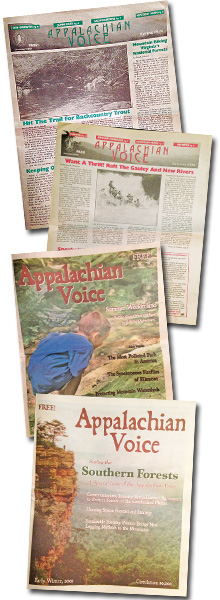
Some of the early issues of The Appalachian Voice, which first appeared on newsstands in February 1996.
Originally starting with just two staff members in a small office in Boone, N.C., today Appalachian Voices has offices in North Carolina, Virginia and Tennessee and employs 25 full-time staff working on eight campaigns related to energy and the environment. The team utilizes legislation, community organizing and litigation to address the negative impacts of mining and burning coal for electricity, and to promote renewable energy, energy efficiency and new economic opportunities for communities struggling from the decline of coal.
The organization continues to maintain The Appalachian Voice as a cornerstone of its communications outreach, distributing over 62,000 papers in a nine-state region and publishing online at appalachianvoices.org/thevoice. Though some of the environmental problems in the region have changed, the mission of The Voice remains the same — to bring to light the vital and often unheard stories of Appalachia’s land and people.
Since The Voice’s inception, five editors including myself have managed the helm, putting in long hours and late nights to edit freelancers, fact-check stories, and search for the perfect photograph for the cover, all while dreaming up ideas for the next issue. Since 2013, our Managing Editor Molly Moore has taken on the daily aspects of running the publication, ensuring that each issue makes it to the printer and on to our readers. It’s a labor of love all the way around, and each of us have enjoyed every minute of it, in our own way.
Throughout it all, we have been assisted by hundreds (if not thousands!) of writers, photographers, proofreaders, volunteers, distributors and friends — more than we could ever hope to repay — who have helped make each issue possible. Not to mention the donors, subscribers and advertisers who help us keep The Voice free.
To celebrate our 20th anniversary, in each issue throughout the year we will include small glimpses into the past, to stir memories and inspire the future.
Thank you for reading. Here’s to another 20.
Jamie Goodman,
Editor, The Appalachian Voice
Related Articles
Latest News
More Stories
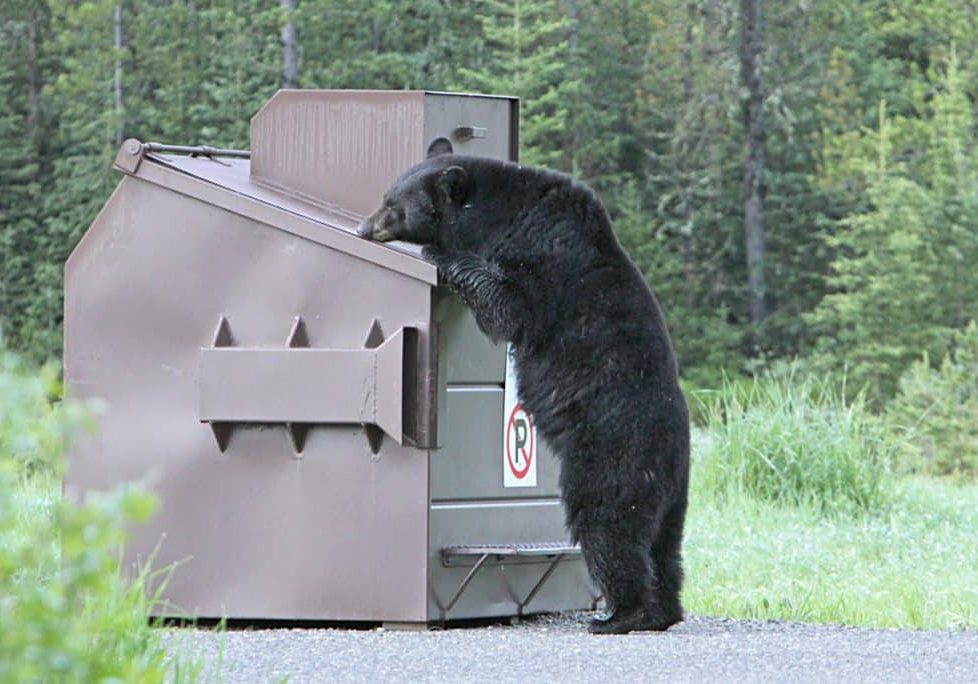
Increasing Human-Bear Conflict Prompts Legislation, Need for More Public Awareness
Experts report human-bear conflicts are on the rise in Western North Carolina, East Tennessee and other parts of the country due to an increasing bear population, development encroaching on bear habitat and other factors.

Planting for the Grandkids
Gardening from memory is getting trickier in Appalachia as hardiness zones change. Some areas, like parts of Asheville, Knoxville and Johnson City, have shifted full hardiness zones since 1990. An arborist explains what this shift means for the trees you plant this fall, and for the grandchildren who’ll live with them.

Ridgeline Pipeline Construction Impacts in Rural East Tennessee
Neighbors share concerns about noise, unpredictable construction schedules and other disruptions due to methane gas pipeline construction in East Tennessee.

Neighbors Help Neighbors
A photo essay that celebrates the volunteer spirit of the grassroots group Hurricane Helene WNC and speaks to the resourcefulness, collaboration and hard work embodied by thousands and thousands of volunteers, first responders and aid workers across the region after Hurricane Helene.

Halloween Approaches, and Night School Is in Session
The House of Art in Bluefield, West Virginia, looks like a haunted tower, making it the perfect location for its sixth annual haunt event: Night School. The Night School will be open every Friday and Saturday night through Oct. 31.

‘The Most Perfect Act of Love’
Hundreds of people attended the second annual Affirming Sumner Pride celebration on a 24-acre farm dubbed “Fruity Farm” in Bethpage, Sumner County, Tennessee.

Leave a comment
Your email address will not be published. Required fields are marked *
Leave a Comment