

Traditional Trout Hang on to Native Waters
By Molly Moore
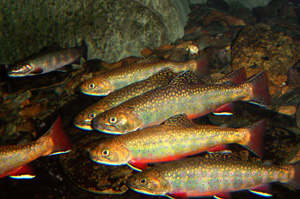
Brook trout south of the New River in Virginia are genetically distinct from brook trout further north. The genetic split took place at the end of the last ice age more than 10,000 years ago. Photo by Jim Habera, Tennessee Wildlife Resources Agency.
Although they only occupy about 25 percent of their historic range, southern brook trout are doing alright, says Jim Habera, a cold water fisheries biologist for the Tennessee Wildlife Resources Agency. He has worked on every brook trout stream in the eastern part of the state, and the remaining population has stayed fairly stable in recent decades.
Poor logging and agricultural practices devastated brook trout populations around the turn of the last century. “People didn’t want to wait for brook trout to recolonize,” says Habera. “They said, ‘Let’s just throw some rainbows and browns in there.”’
Cool mountain streams have a finite amount of food available for hungry fish, and once rainbow trout from the American West and brown trout from Europe took hold, the brook trout were at a disadvantage. Those troubles, combined with water pollution, have limited the fish to headwater streams above 3,500 feet in elevation.
Well-intentioned fisheries managers introduced brook trout from northern hatcheries, but later genetic testing revealed a difference between southern Appalachian brook trout and their larger northern brethren. Conservationists learned they had unintentionally brought another non-native species into the mix.
Today, biologists have mapped out streams with native southern trout and are careful to introduce the right type, preferably fish from within the same watershed. By restoring habitat, removing invasive trout and re-introducing southern brook trout, state and federal agencies along with nonprofit conservation groups are keeping non-native trout at bay.
In some places, tension persists between anglers fond of rainbow trout and conservation plans that favor the “brookies.” Habera recalls that after area biologists teamed up with the Great Smoky Mountains National Park to clear Lynn Camp Prong of invasive fish and reintroduce brook trout, a few anglers threw large rainbows back into the stream. Not only is that illegal and expensive for wildlife agencies, he says, it defies the principle of returning southern Appalachian fish to the streams that were their evolutionary homes. “We’ve decided, and the public has generally agreed, that we want to manage for native game species.”
Related Articles
Latest News
More Stories

Halloween Approaches, and Night School Is in Session
The House of Art in Bluefield, West Virginia, looks like a haunted tower, making it the perfect location for its sixth annual haunt event: Night School. The Night School will be open every Friday and Saturday night through Oct. 31.

‘The Most Perfect Act of Love’
After losing its rural pride celebration, hundreds of people attended the second annual Affirming Sumner Pride celebration on a 24-acre farm dubbed “Fruity Farm” in Bethpage, Sumner County, Tennessee.

Signs of Life
In the Nantahala National Forest, a team of biologists spotted Indiana bats, an endangered species that hasn’t been seen in North Carolina for the last 11 years.

‘First Line of Defense’
During Hurricane Helene and its aftermath, rural fire departments and other first responder hubs played critical roles in keeping their communities safe, even without power and cut off from outside support for days or weeks after the storm. Two years later, plenty of work remains to ensure these hubs have the resources they need to operate day to day and be ready when emergencies or natural disasters strike.

The Rocky Road — and Bridge — to Recovery
Hurricane Helene is estimated to have damaged nearly 7,000 private roads and bridges in Western North Carolina. Two years later, many restoration projects are complete, but the journey hasn’t been easy — and isn’t over for others.

After 20 Years, Letcher County Prison Proposal Is Still Alive, Though Obstacles Remain
A $605 million proposal for a federal prison on a former strip mine site in Letcher County, Kentucky, championed by U.S. Rep. Hal Rogers, refuses to die, despite local opposition, a lack of support from the executive branch and numerous other obstacles.

Leave a comment
Your email address will not be published. Required fields are marked *
Leave a Comment