

Ridgeline Pipeline Construction Impacts in Rural East Tennessee
Neighbors share about noise, unpredictable construction schedules and other disruptions from methane gas pipeline construction

It’s been more than a year since East Tennessee Natural Gas, a subsidiary of multibillion-dollar Canadian fossil fuel company Enbridge, began construction on the 122-mile Ridgeline Expansion Project. The methane gas pipeline runs through eight counties in Middle and East Tennessee to supply the Tennessee Valley Authority’s new gas power plant in Kingston.
Ridgeline, which went into service this month, crosses hundreds of waterways and numerous private properties, including Patricia Smarsh and her husband Jeffrey Gilliam’s “little piece of heaven” in Wartburg, Tennessee. The pipeline runs directly in front of their house and through many of their neighbors’ properties.
“I made this place my serenity,” Smarsh says. “And never thought I would go through such a horrible time having a pipeline go across my property. It’s been really depressing and just heart-wrenching.”
‘They were coming no matter what’
Smarsh and Gilliam didn’t know about an old pipeline easement on their property until a pipeline company representative showed up on their doorstep a few years ago. Easements are legal agreements that developers often use to build new infrastructure like the Ridgeline pipeline across existing property. With help from an eminent domain attorney, Smarsh and Gilliam agreed to a new permanent easement with East Tennessee Natural Gas and an 18-month temporary workspace agreement, which ends in early 2027.
“Our hands were tied,” Smarsh says.

Martha Dyer, a retired teacher, lives a few houses down from Smarsh. Dyer and her late husband, who unexpectedly passed away in January 2025, built their home in the early 1980s. The pipeline construction is about 15 feet from her front door. When he was alive, her husband handled every conversation with Enbridge’s representatives. Now, that burden falls on Dyer.
“If he was alive, he’d be — he’d just be beside himself,” she says. “So I’m pretty, well, I’m not glad he’s gone. But for his sake, it would tear him up.”
In hindsight, Dyer wasn’t aware of how disruptive the entire process would be. Dyer and her late husband agreed to an easement with pipeline representatives and received some compensation, but she doesn’t believe it was fair given what she’s enduring.
“Of course, what could you do?” she says. “I mean, they were coming no matter what.”
‘Temporary impacts’

In a January 2026 guest column for The Mountain Press, Art Haskins, who leads stakeholder engagement for the Ridgeline pipeline, wrote, “As we move through the construction process, there will be temporary impacts to your communities.”
But for some along the pipeline’s route, those “temporary impacts” have greatly diminished their enjoyment and comfort at home.
Construction has “really disrupted our peaceful, quiet, happy little life we had here,” Gilliam says. Smarsh says the process has been “a nightmare” and violated her sense of “security and happiness” with her land.
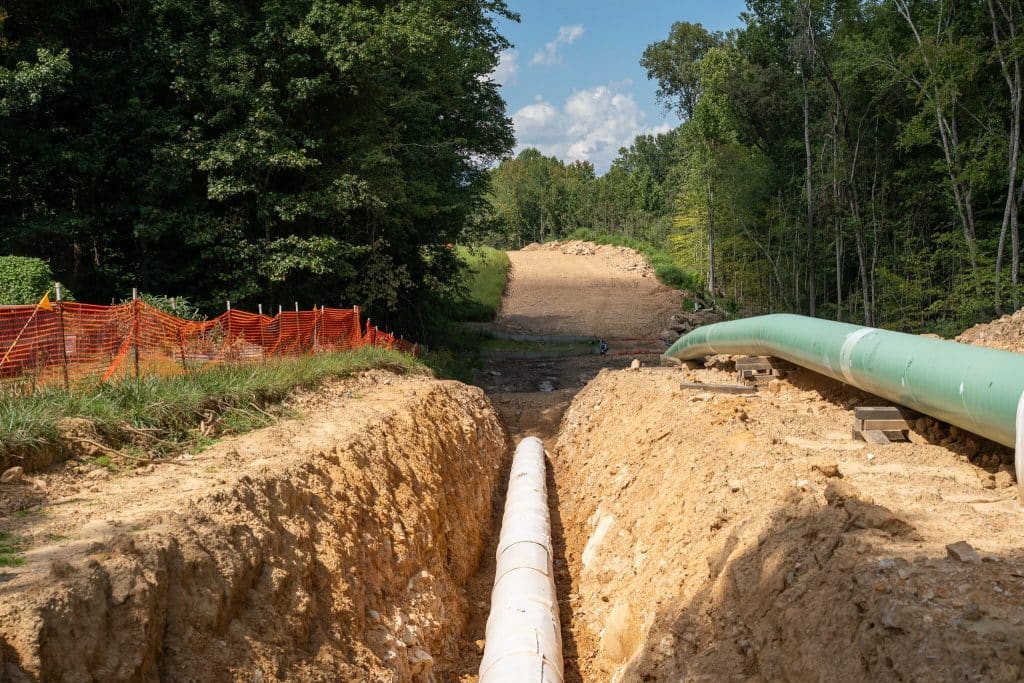
Off and on for months, crews have dug massive trenches, laid pipe and severely upended the typically quiet, rural community. Gilliam has found broken pieces of equipment — parts of a metal backhoe and a steel bracket — in their yard. The couple had to replant one of Smarsh’s beloved 70- to 80-year-old crepe myrtles in their backyard to avoid losing them to pipeline construction.
Dyer cried when construction crews ripped out a much-loved cherry tree her husband planted years ago that belonged to his mother. It produced cherries nearly every year and “was part of his mom’s legacy,” she says. Crews cut down all but one tree on Dyer’s property.
“I’m very sad,” she says. “I’m very, very sad for what they did — it’s heartbreaking.”
Referencing Dyer’s situation, Gilliam says, “They’re tearing through people’s lives just to put a gas line in.”
Construction has not only torn up property, but neighbors have expressed that the loud noise and disruptions feel never-ending. Enbridge doesn’t inform landowners when crews will show up or leave. Or when construction will be completed.
“They’ll be here for — might be here for a couple of days and might be here for a couple of weeks — and they’ll disappear,” Gilliam says.

One of the worst moments came when crews began hammering through rock for 10 to 12 hours a day for several days over the summer.
“Just bam, bam, bam, bam all day,” Gilliam says.
Smarsh and Gilliam believe construction vibrations have damaged their home’s foundation and have raised their concerns with the pipeline developer. They also worry about being so close to the pipeline if something goes wrong.
After seeing an Oct. 21 headline about an Enbridge pipeline rupture in Overton County, Smarsh joked that her dentures have her name “inscribed in them in red” to identify herself if there were an explosion.
Ongoing litigation over Kingston gas plant
As a member of Appalachian Voices, Smarsh is part of an ongoing lawsuit against TVA filed by the Southern Environmental Law Center on behalf of the Center for Biological Diversity, Sierra Club and Appalachian Voices, publisher of The Appalachian Voice. The lawsuit argued that TVA didn’t evaluate cleaner, affordable alternatives to the gas plant and invested a significant amount of customer dollars in methane gas infrastructure before deciding to build the plant.
In August, the U.S. District Court for the Eastern District of Tennessee ruled that TVA’s choice to build its Kingston gas plant violated the federal National Environmental Policy Act, which requires agencies to review the environmental effects of major projects before undertaking them. The court vacated the federal utility’s decision to build the plant. However, TVA appealed that decision, and the U.S. Court of Appeals for the Sixth Circuit ruled in October that TVA can move forward with construction.
On Oct. 30, the Federal Energy Regulatory Commission approved East Tennessee Natural Gas’ request to go into service on Nov. 1 and conduct additional restoration work on Sundays between Nov. 1 and Dec. 17. The developer stated that it had provided advance notice to impacted landowners about the Sunday work “and received no objections.” In court records, TVA has indicated that its gas plant won’t go into operation until at least 2028.
Related Articles
Latest News
More Stories

Neighbors Help Neighbors
A photo essay that celebrates the volunteer spirit of the grassroots group Hurricane Helene WNC and speaks to the resourcefulness, collaboration and hard work embodied by thousands and thousands of volunteers, first responders and aid workers across the region after Hurricane Helene.

Halloween Approaches, and Night School Is in Session
The House of Art in Bluefield, West Virginia, looks like a haunted tower, making it the perfect location for its sixth annual haunt event: Night School. The Night School will be open every Friday and Saturday night through Oct. 31.

‘The Most Perfect Act of Love’
Hundreds of people attended the second annual Affirming Sumner Pride celebration on a 24-acre farm dubbed “Fruity Farm” in Bethpage, Sumner County, Tennessee.

Signs of Life: Endangered Bats Found in Nantahala for First Time in More Than a Decade
In the Nantahala National Forest, a team of biologists spotted Indiana bats, an endangered species that hasn’t been seen in North Carolina for the last 11 years.

‘First Line of Defense’
During Hurricane Helene and its aftermath, rural fire departments and other first responder hubs played critical roles in keeping their communities safe, even without power and cut off from outside support for days or weeks after the storm. Two years later, plenty of work remains to ensure these hubs have the resources they need to operate day to day and be ready when emergencies or natural disasters strike.

The Rocky Road — and Bridge — to Recovery
Hurricane Helene is estimated to have damaged nearly 7,000 private roads and bridges in Western North Carolina. Two years later, many restoration projects are complete, but the journey hasn’t been easy — and isn’t over for others.

Leave a comment
Your email address will not be published. Required fields are marked *
Leave a Comment