

‘The Most Perfect Act of Love’
Fruity Farm hosts second annual pride celebration after loss of Bethpage’s pride festival in rural Tennessee
By Debra Murray
On a hot September day, singer-songwriter Morgan Isaac Karr and husband Gabriel Max Starner enjoyed a day of drag, heartfelt speeches, fun vendors and live music alongside hundreds of attendees at the second annual Affirming Sumner Pride celebration on their 24-acre farm, dubbed “Fruity Farm,” in Bethpage, located in Sumner County, Tennessee.
Previously, the county didn’t have an annual pride celebration, and an attempt to hold one in 2025 failed after potential venues and businesses backed out after facing online harassment, Karr explains. When news surfaced that community organizers needed a space for the event, someone suggested Fruity Farm as a new venue.
“We want Fruity Farm to be a space for everyone, gay, straight, Black, White — everyone under the sun to feel welcome,” says Karr, whose stage name is MORGXN. “Hosting Pride on our farm in rural Tennessee is like the most perfect act of love I could possibly ever imagine.”
Despite an overwhelmingly positive reaction to the event, hosting a Pride celebration in rural Tennessee isn’t without risks and online negativity, which is not new to Karr, who has faced his own share of online vitriol.
“I really do think that their hatred is not my burden to bear,” Karr says. “It’s more just like I wish that they had half the love in their heart that I experience on an hourly basis with my husband.”
In April, Tennessee Gov. Bill Lee signed a resolution declaring June, nationally recognized as Pride Month, as “nuclear family month.” The resolution specifically defines a nuclear family as including a husband and wife.
Yet, to Karr, there is nothing more American than a community coming together to make sure everyone feels safe and supported.
Community unites to host second Affirming Sumner Pride celebration
For several months leading up to the event, a committee made up of volunteers met every week to plan Affirming Sumner. One committee member is Rory Edmonds, who flipped a 16-year incumbent seat on the Sumner County Commission in August.
“This is a miracle in the state of Tennessee, and it feels very exciting that he’s a part of our planning committee,” Karr says. “Now there is an elected official in the county of Sumner County who cares because he’s an ally. He’s not queer, he’s just an ally who cares that all people feel seen, heard and loved.”
Edmonds, who works in marketing and event planning, joined the planning committee to see how he could help.
“My wife and I attended the first one last year at their farm, and we loved it. We’re huge allies,” Edmonds says. “We were frustrated by the lack of representation within the community, and we’re frustrated by the county’s response to that. We were very glad to see that it happened at their farm, and they hosted it.”
Since the first celebration, Karr and Starner have worked to make the farm more suitable for hosting hundreds of people.
“Gabe and Morgan made a ton of investments this year in changing how their property was laid out and how the festival would operate logistically, and a number of other things,” Edmonds said. “I think we’ll really start to see the investments that were made throughout this year show up next year and the year after, and really just kind of build on itself.”
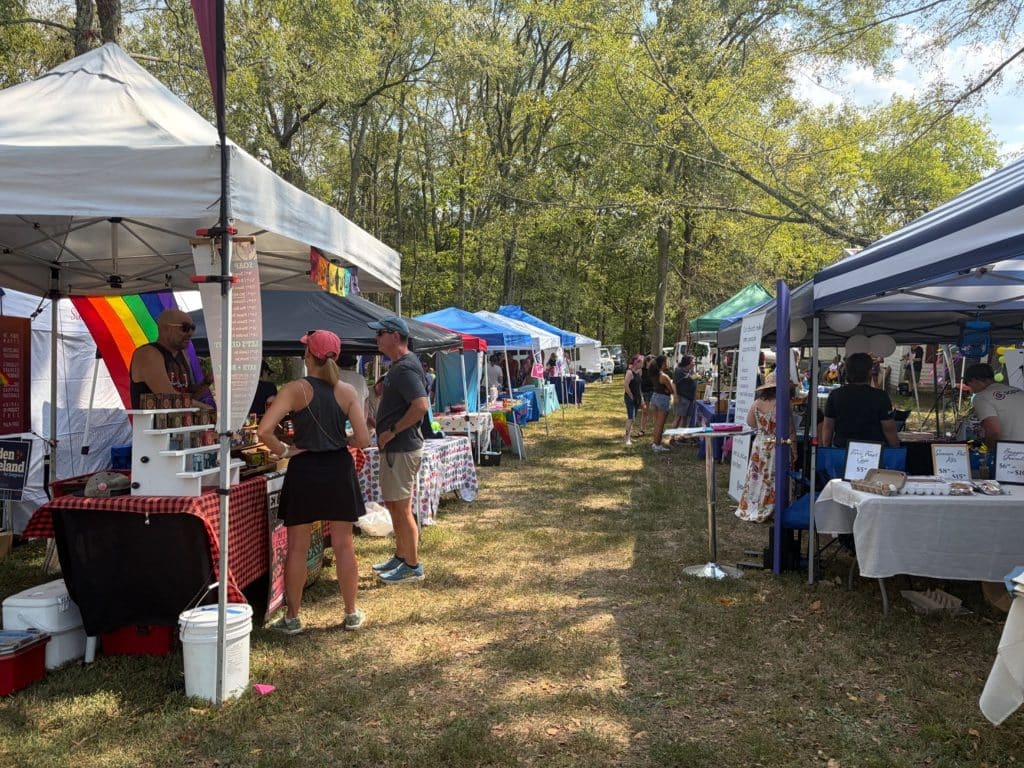
Rows of vendors, including a local hot-sauce maker and the Human Rights Campaign, filled a grassy area of the 24-acre farm. Next to the stage where speeches and performances were held, a community art project led by transgender artist Dylan Stevens was underway. Celebrants could pick from a tray of paint colors to contribute to the art project. The project was displayed at the Human Rights Campaign office in Washington, D.C., for a week after the festival.
“What you all are doing here is literally saving lives, literally, and you will never know whose life you save,” says Brian Bond, chief executive officer of PFLAG, an LGBTQ+ advocacy organization, during a speech. “I promise you that.”
Organizers also held a land dedication to Marcus Gann, a gay man who lived on the farm during a time when he could not live openly, decades before Karr and Starner bought the farm in 2023. His ashes were spread near a dogwood tree when he passed in 1991.
“May this spot offer rest and reflection, honoring both the pain and the joy of Marc’s journey,” reads the plaque made in conjunction with Gann’s family. “Marc, we wish you could see it.”
‘It will be at Fruity Farm forever’

Tangela Robinson, a member of the Affirming Sumner planning committee, has helped organize the celebration at Fruity Farm for the past two years. She shares that she is happy to see the celebration hosted on the farm permanently.
“We don’t need to necessarily rely on the city to get it done,” Robinson says. “We can get it done and come together as a community and do it ourselves.”
She hopes that people look forward to Affirming Sumner every September and that the festival continues to grow.
“You have the ability to create your chosen family and still be seen and still be affirmed, because that’s really what we’re all here for,” Robinson says. “There’s going to be a weekend in September where I can go and be with my family, my community, my support system, and hopefully it becomes something that they have to look forward to.”
Now, Karr and Starner plan for Fruity Farm to be Affirming Sumner’s forever home. Last year, 300 people attended. This year, over 400 people attended — more than Bethpage’s entire population.
“This is the second year at Fruity Farm, and it will be at Fruity Farm forever,” Karr says.
Related Articles
Latest News
More Stories

Halloween Approaches, and Night School Is in Session
The House of Art in Bluefield, West Virginia, looks like a haunted tower, making it the perfect location for its sixth annual haunt event: Night School. The Night School will be open every Friday and Saturday night through Oct. 31.

Signs of Life
In the Nantahala National Forest, a team of biologists spotted Indiana bats, an endangered species that hasn’t been seen in North Carolina for the last 11 years.

‘First Line of Defense’
During Hurricane Helene and its aftermath, rural fire departments and other first responder hubs played critical roles in keeping their communities safe, even without power and cut off from outside support for days or weeks after the storm. Two years later, plenty of work remains to ensure these hubs have the resources they need to operate day to day and be ready when emergencies or natural disasters strike.

The Rocky Road — and Bridge — to Recovery
Hurricane Helene is estimated to have damaged nearly 7,000 private roads and bridges in Western North Carolina. Two years later, many restoration projects are complete, but the journey hasn’t been easy — and isn’t over for others.

After 20 Years, Letcher County Prison Proposal Is Still Alive, Though Obstacles Remain
A $605 million proposal for a federal prison on a former strip mine site in Letcher County, Kentucky, championed by U.S. Rep. Hal Rogers, refuses to die, despite local opposition, a lack of support from the executive branch and numerous other obstacles.
The Washout and Rebuild
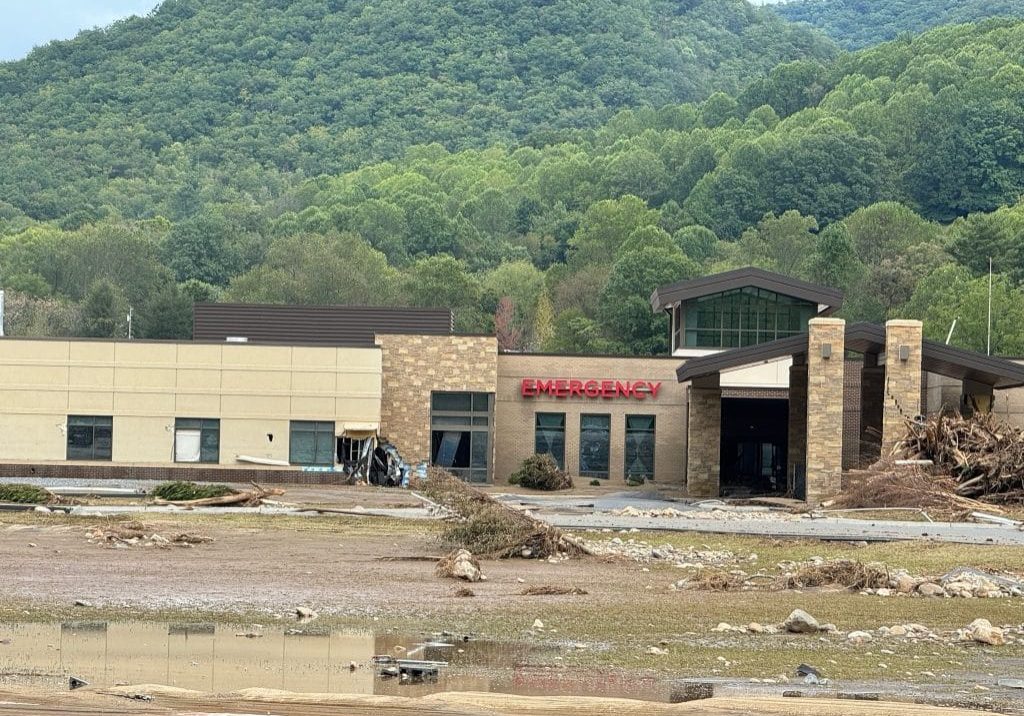
For nearly two years, residents of Unicoi County, Tennessee, have had to make do without a hospital after Hurricane Helene destroyed the rural hospital. Ballad Health, which owns the hospital, broke ground on a new location — in another floodplain — in August 2026.

Leave a comment
Your email address will not be published. Required fields are marked *
Leave a Comment