
Front Porch Blog
Solar-powered microgrids are ready to support communities in WNC
Two mobile power stations were unveiled last week!

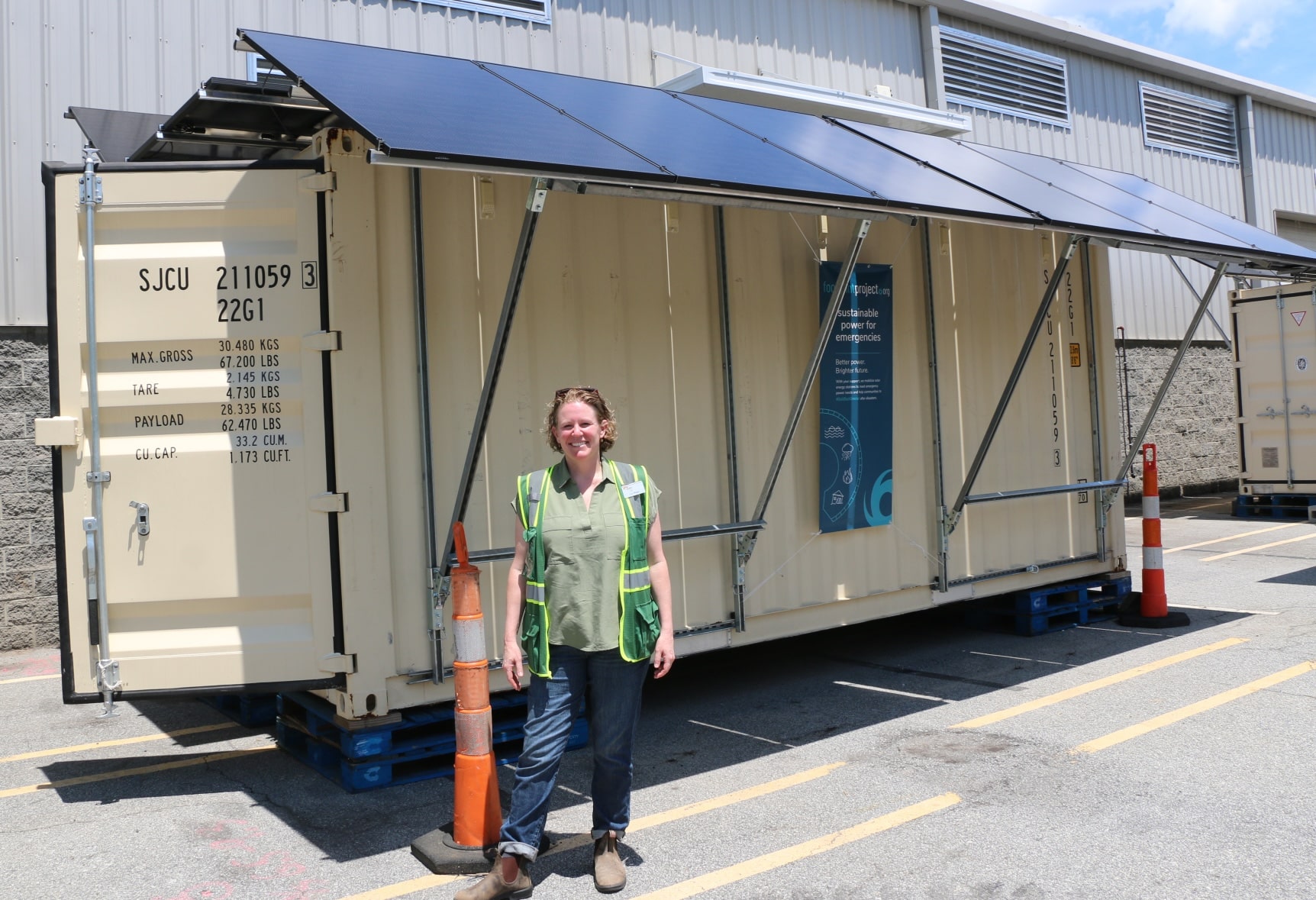
The sun beat down on a hot parking lot outside Manna Food Bank last Friday in Mills River, North Carolina. But despite temperatures that crept into the ’90s, the peaches and tomatoes inside of two shipping containers stayed cool, thanks to air-conditioning powered by the solar panels affixed to their roofs. The so-called “cooler bees” also feature battery energy storage — so they can keep running when the sun goes down, and keep food refrigerated no matter what.
These units could have helped feed residents of Western North Carolina in the wake of Hurricane Helene, when Manna Food Bank was flooded. Today, if one of Manna’s partner sites in the 16 counties they serve has a prolonged power outage, the food bank could dispatch one of these solar-powered coolers, and it would be able to operate self-sufficiently to keep food fresh.
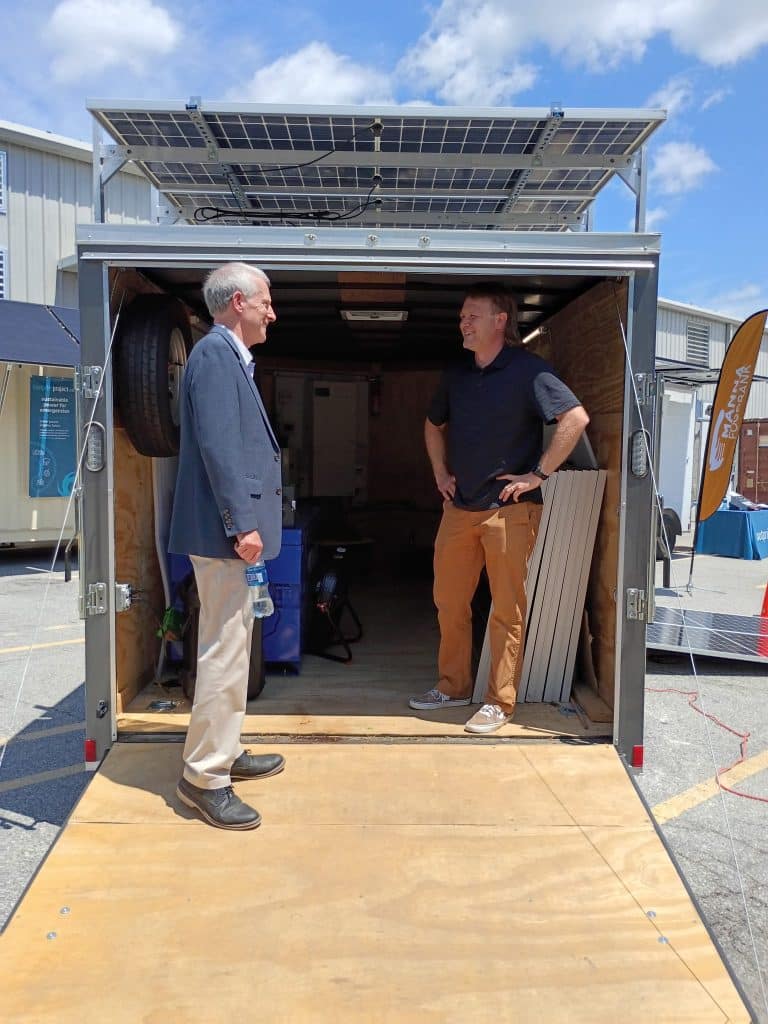
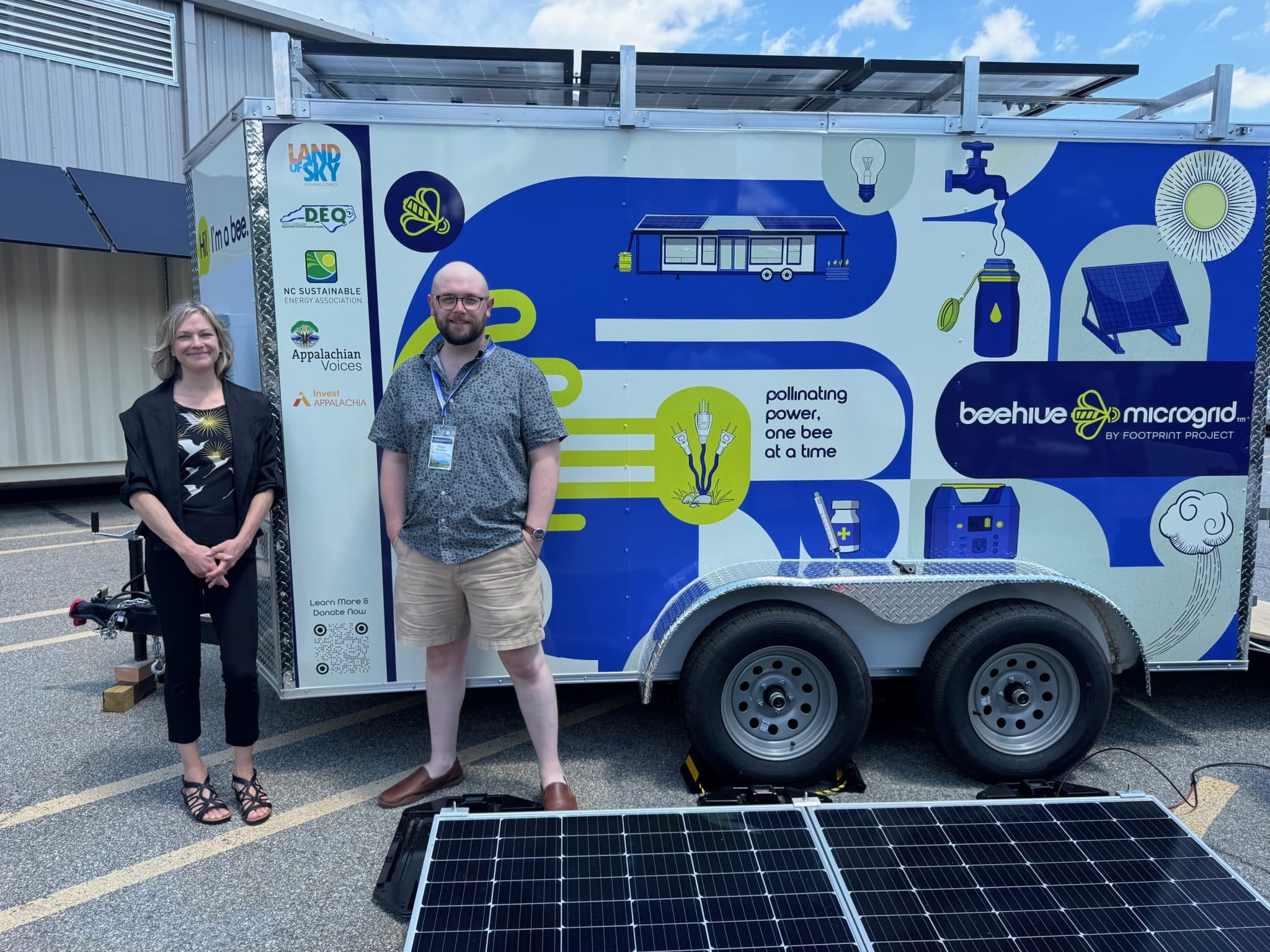
But on this hot Friday, a crowd gathered to see two new solar microgrids in action — mobile stations ready to provide electricity wherever it’s needed. Each of these trailers is equipped with 18 kilowatts of solar power and 28.6 kilowatt-hours of batteries, enough to power a mid-sized fire station for days. That means the trailer is capable of supporting multiple critical response needs such as water filtration, satellite communications, mobile medical clinics and power tools.
These two mobile microgrids complement 24 stationary solar and battery storage microgrids that are being deployed across Western North Carolina to help ensure that vital community places that were stranded without grid power during Helene can keep operating during extreme conditions in the future. These microgrids are going to fire stations, community centers, health centers, libraries and more — places that will benefit from the energy cost savings when skies are blue and be better prepared to serve their communities when the next prolonged outage comes.
At the event Friday, the first recipients of stationary microgrids were announced. They include the East Asheville Library, Beacon of Hope in Madison County, Buladean Community Center in Mitchell County, Burnsville Fire Department in Yancey County and Bills Creek Community Center in Rutherford County.
It’s a huge effort with many partners, and Appalachian Voices is proud to be one. The North Carolina Department of Environmental Quality, using funding from the 2021 Bipartisan Infrastructure Law, granted $5 million for the effort last year. The local government organization Land of Sky Regional Council is the grant recipient and is leading implementation of the project with the nonprofit Footprint Project, a group with deep expertise deploying sustainable energy solutions for extreme weather disaster response. The NC Sustainable Energy Association, Appalachian Voices and Invest Appalachia round out the project team, supporting project administration, outreach, beneficiary selection and financial support, including facilitation of federal tax incentives.
“We do know there’s more storms in our future. Investments to ensure that communities not only experience less damage but also bounce back faster are so critical,” NC Department of Environmental Quality Secretary Reid Wilson said at the event. “Microgrids can be an important element of the suite of investments we make to ensure that our energy systems, our water systems, our communication systems are all more resilient to what’s coming towards us.”
Solar bees
The two mobile trailers demonstrated last week are the first North Carolina example of a “beehive microgrid” — an innovative approach developed by the Footprint Project that integrates mobile and stationary electrical systems to form a standalone microgrid with multiple modalities. The “bees” can consist of mobile trailers equipped with solar and battery power, which are deployed during disasters to provide immediate response and relief during grid outages, and to offset diesel generator use or electricity costs during normal times. Bees can also consist of small, portable batteries that are loaned out to households like books from a library, so that people have nimble backup power for small-scale uses like CPAP machines. The “hive” consists of a fixed system of solar panels, batteries and other components for powering a stationary resilience hub and recharging the bees.
“As we’re seeing these cascading climate events, we really need to get more creative in how we deliver access to electricity to the folks that might be the farthest down at the end of the line when the line is catastrophically broken, and those people often cannot get physically back to the resilience hub,” Footprint Project CEO Will Heegaard said at the event.
He explained that these assets can be strategically positioned in advance and relocated with input from people in a community who know best where they will be most helpful.
“I’m really excited because it allows us to get the tools to the people that really know how to use them best and let them take the power into their own hands, decide how to use it, when to deploy it, when to redeploy it, and that changes the arc of recovery from day one,” Heegaard said.
PREVIOUS
NEXT

Leave a comment
Your email address will not be published. Required fields are marked *
Leave a Comment