
Front Porch Blog
Gov. Youngkin’s attempt to repeal RGGI administratively violates the law

Gov. Glenn Youngkin is following through on his ill-designed plans to withdraw Virginia from a regional 12-state agreement to reduce power plant pollution and fund programs to help communities impacted by climate change.
After Youngkin stacked the Virginia Air Pollution Control Board with his appointees, its members voted 4-3 in early June to remove the state from the Regional Greenhouse Gas Initiative. The administration published its “RGGI repeal” regulation at the end of July. Nevermind that Youngkin and the air board took these actions during the hottest month ever recorded on Earth, and over a period when climate change-fueled Canadian wildfires were turning Virginia’s skies orange and polluting them with soot.
At the heart of Youngkin’s effort is the question: Is the governor allowed to do this? The answer is no, and Appalachian Voices, along with a number of our partner organizations represented by the Southern Environmental Law Center, are going to court to enforce the law.
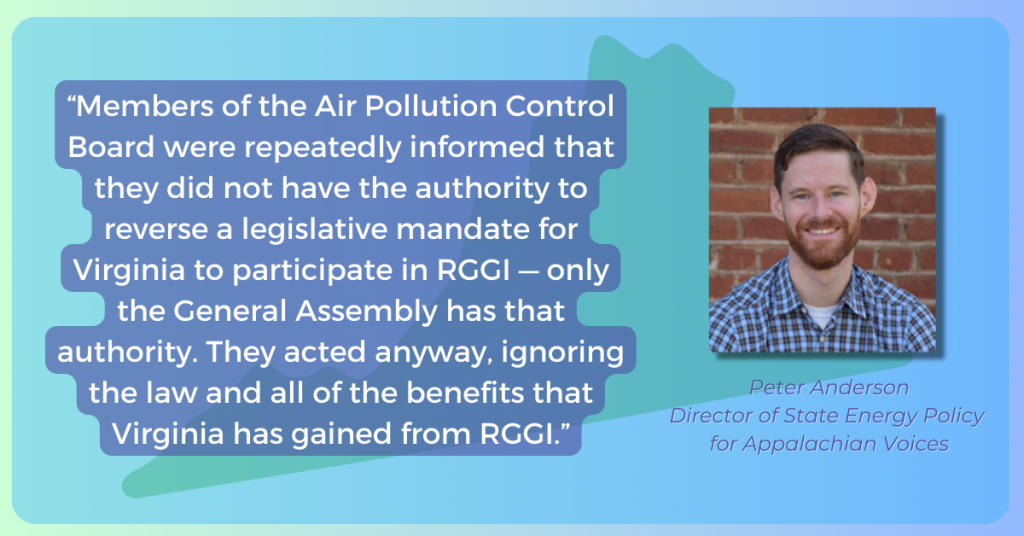 We are challenging Youngkin’s effort because he does not have unilateral authority to reverse legislation passed by the General Assembly and enacted into law in 2020. The Southern Environmental Law Center served a notice of appeal at the end of July to administration officials on behalf of Appalachian Voices, the Association of Energy Conservation Professionals, Faith Alliance for Climate Solutions, and Virginia Interfaith Power and Light.
We’re challenging Youngkin’s efforts to repeal RGGI in court by participating in a lawsuit brought by different Virginia environmental groups. Read our press release!
Four different locales are rallying to support our participation in RGGI on Aug. 28! RSVP today!
In Virginia, as in most states, when we want something to become state law, a legislator introduces a bill to the General Assembly, which debates the bill’s merits and votes on it. If the body approves enacting the bill, it’s up to the governor to sign the bill into law. It’s a fairly straightforward process and one with which most people are familiar.
In 2020, that’s exactly how the Virginia legislature passed the Clean Energy and Community Flood Preparedness Act, which required the state’s participation in RGGI. Then-Gov. Ralph Northam signed the bill into law.
Now, when we want to change or repeal a law in Virginia, a legislator must introduce the changes as a bill to the General Assembly, and the same process that I outlined previously must be followed in order to amend or repeal a law. But Youngkin doesn’t think he has to follow that process in his efforts to withdraw the state from RGGI. Maybe he missed the “I’m Just a Bill” episode of Schoolhouse Rock and doesn’t understand.
RGGI has been in Youngkin’s crosshairs since he took office. In 2022, Youngkin’s legislative allies introduced at least five bills that would have undermined or ended Virginia’s participation in RGGI. In 2023, State Sen. Richard Stuart, a Youngkin ally, again introduced a bill to withdraw Virginia from RGGI. All of these bills failed to pass, which should have meant GAME OVER for this ill-conceived pursuit.
 But after legislative efforts failed, Youngkin took his case to the air board, with his four hand-picked appointees, and the Virginia Department of Environmental Quality. Administration officials argued to the board that the Clean Energy and Community Flood Preparedness Act doesn’t mandate Virginia’s participation in RGGI, that it’s to the discretion of the DEQ director. Unsurprisingly, Youngkin’s Air Board agreed with him. Excuse me while I scream into my pillow.
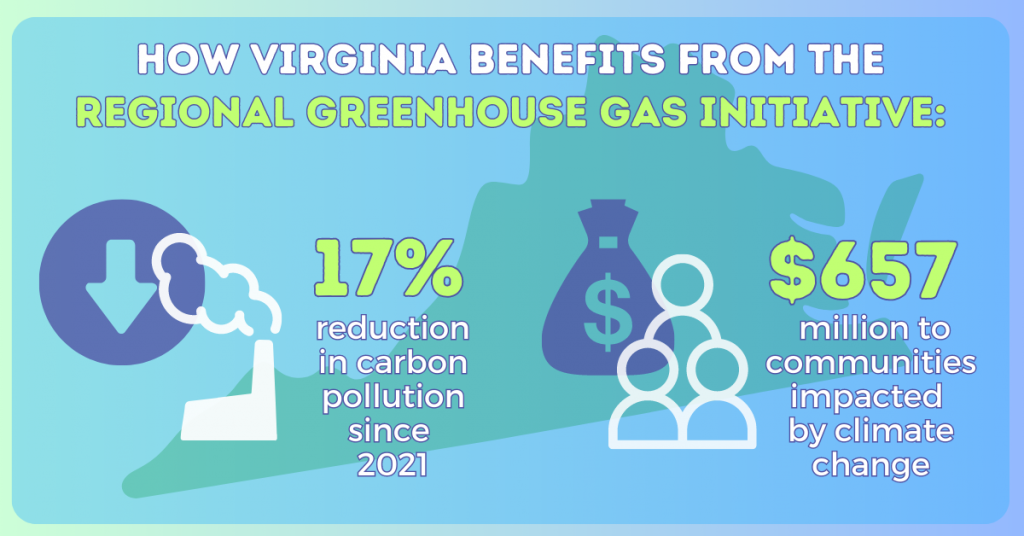
The benefits of RGGI for Virginia are clear. Since joining RGGI in 2021, Virginia has reduced power plant emissions by 16.8%, which is nothing to blink at. Additionally, $657 million in funds generated through RGGI were distributed to energy efficiency programs in low-income communities and for resiliency projects in areas affected by sea-level rise and flooding, including in Southwest Virginia.
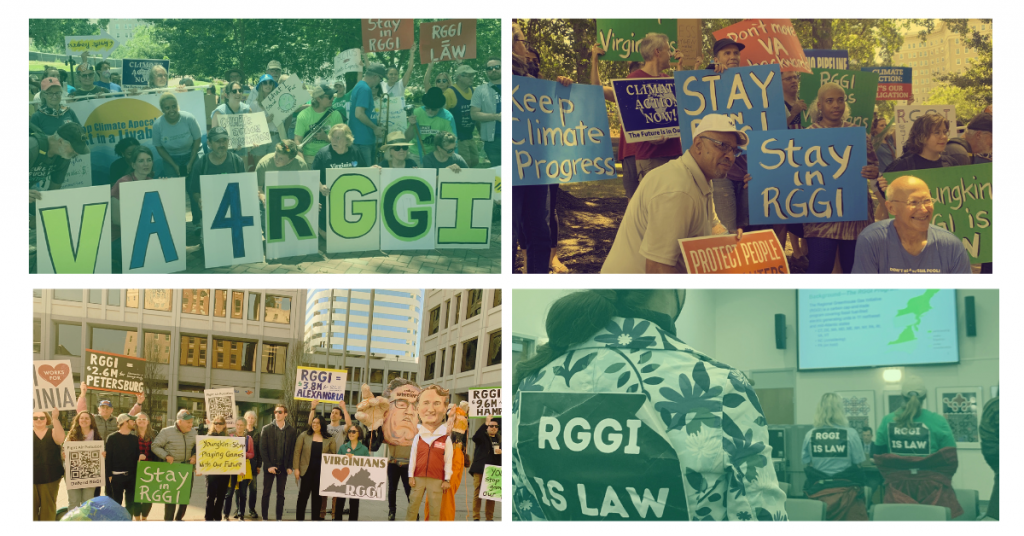 It’s worth noting that RGGI is quite popular with Virginians. According to a January poll produced by Christopher Newport University’s Wason Center for Civic Leadership, two thirds of Virginians support staying in RGGI. The majority of submissions from a comment period that occurred at the beginning of the year also support keeping Virginia in RGGI. I’ve attended so many protests opposing RGGI withdrawal since last summer at the state capitol and air board meetings that I’ve lost count. Plain and simple: Virginia loves RGGI!
If the governor had his way and Virginia exited RGGI, what would he do to address climate change — the greatest challenge facing Virginia, in my opinion? Youngkin has no plan to lower pollution in Virginia and fund programs that help people deal with climate change. You have until August 31 to submit your comment to tell Gov. Youngkin that his attempt to withdraw Virginia from RGGI violates the law and our democratic legislative process.

PREVIOUS
NEXT

Leave a comment
Your email address will not be published. Required fields are marked *
2 responses to “Gov. Youngkin’s attempt to repeal RGGI administratively violates the law”
-

We need the Regional Greenhouse Gas Initiative! Obviously Youngkin doesn’t belong in Virginia! He wants to destroy our beautiful State by opposing RGGI!
-
Thanks so much for keeping us posted!


Leave a Comment