

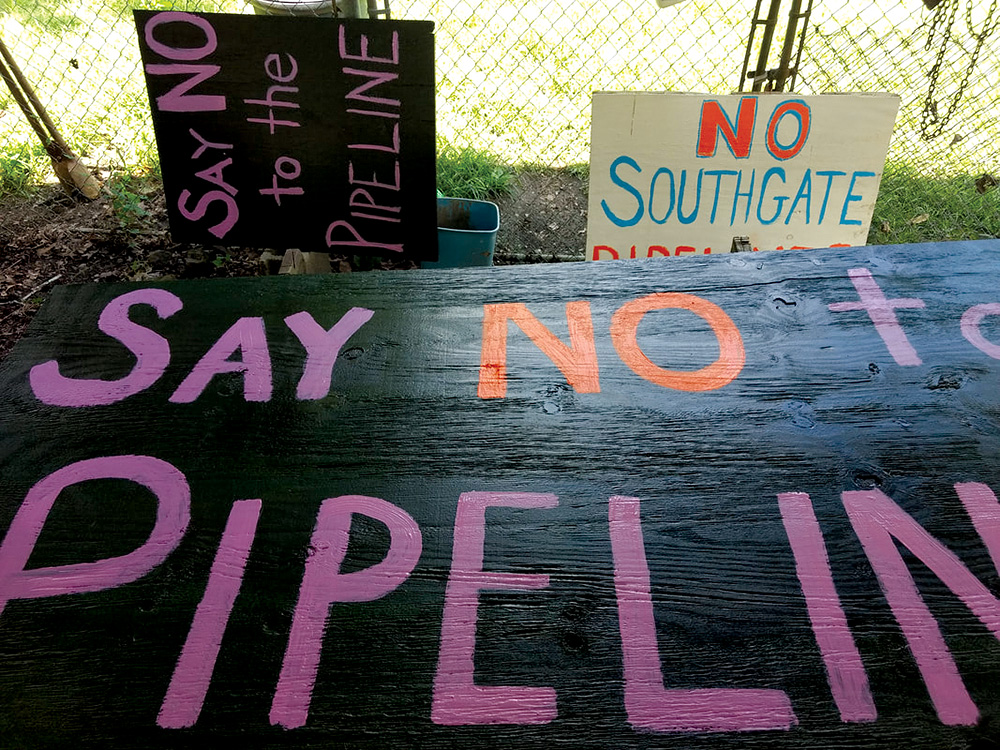
Mountain Valley Pipeline’s Southgate expansion into North Carolina has drawn significant criticism. Photo courtesy of Haw River Assembly
The project, known as MVP Southgate, would snake 73 miles from Pittsylvania County, Va., through North Carolina’s Rockingham and Alamance counties. While Mountain Valley can now seek permits from the state, it will likely face difficulty from the North Carolina Department of Environmental Quality.
On Nov. 5, the state agency sent a letter to FERC stating that many residents are “apprehensive of and sensitive to the possibility of another new pipeline” after last year’s approval of the Atlantic Coast Pipeline.
“We question whether the project satisfies the criteria for the Commission to deem it in the public interest, and whether it is essential to ensure future growth and prosperity for the residents of our State,” reads the state agency’s letter to FERC.
On Dec. 12, a coalition of environmental groups including the Center for Biological Diversity and Appalachian Voices, the publisher of this newspaper, filed a motion to intervene in FERC’s case on whether to approve the pipeline.
“This destructive pipeline would do immense harm to endangered species in North Carolina and Virginia as bulldozers clear a path through their habitat,” said Perrin de Jong, North Carolina staff attorney at the Center for Biological Diversity, in a press release. “MVP Southgate would also degrade air and water quality by accelerating fracking throughout West Virginia, Ohio and Pennsylvania.”
Related Stories
In September, Alamance County Commissioners unanimously passed a resolution opposing MVP Southgate. The resolution stated that stormwater and erosion control problems in Mountain Valley’s path in Virginia raised concern about Southgate’s impact on Alamance County’s riverfront terrain and other water bodies. The commission has no permitting authority over the pipeline.
The town council of Stoneville, N.C., narrowly passed a resolution against MVP Southgate on Oct. 2. Energy News Network reports that Stoneville citizens like Steven Pulliam are hoping to start a wave of action in Rockingham County.
“We’re really happy about it, this is the first in our county,” Pulliam told the publication. “I think this will set a chain of events off.”
MVP Southgate originally planned to build two high-powered compressor stations to pump gas through the pipeline, but reduced it to a single station in Pittsylvania County, Va. — By Kevin Ridder
Editor’s Note: This article was updated Dec. 19 to reflect changes following our print edition’s press date on Dec. 6.
Related Articles
Latest News
More Stories

Halloween Approaches, and Night School Is in Session
The House of Art in Bluefield, West Virginia, looks like a haunted tower, making it the perfect location for its sixth annual haunt event: Night School. The Night School will be open every Friday and Saturday night through Oct. 31.
‘The Most Perfect Act of Love’
After losing its rural pride celebration, hundreds of people attended the second annual Affirming Sumner Pride celebration on a 24-acre farm dubbed “Fruity Farm” in Bethpage, Sumner County, Tennessee.

Signs of Life
In the Nantahala National Forest, a team of biologists spotted Indiana bats, an endangered species that hasn’t been seen in North Carolina for the last 11 years.

‘First Line of Defense’
During Hurricane Helene and its aftermath, rural fire departments and other first responder hubs played critical roles in keeping their communities safe, even without power and cut off from outside support for days or weeks after the storm. Two years later, plenty of work remains to ensure these hubs have the resources they need to operate day to day and be ready when emergencies or natural disasters strike.

The Rocky Road — and Bridge — to Recovery
Hurricane Helene is estimated to have damaged nearly 7,000 private roads and bridges in Western North Carolina. Two years later, many restoration projects are complete, but the journey hasn’t been easy — and isn’t over for others.
After 20 Years, Letcher County Prison Proposal Is Still Alive, Though Obstacles Remain
A $605 million proposal for a federal prison on a former strip mine site in Letcher County, Kentucky, championed by U.S. Rep. Hal Rogers, refuses to die, despite local opposition, a lack of support from the executive branch and numerous other obstacles.

Leave a comment
Your email address will not be published. Required fields are marked *
Leave a Comment