

Landowners Support Songbird Conservation
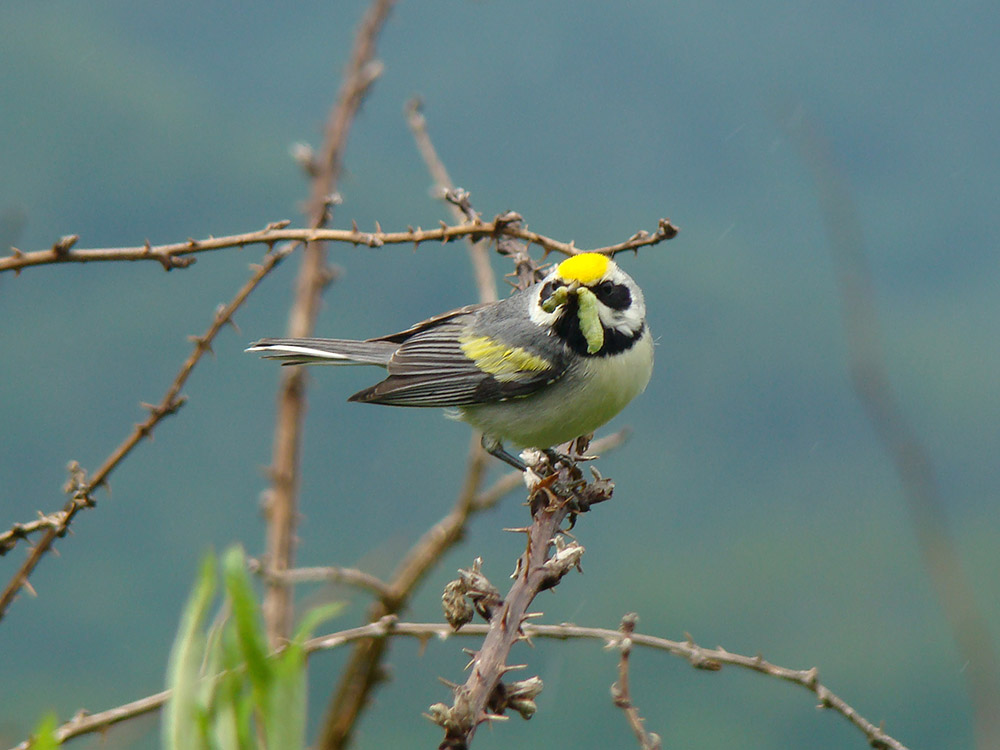
A golden-winged warbler eats a caterpillar. Photo by Ed Burress
Cerulean warbler. Photo courtesy of Mdf, Wikimedia Creative Commons
By Kimber Ray
The prevailing chorus of Appalachia’s spring, once dominated by the trills of tiny warblers migrating from Central and South America, has grown increasingly muted over the past century. Efforts to rejuvenate this song are receiving support from two separate, federally funded projects to restore wildlife habitat on private lands, which host nearly two-thirds of all threatened and endangered species in the country.
Since 2012, the U.S. Department of Agriculture and the U.S. Fish and Wildlife Service have partnered with farmers, ranchers and forest landowners on the Working Lands for Wildlife initiative, a five-year project targeting seven at-risk species.
One selected species, the golden-winged warbler, once thrived in the Appalachian mountains from Georgia to New York. The choice nesting ground for this songbird — areas of young trees and shrubland along the edge of dense forests — has declined due to activities such as development and fire suppression. With the assistance of federal funding, landowners commission foresters and wildlife experts from either the state or other local groups to help implement habitat protection strategies, which include limited timber harvesting and selective burning to thin canopy covers, removal of invasive shrubs, and the planting of native species, many of which also benefit pollinators.
The creation of forest-edge habitat in the 7,000 acres currently enrolled in the golden-winged warbler program is already supporting greater populations of the warbler and other shrub-dependent birds, according to a federally funded 2014 assessment. For three years, a team of academic, nonprofit and government researchers tracked more than 800 warblers on 95 properties managed through the program.
It used to be more difficult to evaluate the success of federal wildlife conservation efforts, according to Todd Fearer, coordinator of a regional bird conservation partnership known as Appalachian Mountain Joint Ventures. Now, however, “These practices are specific enough that we can look at how the land was before and after the habitat was implemented, and how the birds respond,” says Fearer.
The partnership has since launched a similar effort in Appalachia, the Cerulean Warbler Appalachian Forestland Enhancement project, which was among 115 conservation programs selected to receive federal funding this past January. The tiny blue-and-white songbirds nest in valuable hardwoods such as oak and hickory, which landowners could be prohibited from harvesting if the cerulean warbler is listed as endangered.
The five-year goal of the project is to enroll 12,500 acres of private forestland in Kentucky, Pennsylvania, Maryland, Ohio and West Virginia. Landowners receive a subsidy to remove lower-quality trees, such as red maple, which in turn creates the open canopy preferred by the cerulean warbler and provides growth space for the more valuable hardwood saplings. This type of habitat also benefits populations of game species such as ruffed grouse, rabbit, deer and turkey.
Additional habitat will be supported by reforesting reclaimed mineland property. More than 1,000 acres of this currently unsuitable habitat will be planted with blight-resistant American chestnut saplings, which may ultimately provide a significant source of habitat and food.
Related Articles
Latest News
More Stories

Halloween Approaches, and Night School Is in Session
The House of Art in Bluefield, West Virginia, looks like a haunted tower, making it the perfect location for its sixth annual haunt event: Night School. The Night School will be open every Friday and Saturday night through Oct. 31.
‘The Most Perfect Act of Love’
After losing its rural pride celebration, hundreds of people attended the second annual Affirming Sumner Pride celebration on a 24-acre farm dubbed “Fruity Farm” in Bethpage, Sumner County, Tennessee.

Signs of Life
In the Nantahala National Forest, a team of biologists spotted Indiana bats, an endangered species that hasn’t been seen in North Carolina for the last 11 years.

‘First Line of Defense’
During Hurricane Helene and its aftermath, rural fire departments and other first responder hubs played critical roles in keeping their communities safe, even without power and cut off from outside support for days or weeks after the storm. Two years later, plenty of work remains to ensure these hubs have the resources they need to operate day to day and be ready when emergencies or natural disasters strike.

The Rocky Road — and Bridge — to Recovery
Hurricane Helene is estimated to have damaged nearly 7,000 private roads and bridges in Western North Carolina. Two years later, many restoration projects are complete, but the journey hasn’t been easy — and isn’t over for others.
After 20 Years, Letcher County Prison Proposal Is Still Alive, Though Obstacles Remain
A $605 million proposal for a federal prison on a former strip mine site in Letcher County, Kentucky, championed by U.S. Rep. Hal Rogers, refuses to die, despite local opposition, a lack of support from the executive branch and numerous other obstacles.

Leave a comment
Your email address will not be published. Required fields are marked *
Leave a Comment