

Appalachian Elegy by bell hooks: “an avalanche of splendor”
By Matt Grimley
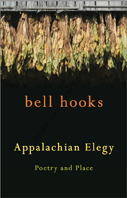
bell hooks doesn’t claim to be an Appalachian. But through her latest collection of poems, Appalachian Elegy, (University Press of Kentucky, 2012) we get the bigger message: that doesn’t matter.
bell hooks was born in Hopkinsville, Ky., in 1952 with the name Gloria Jean Watkins. A celebrated teacher, author and activist, she has written over 30 books on issues such as social class, environmental justice, race and gender. She is currently a professor at Berea College.
As a tribute to her grandmother, Watkins adopted “bell hooks” as her name, decapitalizing it to emphasize the importance of her writing as opposed to who she is.
What really matters, then, is the process of creation and re-creation, the poetry itself.
As she writes in her introduction, these poems “extend the process of lamentation,” repeating “sorrow sounds” and connecting the pain of a “historical Kentucky landscape ravaged by war and all human conditions that are like war.” They do not only reflect the domination of subjugated peoples and demolished lands; they also give voice and control to a lost past, “until history/rewritten resurrected/returns to its rightful owners.”
Upending that history are her poems. They are pillars of moods. Monosyllabic with short lines, they echo the beats of a music that plays incessantly. It is no wonder that Appalachian Elegy’s poems remain untitled and merely enumerated: by a sequence of numbers, as if by minutes or years, they mark the almost indistinct passage of time with echos of images past and present.
The images of the poems recur like dreams, both good and bad. Animals such as horses trot in and out of the pages, reflecting the introduction’s proposition: “Nowadays we can hear tell of black jockeys … But where are the stories of all enslaved black servants who worked with horses, who wanted to mount and ride away from endless servitude?”
The horses gather at “morning dawn” in poem 28. They are “ready to run/speaking a language only they can hear,” displaying limitless possibility and a sacred community that defies interpretation. There is “no need to tame and mount,” because they have simultaneity and the will “to reach the beyond.” It’s mystic, the kind of relationships that hooks describes, because they are an ecology of their own.
We begin to understand why she declares, “I am wild.” The wildness offers her a place of contemplation, of strength in beauty and imagination. In poem 55, the “backwoods souls” chant that “we a people of plenty/back then/work hard/know no hunger/grow food.” They did not know about any political or sociological “culture of poverty,” nor did they need to. They instead possess “the promise/of an eternal now” and the freedom of timelessness.
hooks may not identify as Appalachian, but she finds that her tools — openness, imagination and living by the congruency of “what one thinks, says, and does” — allow her to belong to the Appalachian past of her ancestors, “black, Native American, white, all ‘people of one blood.’”
If this book is a dirge, it is a joyful dirge because it wants to make whole a shattered past. It wants us to celebrate that which is constant because it is our means of creating the future. In that, there is hope and there is a knowledge that bell hooks was — and will continue to be — a triumph in and beyond Appalachia
Related Articles
Latest News
More Stories

Halloween Approaches, and Night School Is in Session
The House of Art in Bluefield, West Virginia, looks like a haunted tower, making it the perfect location for its sixth annual haunt event: Night School. The Night School will be open every Friday and Saturday night through Oct. 31.

‘The Most Perfect Act of Love’
After losing its rural pride celebration, hundreds of people attended the second annual Affirming Sumner Pride celebration on a 24-acre farm dubbed “Fruity Farm” in Bethpage, Sumner County, Tennessee.

Signs of Life
In the Nantahala National Forest, a team of biologists spotted Indiana bats, an endangered species that hasn’t been seen in North Carolina for the last 11 years.

‘First Line of Defense’
During Hurricane Helene and its aftermath, rural fire departments and other first responder hubs played critical roles in keeping their communities safe, even without power and cut off from outside support for days or weeks after the storm. Two years later, plenty of work remains to ensure these hubs have the resources they need to operate day to day and be ready when emergencies or natural disasters strike.

The Rocky Road — and Bridge — to Recovery
Hurricane Helene is estimated to have damaged nearly 7,000 private roads and bridges in Western North Carolina. Two years later, many restoration projects are complete, but the journey hasn’t been easy — and isn’t over for others.

After 20 Years, Letcher County Prison Proposal Is Still Alive, Though Obstacles Remain
A $605 million proposal for a federal prison on a former strip mine site in Letcher County, Kentucky, championed by U.S. Rep. Hal Rogers, refuses to die, despite local opposition, a lack of support from the executive branch and numerous other obstacles.

Leave a comment
Your email address will not be published. Required fields are marked *
Leave a Comment