

Story by Sarah Vig
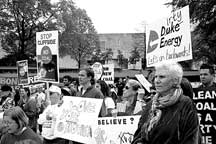
Hundreds of concerned citizens from North Carolina and from surrounding Appalachian states impacted by mountaintop removal marched in protest of Duke’s Cliffside plant expansion on April 20, 2009. Photo by Jamie Goodman.
Thoreau wrote near the end of his life, “if I repent of anything it is likely to be my good behavior.”
At 76, Bruce King, a retiree and military veteran – like Thoreau – was beginning to regret his good behavior.
It was the first formal protest of his life, but on the morning of April 19, King joined more than 200 others who answered the Stop Cliffside Coalition’s “Call to Conscience” in Charlotte, N.C.
The Stop Cliffside Coalition is comprised of 10 environmental and citizen advocacy groups partnering in opposition to the 800-megawatt expansion of Duke Energy’s Cliffside Power Plant in Rutherford County, 50 miles west of Charlotte. The plant’s expansion represents a $2.3 billion dollar investment in coal-fired electricity generation, and it is anticipated that much of the coal used at the plant would come from mountaintop removal mining operations in neighboring Appalachian states. This, in addition to growing concerns about carbon emissions and climate change, air quality and coal combustion waste, has led many North Carolinians to oppose the plant.
The Coalition’s Call declared that “we cannot be silent as Duke poisons our air, destroys the Appalachian Mountains, and fans the flames of climate change for the sake of profit,” and King was not the only one participating who did not fit the typical image of a environmental activist.
Of the hundreds of people gathered for the protest, many were elderly, clergy and regular citizens dressed in their Sunday best.
The peaceful protest, which took place shortly before Earth Day, traveled through downtown Charlotte, stopping at Governor Purdue’s office and finally reaching the Duke Corporate Headquarters.
As the group crossed the street to stand in front of Duke Headquarters, their rallying cries faded. 44 individuals of all ages and professions crossed the line spray-painted on the cement sidewalk to illegally trespass on Duke’s private property. As the rest of the marchers watched, the 44 accepted arrest, one-by-one.
It now stands as the largest arrest total for civil disobedience on climate change in history.
Though King was not one of those arrested, he did feel that this, his first protest in the name of climate change and clean air, would not be his last.
“If I had known this was what protesting was like, I would have done it sooner,” King said.
Related Articles
Latest News
More Stories

Halloween Approaches, and Night School Is in Session
The House of Art in Bluefield, West Virginia, looks like a haunted tower, making it the perfect location for its sixth annual haunt event: Night School. The Night School will be open every Friday and Saturday night through Oct. 31.

‘The Most Perfect Act of Love’
After losing its rural pride celebration, hundreds of people attended the second annual Affirming Sumner Pride celebration on a 24-acre farm dubbed “Fruity Farm” in Bethpage, Sumner County, Tennessee.

Signs of Life
In the Nantahala National Forest, a team of biologists spotted Indiana bats, an endangered species that hasn’t been seen in North Carolina for the last 11 years.

‘First Line of Defense’
During Hurricane Helene and its aftermath, rural fire departments and other first responder hubs played critical roles in keeping their communities safe, even without power and cut off from outside support for days or weeks after the storm. Two years later, plenty of work remains to ensure these hubs have the resources they need to operate day to day and be ready when emergencies or natural disasters strike.

The Rocky Road — and Bridge — to Recovery
Hurricane Helene is estimated to have damaged nearly 7,000 private roads and bridges in Western North Carolina. Two years later, many restoration projects are complete, but the journey hasn’t been easy — and isn’t over for others.

After 20 Years, Letcher County Prison Proposal Is Still Alive, Though Obstacles Remain
A $605 million proposal for a federal prison on a former strip mine site in Letcher County, Kentucky, championed by U.S. Rep. Hal Rogers, refuses to die, despite local opposition, a lack of support from the executive branch and numerous other obstacles.

Leave a comment
Your email address will not be published. Required fields are marked *
Leave a Comment