

Story by Bill Kovarik
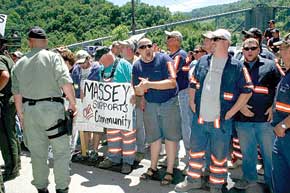
Miners and workers for Massey Energy counter a protest at Marsh Fork Elementary School in West Virgina. One counter-demostrator was arrested for slapping a local environmentalist. Photo by Jamie Goodman
A summer of discontent is rapidly turning into an autumn of confrontation, as Congressional hearings and regional protests increasingly pit environmental activists against coal industry employees.
In one of over a dozen full scale protests this spring and summer, scientist James Hansen and actress Daryl Hannah were arrested in a protest at Marsh Fork elementary school in June. The arrests took place amid a swirl of abusive and threatening commentary from coal miners, and one counter-demonstrator was arrested after she struck Goldman environmental prize winner Judy Bonds.
A few days later, spectators swamped the first formal Congressional hearing on mountaintop removal mining. Testifying that MTR contaminated water so badly that it was impossible to live near the mines. Others testified to “immense and irreversible damage” being done to West Virginia.
Margaret Palmer of the U. of Md also testified: “There is no evidence to date that mitigation actions can compensate for the lost natural resources and ecological functions of the headwater streams that are buried.”
The hearing begins a legislative process to the Clean Water Act to stop the dumping of coal overburden into stream beds. Such a prohibition would effectively stop mountaintop removal mining. Some 155 Congressmen are cosponsoring HR 1310, the Clean Water Protection Act, on the House side, while eight Senators have thus far signed on to cosponsor a companion bill.
A few days after the Congressional hearing, at a family picnic on Kayford Mountain, 20 men and women dressed in coal miners outfits crashed a picnic intending to intimidate environmental advocates. One particularly disturbed man issued a string of direct death threats. A video of the event (“Mountain Madness – Invasion of the coal thugs”) went viral on YouTube in July.
In response, the West Virginia Council of Churches issued a statement warning that “bitter rhetoric and latent violence” needed to be “put aside.”
“We ask leaders to encourage an attitude of understanding toward those with whom one disagrees,” said the Rev. Dennis Sparks, head of the council.
Meanwhile, on the regulatory side, the US EPA will be taking over some water discharge reviews from West Virginia’s state Dept. of Environmental Protection. To highlight the issue, four demonstrators chained themselves to the doors of DEP offices in mid-August, saying the agency was “closed for incompetence.”
Related Articles
Latest News
More Stories

Halloween Approaches, and Night School Is in Session
The House of Art in Bluefield, West Virginia, looks like a haunted tower, making it the perfect location for its sixth annual haunt event: Night School. The Night School will be open every Friday and Saturday night through Oct. 31.

‘The Most Perfect Act of Love’
After losing its rural pride celebration, hundreds of people attended the second annual Affirming Sumner Pride celebration on a 24-acre farm dubbed “Fruity Farm” in Bethpage, Sumner County, Tennessee.

Signs of Life
In the Nantahala National Forest, a team of biologists spotted Indiana bats, an endangered species that hasn’t been seen in North Carolina for the last 11 years.

‘First Line of Defense’
During Hurricane Helene and its aftermath, rural fire departments and other first responder hubs played critical roles in keeping their communities safe, even without power and cut off from outside support for days or weeks after the storm. Two years later, plenty of work remains to ensure these hubs have the resources they need to operate day to day and be ready when emergencies or natural disasters strike.

The Rocky Road — and Bridge — to Recovery
Hurricane Helene is estimated to have damaged nearly 7,000 private roads and bridges in Western North Carolina. Two years later, many restoration projects are complete, but the journey hasn’t been easy — and isn’t over for others.

After 20 Years, Letcher County Prison Proposal Is Still Alive, Though Obstacles Remain
A $605 million proposal for a federal prison on a former strip mine site in Letcher County, Kentucky, championed by U.S. Rep. Hal Rogers, refuses to die, despite local opposition, a lack of support from the executive branch and numerous other obstacles.

Leave a comment
Your email address will not be published. Required fields are marked *
Leave a Comment