
Follow Us on Twitter: Appalachian Voices | iLoveMountains.org

Archive for the ‘2009 – Issue 2 (April/May)’ Category

Article 1

Tuesday, July 21st, 2009 - posted by Appalachian Voices

This is Article 1

The Appalachian Voice – Issue 1 – 2009

Wednesday, July 1st, 2009 - posted by Appalachian Voices

Article 1
Article 2
Article 3
Article 4
Article 5
Article 6

Appalachian Mountains Preservation Act Still on the Table in North Carolina

Friday, April 10th, 2009 - posted by meghan

Story by Sarah Vig

Mountaintop removal is hard to ignore when it’s in your backyard. This is a well-known fact for Bo Webb, whose home on Cherry Pond Mountain lies near an active mountaintop removal mine. In his recent letter to President Obama, asking him to take executive action against the destructive mining practice, Webb painted a picture of how living near a mine site has dramatically impacted his life. “Outside my door,” he wrote, “pulverized rock dust, laden with diesel fuel and ammonium nitrate explosives hovers in the air, along with the residual of heavy metals that once lay dormant underground.”

Yet, in the places where mountaintop removal coal is burned to generate electricity, mountaintop removal is not happening in anyone’s backyard. The connection between flipping on a light switch and the blasting of one of the world’s oldest mountains is one not many consumers make. This year, citizens and legislators are trying to change that.

States connected to mountaintop removal are taking legislative action in an unprecedented way with the Appalachian Mountains Preservation Act (AMPA), a bill that would phase out state electrical utilities’ contracts for mountaintop removal coal. The bill, which was first introduced in the North Carolina House in 2007 by Representative Pricey Harrison (D-57), came back with serious momentum this session; not only was it reintroduced in the North Carolina House with 30 original bi-partisan co-sponsors, Senator Steve Goss (D-45) also introduced a companion bill in the North Carolina Senate. The bill was also introduced in Maryland and Georgia by Rep. Tom Hucker and Rep. Mary Margaret Oliver, respectively.

Since the introduction of the legislation, there has definitely been considerable pushback from coal industry lobbyists. But, according to Appalachian Voices’ North Carolina Field Coordinator Austin Hall, that could be considered one of the greatest victories of the AMPA campaign. “We’ve put utilities in a corner, and made them defend something [mountaintop removal mining] that’s indefensible,” Hall explained.

“I am firmly convinced that mountaintop removal is a moral issue that begs our hearts and minds to do the right thing,” Senator Goss said. “When this bill becomes law in North Carolina, once again we will take our place as a leader in the nation concerning environmental issues.”

Though the bill never made it to the floor in Maryland or Georgia, it is still on the table in North Carolina. A committee hearing on the bill is scheduled for April 15, 2009.

“We are part of the cycle of coal consumption, and we must take responsibility,” observed Representative Oliver, lead sponsor of the Georgia AMPA bill, which also placed a five-year moratorium on the permitting and construction of new coal-fired power plants in the state. “We need to step back and look at how we can do things differently.”

With AMPA, states have the opportunity to lead the way in creating and passing legislation that places the lives, health and safety of its citizens, as well as those of Appalachia, above the desires of coal companies and corporate interests. Or, they can blow it.

For more information on AMPA and how you can show your support, contact Austin Hall at austin@appvoices.org or visit www.ilovemountains.org/state-actions.

Earth Day 2009

Friday, April 10th, 2009 - posted by meghan
This billboard was spotted on the highway heading in to Nashville, Tennessee in March, 2009. The sign was erected by the Tennessee-based Lindquist-Environmental Appalachian Fellowship (LEAF) with help from the Natural Resources Defense Council (NRDC).

This billboard was spotted on the highway heading in to Nashville, Tennessee in March, 2009. The sign was erected by the Tennessee-based Lindquist-Environmental Appalachian Fellowship (LEAF) with help from the Natural Resources Defense Council (NRDC).

Americans celebrated the first nationwide Earth Day 39 years ago, in 1970.

Usually we remember such events when they fall on a decade or a century mark, and of course, next year’s 40th anniversary will be on everyone’s calendar.

It’s important to remember, however, that by this time 40 years ago, a nationwide Earth Day movement was already in the works. Then-Senator Gaylord Nelson had been planning the event since 1963, when he talked President John F. Kennedy into a five-day, 11-state conservation tour. There were offices being staffed and meetings being planned. Things were happening.

They say every overnight success is years, or even decades, in the making. This year, as we celebrate the environmental victories at Blair Mountain, W. Va. or in the EPA permitting process, let’s remember that this has been a painstaking, step-by-step process of researching injustice, arousing public opinion, building coalitions, and trying to compel reform.

Next year, on Earth Day, we hope to be celebrating a major victory with the Clean Water Protection Act, which would ban all mountaintop removal coal mining. There has never been a better time to go forward, but we need to remember what is at stake: Appalachia is rapidly losing its wealth of biodiversity and clean water.

So, yes, it’s a very happy 39th Earth Day. But let’s not recline on a few temporary laurels.

Herculean efforts are needed; every voice is necessary, now more than ever. Saving Appalachia is not going to be easy.

But if we pull together, by next year’s 40th anniversary, we might have a worthy story to tell our grandchildren.

Test Results from TVA Ash Spill Warn of Serious Environmental Impacts

Friday, April 10th, 2009 - posted by meghan

Story by Sarah Vig

A respected team of scientists and water quality experts from North Carolina and Tennessee recently released a report analyzing water, sediment, and fish tissue samples taken near the site of the 1 billion gallon coal ash spill that occurred in Harriman, Tenn. last December. The report’s authors include Upper Watauga Riverkeeper Donna Lisenby, Appalachian State University faculty members Dr. Shea Tuberty and Dr. Carol Babyak, Dr. Anna George of the Tennessee Aquarium, and Wake Forest University professor and widely recognized selenium expert Dr. Dennis Lemly. The report shows a number of serious impacts on the water quality of the river ecosystem.

Lisenby, Tuberty and Babyak were among the first to release independent testing results after the disaster occurred (see our coverage in the Feb/March issue, available online at www.appalachianvoices.org). The data they obtained from their initial samples showed much higher levels of a number of toxic heavy metals than the data being released by TVA, leading them to request permits for further testing and partner with the Tennessee Aquarium for sample collection.

Their second round of testing was much more extensive, and included water sampling at seven sites, sediment collection, and tissue sampling of collected fish. The sample analysis indicates that the effects of the ash spill on water quality and aquatic ecosystems are serious and will probably continue to grow.

The report drew three major conclusions from each of their sample categories. First, they found several heavy metals–arsenic, barium, cadmium, chromium, copper, nickel, lead, selenium and thallium–in the water in concentrations that exceed protective drinking water standards and/or criteria levels for aquatic life.

Second, electron scanning microscope images of the cenospheres (pictured above)–floating coal ash particles, which TVA has insisted are “harmless”–show a layer of what the report calls “secondary mineralization gel coating” encasing the particle; this hardened outer layer contains arsenic levels equivalent to 20,000 to 30,000 parts per million.

Finally, in their analysis of fish tissue they found elevated levels of selenium, a dangerous heavy metal responsible for birth defects and stunted development in aquatic life. According to the report, “the aquatic life in the river may be on the threshold of a toxic event.” This result is especially striking, as the samples were taken before the full window for bio-accumulation (typically 30 days after introduction) had passed, meaning that as selenium levels in the water rise due to the massive introduction of coal fly ash, the river ecosystem may cross the toxic threshold and see much more drastic changes as the metal bio-accumulates up the food chain.

The effects on aquatic life were also apparent in the team’s harrowing observations from on the water. They found fishes’ gills clogged with ash, and upon dissection found that ash had clogged the entire digestive system. One specimen cited in the report had so much ash in its system that ash comprised 7.7 percent of its body weight.

Information from the report has already been used in testimony from Renee Hoyos of Tennessee Clean Water Network during the March 31 hearing on the issue in front of the U.S. House Water Resources subcommittee. The report proves the need for ongoing study of and attention to the impacts of the disastrous spill.

6th Annual Dine Out for the Mountains

Friday, April 10th, 2009 - posted by meghan

April 22 Earth Day event to benefit Appalachian Voices

If troubled economic times have meant cutting back on your charitable giving or if you’ve been looking for a good reason to go out to eat, Dine Out for the Mountains has come to the rescue.

On Wednesday, April 22, a number of restaurants in the High Country of western North Carolina will donate a portion of the day’s proceeds to Appalachian Voices in celebration of Earth Day and the organization’s work to protect the region’s beautiful Appalachian Mountains. You can support Appalachian Voices and our efforts to safeguard the mountains by Dining Out at one of the following restaurants:

    Black Cat Burrito (Boone)
    Boone Bagelry (Boone)
    Canyons (Blowing Rock)
    CiCi’s Pizza (Boone)
    Coyote Kitchen (Boone)
    Dos Amigos (Boone)
    The Gamekeeper (Blowing Rock)*
    Joe’s Italian Kitchen (Boone)
    Makoto’s (Boone)
    Mellow Mushroom (Boone/Blowing Rock)
    Murphy’s (Boone)
    Our Daily Bread (Boone)
    Pepper’s (Boone)
    Red Onion Café (Boone)
    Reid’s Café (Boone)
    Six Pence Pub (Blowing Rock)
    Woodland’s Barbeque (Blowing Rock)

For more information, visit our website at www.appalachianvoices.org or call 828-262-1500.

Citizen Lobby Effort Wins Cosponsors for Clean Water Protection Act

Friday, April 10th, 2009 - posted by meghan

Week in Washington Results In New Sponsors For H.R. 1310

Story by Sarah Vig
In the largest lobby effort to end mountaintop removal to date, nearly 150 people from 30 states joined forces in Washington, D.C. March 16 through 19 for the fourth annual End Mountaintop Removal Week in Washington.

Their goal was to gain support for the Clean Water Protection Act (H.R. 1310) in Congress. The Clean Water Protection Act would effectively end mountaintop removal mining by making valley fills illegal and thereby preventing toxic mountaintop removal mining waste from being dumped into mountain headwater streams.

Organized by the Alliance for Appalachia, the lobby week brought together impacted coalfield residents, activists, and concerned citizens both from Appalachia and beyond. Their combined efforts brought on 10 new co-sponsors to the bill: Rep. Yvette Clark (D-NY), Rep. Michael McMahon (D-NY), Rep. G.K. Butterfield (D-NC), Rep. Paul Tonko (D-NY), Rep. Walt Minnick (D-ID), Rep. John Spratt (D-SC), Rep. Maxine Waters (D-CA), Rep. Linda Sanchez (D-CA), Rep. Jesse Jackson (D-IL) and Rep. Kathy Castor (D-FL). With these new co-sponsors, H.R. 1310 ended the lobby week with 133 bi-partisan co-sponsors after less than two months of recruiting in the 111th Congress.

Among the 133 are: eight bipartisan members from states in which mountaintop removal mining occurs; 19 bipartisan members of the Transportation and Infrastructure Committee, which will hear the bill before it can go to the floor; 11 bipartisan members of the Subcommittee on Water Resources and the Environment, which will hear the bill before it goes to the larger committee; six Republicans; eight freshmen; 26 members of the Congressional Black Caucus.

Over the course of three days, citizen lobbyists held over 150 meetings with members of Congress and their staffs. Overall, the group met with more than one-fourth of the House and one-third of the Senate.
In addition, a nation-wide call-in campaign generated hundreds of calls to legislative offices urging their support of the Clean Water Protection Act.

How You Can Help
As we go to press on April 6, 2009, support for the Clean Water Protection in Congress has grown to 141 cosponsors. To keep track of the ever-expanding list of co-sponsors or to contact your representative about supporting the Clean Water Protection Act, go to www.ilovemountains.org/action/write_your_rep.

Film Explores Appalachia’s Environment

Friday, April 10th, 2009 - posted by meghan

Story by Linda Coutant

A new film about the Appalachia region underscores a universal truth Western Civilization seems to struggle remembering: humanity is part of the environment, not separate from it.

Appalachia: A History of Mountains and People airs on PBS four consecutive Thursdays beginning April 9. Produced by award-winning filmmakers Jamie Ross and Ross Spears and narrated by Academy Award-winner Sissy Spacek, this four-hour series is considered the first-ever environmental history film.

The filmmaking duo of Ross and Spears spent 10 years on this documentary, which explores the intersection of natural history and human history in a biologically rich, diverse and beautiful mountain region. Its four parts focus on Appalachia’s geological formation, clash of European and Native cultures, industrial age and the search for identity in the 20th and early 21st centuries.

Interviews include Pulitzer Prize-winning biologist E.O. Wilson, best-selling novelist Barbara Kingsolver, the late writer Wilma Dykeman, historian Ron Eller of the University of Kentucky and anthropologist Harvard Ayers of Appalachian State University.

More untruths are known about Appalachia than any other region in the United States, explains Ross, which is why she, a longtime Asheville, NC resident, and her filmmaking partner Spears, who grew up in Johnson City, Tenn., felt a new look at the mountains was needed.

In their storytelling, they make the mountains a central character, rather than a natural backdrop.
“I was constantly excited and flabbergasted to learn of the extraordinary diversity of life in this region: There are more species of salamanders in the Smoky Mountains than any other part of the world,” said Spears.

“For environmental change, we need to include the environmental part of the story. Our hope is that viewers of our film will look around – wherever they live – and become more aware of their surroundings and develop a conversation about what we can do to protect our natural resources,” Ross said.

Visit the films’ website www.appalachiafilm.org for details.

Scientists Describe Champion Trees of Virginia
Friday, April 10th, 2009 - posted by meghan

Story by Maureen Halsema

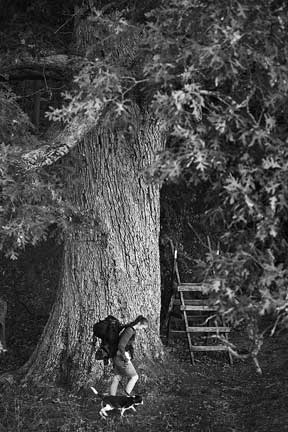
Photo by Craig Keffer Oak

As I scrambled down the hill along the Appalachian Trail in Craig County, I could see gargantuan branches protruding in every direction. I realized that I had found the Keffer Oak.

The massive branches spiraled around this centuries-old tree trunk covered with moss and snow. I stepped over a section of a rusted barbed wired fence, noticing sections that had been absorbed by the trunk of this impressive life force. It was bigger than I had imagined.

I craned my neck, staring up into the branches of this fantastical tree that seemed like it had been drawn from a storybook. The gnarly white oak is estimated to be 300 years old and over 18 feet in circumference. It’s one of the largest standing trees on the AT, the faded white blaze barely visible on the old bark.
“It serves as a sturdy representation of Virginia for all the thru-hikers who pass by on the trail each year,” Virginia Tech forestry professor Jeff Kirwan wrote in a new book, Remarkable Trees of Virginia.

Kirwan teamed up with garden writer and lecturer Nancy Ross Hugo and photographer Robert Llewellyn to write this book to showcase the state’s most special trees and to connect a new generation to its roots.

The trio published the book of nominated trees in September after four years of work. The Virginia Big Tree Program, funded by Trees Virginia (the state’s urban forestry council) and coordinated by Kirwan, provided the foundation from which the authors worked.

The program continually identifies and catalogs the state’s largest trees. These “champion trees” are determined by a formula using the tree’s circumference, height, and crown. When Kirwan first decided to update the state’s list of champion trees several years ago, he expected to find as many as 30 percent of the listed trees perished or gone. To his dismay, over half of the original 52 trees identified by the program were dead or severely injured. Sadly, approximately 25 percent of the landowners were not aware that they had champion trees on their property. 

Virginia’s diversity among species of trees has traditionally ranked high in the national register of trees.
According to American Forests, which publishes the National Register of Big Trees, Virginia ranks fifth in the nation for champion trees. The state is home to 56 national champion trees, the largest of their species.

The Virginia Big Tree Program provided a starting point for the Remarkable Trees of Virginia book project. The authors hope that the book will help increase awareness and appreciation for trees, particularly within local communities. “We’re trying to emphasize the values of trees and the services they provide,” Kirwan said.

“Trees, to me, are the highest and best representations of nature,” Hugo explained. “I’m fascinated by them. After we looked at the Virginia Big Tree Program register, we envisioned a book that would not only unveil champion trees, but would also honor trees that were noteworthy for their age, beauty, history and community significance.”

The book project was sponsored by Virginia Tech’s forestry and fisheries and wildlife sciences departments, Virginia Forestry Education Foundation, Bartlett Tree Experts, Robert H. Smith Family Foundation, Peck Family Fund, and Trees Virginia.

Kirwan grew up in a rural section of Maryland that has since lost its trees to the growing metropolitan areas of southeast Washington, D.C. This urbanization of forestland made him realize the true value of trees. “Trees connect us with our roots,” Kirwan said. “Trees that are 300 or 400 years old have been witnesses to every single event of our country’s history.”

Four different people nominated one particular tree, the Emancipation Oak. Though it is not the largest of its kind, this remarkable tree resides on the campus of Hampton University. The Emancipation Proclamation was read for the first time in the South under this noteworthy oak by educator Mary Peake in 1863. Peake later taught some of the first lessons to newly freed men and women beneath this same tree. The National Geographic Society designated this oak as one of the 10 Great Trees of the World because it is witness to one of the most significant moments in our nation’s history.

The Remarkable Trees of Virginia book, as well as the project’s website, lists every nominated tree and the person who nominated it, regardless of whether or not that tree made the book cut. A major focus of the book project was to incorporate children in the nomination process. The authors involved scout troops, 4-H groups and schools.

“The project encouraged children to connect not just to trees in general but to specific trees,” Hugo said. “We wanted them to look carefully at the trees in their neighborhoods, so that they would begin to feel connected to specific trees and their habitats, not just to anonymous nature.”

Over 1,000 Virginia trees were nominated for possible inclusion in the book, which will feature the stories and photographs of 100 of Virginia’s most special trees. “We have chapters of big trees, historic trees, community trees, tree places, unique or unusual trees, and noteworthy specimens,” Kirwan noted.

Historic Blair Mountain Battlefield Wins Recognition
Friday, April 10th, 2009 - posted by meghan

Organizers Hope Register Status Will Help Protect The Mountain

Story by Peter Slavin

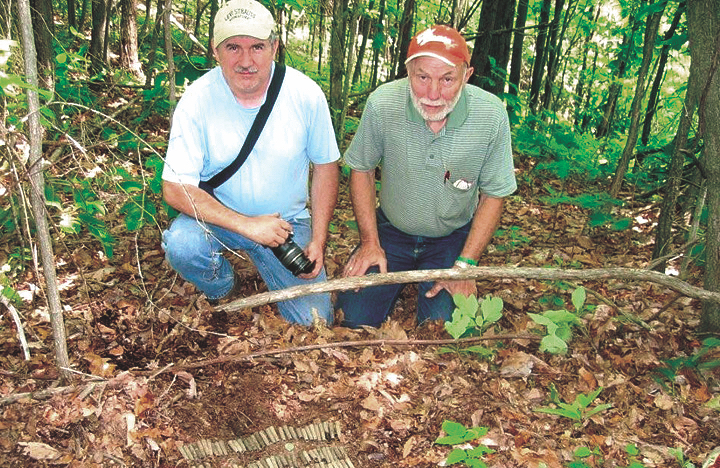
Kenny King and Appalachian Voices founder Harvard Ayers survey over one hundred rifle casings found in a one-foot diameter area along Spruce Fork Ridge on Blair Mountain. The archeological finds helped convince the Park Service to put the area on the Historic Register

The nearly 30-year struggle for federal recognition of the Blair Mountain battlefield in West Virginia, scene of an epic military clash in 1921 between thousands of armed union miners and the coal establishment, climaxed on March 30 with its placement on the National Register of Historic Places. The announcement by the

National Park Service rewarded a tireless campaign by local residents, environmentalists and others. Last year, West Virginia’s historic preservation office finally nominated the battlefield to the register and the Park Service agreed it warranted special status.

The decision, which protects just the 1,600 acre battlefield, not the entire mountain, does not—contrary to widespread belief– guarantee protection of the site. Listing on the register “will not in and of itself prevent further strip mining on the mountain,” says historian Barbara Rasmussen, who chairs the West Virginia Preservation Alliance’s task force on Blair Mountain.

Property owners remain largely free to do as they please with land on the register, including mine it. Still, Rasmussen says, strip mining would require a federal permit, triggering a review of its impact on the battlefield. In addition, federal agencies would feel political pressure to protect the site. That probably makes strip mining less likely. Still, Rasmussen warns, there’s no telling whether it will occur.

Blair Mountain in Logan County was the scene of a violent encounter between upwards of 20,000 union miners and civilian supporters bent on unionizing exploited miners and state and local authorities backing the coal operators. The undeclared civil war, known as the Battle of Blair Mountain, lasted for close to a week until federal troops were called in and declared martial law. Total casualties were never revealed.

“National Register designation is a vitally important step in the preservation of Blair Mountain, a site we listed as one of America’s 11 Most Endangered Historic Places in 2006,” said Richard Moe, president of the National Trust for Historic Preservation. “Nevertheless, the threat of coal mining activity at Blair Mountain remains present, and we will continue to vigorously oppose mining efforts at the site.”

To Rasmussen, “This battlefield memorializes the beginning of a long struggle to bring the benefits of unionization to America’s working people.” Despite the standoff at Blair Mountain, in the 1930s, organizing spread among coal miners. The United Mineworkers, in turn, helped organize steelworkers and autoworkers into their own unions.

Wess Harris, publisher of the groundbreaking history of the battle When Miners March: The Story of Coal Miners in West Virginia, believes Barack Obama’s election helps explain the government’s decision. With the Bush administration gone, he said, federal officials could make a decision free of political interference. Bill Price, a Sierra Club official, agreed that five years ago the betting would have been against Blair Mountain being listed.

Earlier efforts to memorialize the battlefield foundered at the state level, owing to coal company opposition and lack of unimpeachable archaeological evidence of the battle. Even from the UMW union there was largely deafening silence about Blair Mountain. The mountain is estimated to harbor hundreds of millions of dollars worth of coal, and every ton mined means tax dollars for the state treasury and the union’s pension fund. There already has been mountaintop removal mining on part of the mountain.

For years, the position of coal companies was that few vestiges of the battlefield remained, so why memorialize it? That argument and the archaeological one were demolished three years ago, when professional archaeologist Harvard Ayers documented the presence of 15 different battle sites, trenches strung with telephone wire, and over 1,000 artifacts, including 26 kinds of rifles, shotguns, and pistols.

Perhaps more than anyone else, credit for federal intervention to preserve the battlefield belongs to Kenny King of Logan County, whose grandfather and great uncle fought on opposing sides of the battle. King relentlessly dug up artifacts buried on the battlefield, and for a decade waged a lonely struggle to save it, jeopardizing his coal company job in the process. At one point he brought over 200 photos of battle sites and artifacts to state officials, but they were dismissed because he was only an amateur archaeologist.

Eventually, a loose alliance of environmental groups called Friends of the Mountains stepped in to help King with mapping, aerial photographs, and a historical narrative. That got the ball rolling.

Still, the fight over preserving Blair Mountain may not be over. Supporters are on guard. King says the other side is talking to landowners on the mountain. Price believes the coal industry is doing so in preparation for trying to overturn the government’s decision through litigation. If they do, he said, the Sierra Club will join the legal battle.

Price added, “We have always said to the company, ‘We are not trying to keep you from your coal. If you want to mine it underground…then we’ll work with you on that. But you can’t blow up the mountain.’”

That way, he says, “They’d get their coal and we’d get our history.”

For a complete story on the history of Blair Mountain, visit www.appvoices.org/blairmountain.