

Story by Derek Speranza
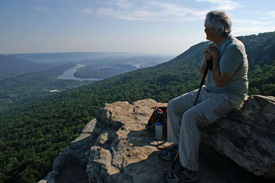
The Great Eastern Trail will eventuall span from Alabama to the Fingerlakes Trail in New York. Above, looking off Sunset Rock in Tennessee.
It is only fitting that poet Robert Frost took “the road less traveled by” in his poetry collection entitled Mountain Interval – and now long distance hikers everywhere have a new opportunity to do exactly that.
The Great Eastern Trail is to be a 2,000-mile alternative to the well-worn Appalachian Trail, and it’s growing toward that goal everyday. Volunteers on the GET project are taking a series of existing trails that run parallel to the AT and creating one contiguous route from Alabama to New York.
Becky Morris, West Virginia coordinator for the GET, is working hard to fill in the gaps of the trail, the largest of which are in West Virginia and Alabama.
“In expanding the trail I have to consult with delegates about current and future legislation, work with parks and wildlife management to see which trails will work, and all that good stuff,” said Morris.
She also helped create a hiking club to support the creation of the trail in West Virginia. The newly formed TuGuNu club (a portmanteau of the Tug (Tu), Guyandotte (Gu), and the New (Nu) Rivers) has received a positive response from the community.
“[For the first meeting] we had 40 people show up, and in a town of 800 I’d say that’s great participation.”
The GET is not just another version of the AT – it is unique and exciting because a large part of it is new territory to explore, and it will be completely free of motorized vehicles for the entire length of the trail.
“Our biggest goal is to have people going out and walking, getting physical and healthy,” said Morris, “as opposed to riding ATVs or sitting in front of the TV.”
While a large part of the GET is meant to be hiked, some places will include mountain bike and equestrian trails. Morris also intends to make some sections of the trail wheelchair accessible, because, as she said, “Anyone who wants to get on the trail should be able to.”
According to the GET Association, between 70 and 80 percent of the trail is complete and connected, and the project is well on its way to making the dreams of hikers everywhere come true.
“I guess the biggest thing we want people to know is that it’s an alternative, 2000-mile, challenging trail of beautiful wilderness,” said Morris.
So if you’re out hiking and two roads diverge in a yellow wood, the Great Eastern Trail looks like your best bet.
For more info, contact Becky Morris at [email protected], 304-732-6707, or visit www.greateasterntrail.net.
Related Articles
Latest News
More Stories

Neighbors Help Neighbors
A photo essay that celebrates the volunteer spirit of the grassroots group Hurricane Helene WNC and speaks to the resourcefulness, collaboration and hard work embodied by thousands and thousands of volunteers, first responders and aid workers across the region after Hurricane Helene.

Halloween Approaches, and Night School Is in Session
The House of Art in Bluefield, West Virginia, looks like a haunted tower, making it the perfect location for its sixth annual haunt event: Night School. The Night School will be open every Friday and Saturday night through Oct. 31.

‘The Most Perfect Act of Love’
Hundreds of people attended the second annual Affirming Sumner Pride celebration on a 24-acre farm dubbed “Fruity Farm” in Bethpage, Sumner County, Tennessee.

Signs of Life: Endangered Bats Found in Nantahala for First Time in More Than a Decade
In the Nantahala National Forest, a team of biologists spotted Indiana bats, an endangered species that hasn’t been seen in North Carolina for the last 11 years.

‘First Line of Defense’
During Hurricane Helene and its aftermath, rural fire departments and other first responder hubs played critical roles in keeping their communities safe, even without power and cut off from outside support for days or weeks after the storm. Two years later, plenty of work remains to ensure these hubs have the resources they need to operate day to day and be ready when emergencies or natural disasters strike.

The Rocky Road — and Bridge — to Recovery
Hurricane Helene is estimated to have damaged nearly 7,000 private roads and bridges in Western North Carolina. Two years later, many restoration projects are complete, but the journey hasn’t been easy — and isn’t over for others.

Leave a comment
Your email address will not be published. Required fields are marked *
Leave a Comment