Coal miners travel to D.C. to advocate for black lung protections and benefits
FOR IMMEDIATE RELEASE
October 1, 2026
CONTACT
Molly Moore, Appalachian Voices Communications, (828) 278-4076, [email protected]
Trey Pollard, Pollard Communications, LLC, (202) 904-9187, [email protected]
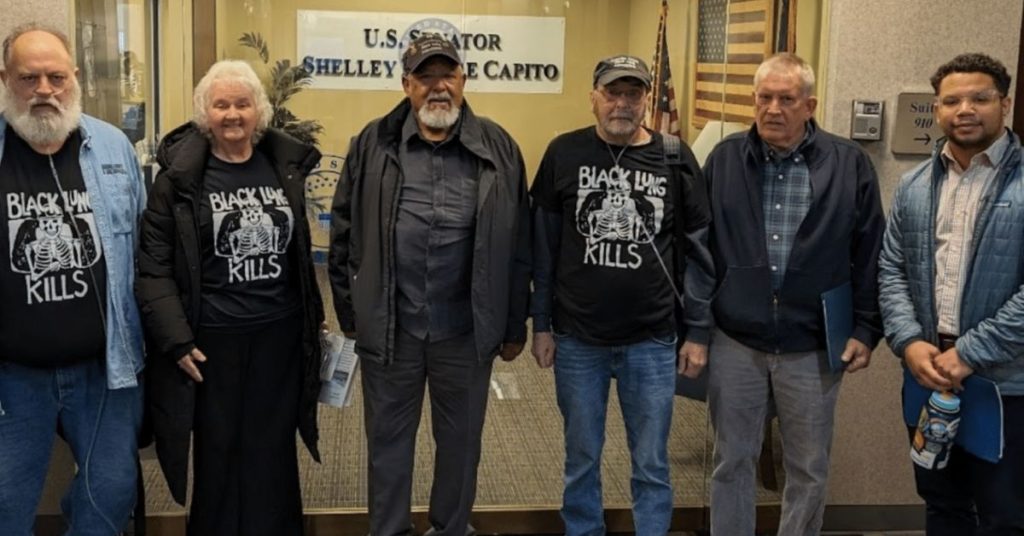
WASHINGTON, D.C. — Coal miners, their families and medical professionals from Kentucky, Pennsylvania, Virginia and West Virginia gathered in the nation’s capitol yesterday to meet with senators and representatives to advocate for improving black lung benefits and protections.
The group, which also included the surviving relatives of miners who died from black lung, urged senators and representatives to pass the Support Our Miners Act, which would increase black lung disability benefit payments and make sure future payments keep up with inflation. They also stressed the importance of protecting miners from silica dust exposure by implementing the 2024 silica dust rule intended to curb the rise of black lung disease. That rule would have limited miners’ exposure to silica dust to 50 mg per cubic meter of air, which is currently the legal standard for all other industries. But the Trump-Vance administration has delayed implementation of the rule for more than a year and is now drafting a new version.
Yesterday afternoon, black lung doctors, clinic professionals, and an attorney also participated in a forum hosted by Sen. Tim Kaine, D-Va., and attended by Sen. Mark Warner, D-Va. The forum speakers addressed the causes and extent of the worsening black lung epidemic in Central Appalachia, as well as the impact it is having on families and communities. They also spoke about the difficulty coal miners and their families have accessing the black lung disability benefits promised to them in federal law once a miner is diagnosed with black lung.
Comments from the forum:
“This notion that there’s been a standard for everybody else but not a standard for those who mine is an outrage,” Kaine said. “The fact that there now is a standard but industry is fighting against it is an outrage. We gotta do what we can to make sure that that standard sticks. I’m just here to tell you briefly that we can do it. We are going to succeed; we’re going to get this standard in place.”
“Over the last number of years I have heard the stories, I’ve seen the toll [black lung] has taken on miners across the Commonwealth of Virginia,” Warner said. “In 2026 in America, people shouldn’t be exposed to these unsafe working conditions where we see not simply miners in their 50s or 60s getting black lung, but miners in their 40s or 30s. You can’t be pro-mining if you’re not pro-miner.”
“There are more patients who have silica-induced lung disease now than in the past,” said Dr. Drew Harris, Assistant Dean of Continuous Education at the University of Virginia School of Medicine and the Medical Director at Stone Mountain Health Services. “This is a problem that is settled. We know the science behind it, we know what’s causing this disease, we just now need to act on it.. There is no reason why coal miners should be allowed to be exposed to more silica dust than every other industry. We know this disease is resurgent, it is more severe, we know why it’s happening. We don’t need more science about it, we need the will to act.”
“A clear and repeated pattern in all of the data is that Appalachian miners have higher rates and more severe coal mine dust disease,” said Lisa Emery, Respiratory Therapist and Director at the New River Health Breathing Center in West Virginia, and Chair of the National Coalition of Black Lung and Respiratory Disease Clinics. “Miners with severe disease are younger and were more likely to have worked in small mines. The scarring in these miners’ lungs is terrible.”
“Coal miners are due. The widows are due,” said Heith Reynolds, Personal Injury Attorney at Mark Hurt Law Firm. “And it’s time that those who are in power to act step up and protect them.”
What they’re saying: Coal miners and their advocates in Washington, D.C.:
“We’re in D.C. this week to make sure Congress knows that black lung is killing our brothers and sisters, and enough is enough,” said Gary Hairston, former coal miner with black lung disease from Beckley, West Virginia. “Miners need immediate protections from silica and coal dust, and coal families deserve a fair black lung disability payment that addresses the rising cost of living.”
“I’m here to try to help these people understand what we’re talking about,” said Thomas Edwards, former coal miner with black lung disease from Big Stone Gap, Virginia. “People in Congress are from an area totally the opposite of where we’re from. If you wanted a living wage, you worked for a coal company or around a coal company. Now I’ve got black lung and I’m paying that price. In the coal industry, all the easy coal is mostly gone. Now they’re going in and they’re getting the smaller seams of coal and they have to cut the rocks just to get the coal. So they’re being exposed to a lot more dust and silica than they were years ago, and now, at a younger age, they’re becoming more disabled.”
“I’m here to fight for our coal miners,” said Monica Glagola, respiratory therapist for Lungs at Work clinic in Washington County, Pennsylvania. “They need somebody on their side to navigate the medical and the legal part of the process of applying for federal black lung benefits. Those benefits are not adequate. It’s a very small amount that has not increased in years as the cost of living has increased”
“We come to D.C. to support all the miners with black lung. We’re fighting for you,” said William McCool, former coal miner with black lung disease from Letcher County, Kentucky. “Anything that we can get done up here and get someone to help us, we’d be far better off.”
“We not only come up here for the coal miners — and they need a lot of help since everything’s gone a little bit backwards the last couple of years,” said Cheryl Banks, wife of a former coal miner with black lung disease from Letcher County, Kentucky. “But also we’re up here for the miners’ wives and widows. We’re down here to show people that we care and we’re working for them.”
Photos of miners and their supporters at the Capitol are available upon request.
About the Support Our Miners Act
The Support Our Miners Act will adjust the black lung disability payment to account for five decades of inadequate increases. This bill would benefit more than 25,000 members of mining families across nearly all states.
The monthly disability benefit that miners with black lung receive hasn’t kept pace with inflation since the Black Lung Program was first established in 1970, according to a report from Appalachian Citizens’ Law Center and Appalachian Voices. Currently, a single miner is eligible for just $794 monthly, about two-thirds what that miner would have received in 1970, adjusted for inflation. Because the disability stipend is tied to federal employee pay rates, the benefit has fallen behind the cost of living. The bill would ensure that benefits are automatically adjusted for inflation each year going forward.
Increasing miner black lung disability benefits has broad support. More than 80 local governments from across Appalachian coal communities have passed local resolutions in support of this policy change. Further, a May 2026 report from the Government Accountability Office found that black lung beneficiaries reported the need for a benefit increase. The report projects that many miners reliant on black lung benefits are living on incomes that are below federal poverty levels or incomes well below the salaries they formerly earned.
About the Silica Dust Rule
In April 2024, after decades of federal research and advocacy from coal miners, their doctors and their loved ones, the Mine Safety and Health Administration finalized a rule to protect coal and other miners from silica dust. It was supposed to go into effect in April 2025. The 2024 rule lowers the “permissible exposure limit” for respirable crystalline silica to 50 micrograms per cubic meter of air — lowered from 100 micrograms per cubic meter of air. The new limit matches the limit set for all other occupations by the Occupational Health and Safety Administration more than a decade ago.
The mining industry immediately sued to challenge the new silica exposure rule. The Biden-Harris administration began defending the protections for miners in court, but when the Trump-Vance administration took office in 2025, it voluntarily paused enforcement of the rule and indicated it would stop defending the rule in court. The Trump-Vance administration is bowing to the industry demands and working on a new rule, which they have yet to release.