
Front Porch Blog
Inside recent efforts to cut the public out of government decision-making and weaken NEPA

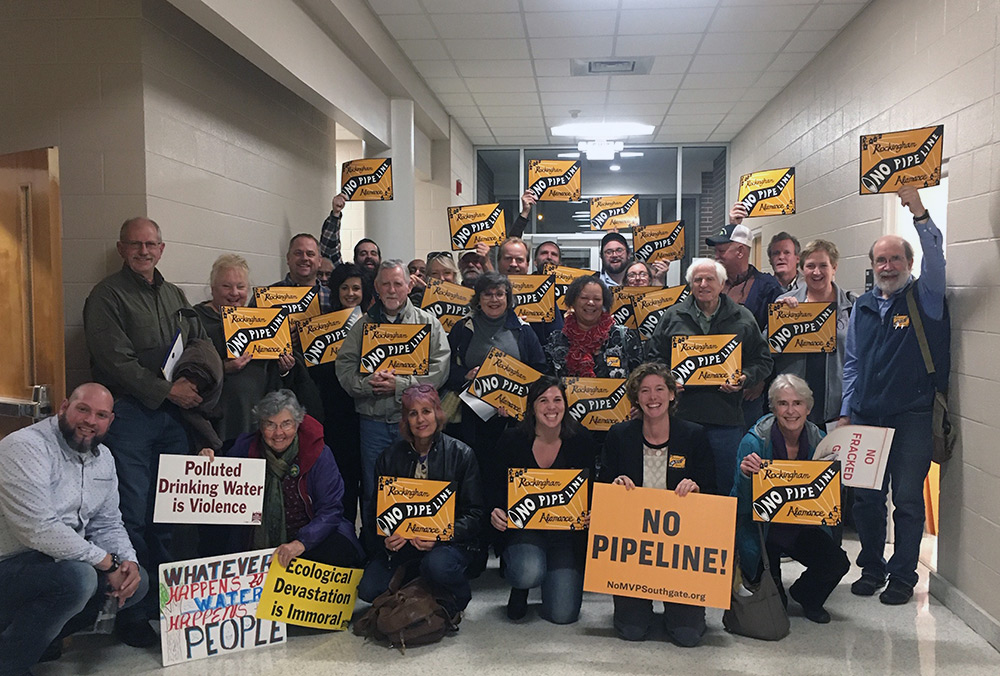
Residents pack the room at a 2018 North Carolina Department of Environmental Quality public meeting about coal ash cleanup at Duke Energy’s Buck Steam Station.
For decades, people across the political spectrum have talked about building infrastructure more quickly by changing regulations and the permitting process. But politicians often disagree about how to accomplish this goal.
Many proposals aim to speed up permitting by changing the National Environmental Policy Act. But in recent years, all three branches of government have already made changes to the law and how it is implemented — in some cases, drastically cutting the public’s role and making changes that favor industry over environmental protection. Now, Congress is considering more changes to NEPA through “permitting reform” legislation. Here, we explore:
(1) what NEPA is and why it matters,
(2) what changes have already been made to NEPA,
(3) what new changes have been proposed, and
(4) what action you can take to support NEPA and continued public participation in government decision-making.
What is NEPA and why does it matter?
The National Environmental Policy Act is a bedrock environmental law that Congress passed with overwhelming bipartisan support more than 50 years ago. NEPA requires federal agencies to consider the environmental impacts and related socioeconomic impacts — such as impacts to water quality, species habitats, traffic patterns, or local businesses — of proposed major federal actions that significantly affect the environment. Major federal actions typically include any actions carried out by federal agencies, as well as projects receiving federal permits or federal funding. Agencies must also consider a reasonable range of alternatives to the proposed project that would help to mitigate any identified environmental or socioeconomic impacts.
NEPA has long been an important tool that members of the public have used to hold the government accountable, lessen the negative impacts of major infrastructure projects and ensure that people directly impacted by a project have a say in what happens in their communities. While agencies are not required to choose the project alternative with the smallest impacts, the process of looking into project alternatives and hearing from a variety of stakeholders often results in a better project, with fewer harmful effects and more community support.

What changes have been made to NEPA in recent years?
In recent years, all three branches of government have made significant changes to NEPA and its implementation.
Cutting time limits and page limits, expanding exclusions: In June 2023, President Joe Biden signed the Fiscal Responsibility Act into law — a bill that averted defaulting on the nation’s debt, and included a provision greenlighting the Mountain Valley Pipeline by exempting it from normal processes and judicial review. It also implemented page limits and time limits for environmental documents prepared under NEPA, and it expanded the use of categorical exclusions — projects that are exempt from NEPA review because they have minimal impacts. These changes to NEPA were supported by members of both parties and were intended to help speed up the permitting process.
Cutting 40+ years of regulations: In November 2024, the D.C. Circuit Court of Appeals issued a ruling in a case called Marin Audubon Society v. Federal Aviation Administration, which held that the White House Council on Environmental Quality did not have the authority to issue NEPA regulations and that these regulations were therefore unenforceable. CEQ had been ordered to issue those regulations in 1977, when President Jimmy Carter signed Executive Order 11991, and those regulations had served as the framework upon which other agencies based their NEPA regulations ever since.
On Jan. 20, 2025, President Trump signed Executive Order 14154, which repealed President Carter’s executive order and directed CEQ to eliminate its NEPA regulations. On Feb. 3, the U.S. District Court for the District of North Dakota decided a case (Iowa v. CEQ) that reiterated CEQ lacked statutory authority to issue NEPA regulations. Later that month, CEQ removed all of its NEPA regulations and replaced them with non-binding guidance. CEQ also directed all federal agencies to revise their NEPA procedures within one year to bring those procedures into compliance with the Fiscal Responsibility Act and Executive Order 14154.
In response to the changes in the law and the CEQ directive, many agencies (including the Department of the Interior, Department of Energy, Department of Transportation, Department of Agriculture, Federal Energy Regulatory Commission, Forest Service, Army Corps of Engineers, Federal Emergency Management Agency and Economic Development Administration) have proposed or finalized changes to their NEPA procedures. Examples of some of the changes made by agencies include:
- Shortening public comment periods for some projects, while eliminating public comment periods for other projects altogether
- Requiring consideration of only the most direct and immediate environmental impacts, not impacts that are more removed in time or geography, such as the long-term impacts of climate change, or downstream impacts like acid mine drainage
- Allowing project applicants to draft their own environmental review documents, rather than the agency preparing these documents, creating serious conflict of interest and integrity concerns
- Requiring consideration of only the environmental costs and not the environmental benefits of choosing not to proceed with a project
These changes have dramatically weakened environmental protections for communities and natural areas across the country. And we are only just beginning to feel the effects of these changes, which could harm waterways, wildlife and public health for decades to come.

What new changes has Congress proposed?
Members of Congress have proposed multiple bills this legislative session that would make additional changes to NEPA. One of the most notable of these bills is the SPEED Act, which passed the House last year and could be considered by the Senate.
The SPEED Act would make a number of significant changes to NEPA, including limiting the ability of members of the public to participate in agency decision-making when new infrastructure projects are proposed. For example, the bill would limit the responsibility of agencies to consider new scientific information that becomes publicly available after a project application has been filed. In other words, agencies could ignore the latest scientific research when deciding how to proceed with a project, even if that research was sent to the agency via public comment.
The bill would also make it harder for impacted stakeholders to sue a federal agency for failing to comply with NEPA — shortening the window of time for bringing a lawsuit from six years to 150 days and requiring those stakeholders to have submitted a unique comment that specifically addressed the issue upon which their challenge is based. These changes will make it especially difficult for communities with limited legal resources to challenge nearby projects, because they may not become aware of a project until after the public comment window has closed, and even when they do, it often takes more than 150 days for a community to understand the potential impacts of a project and obtain legal representation.

These proposed changes are particularly concerning in light of the recent agency changes to NEPA procedures, which have already weakened the law’s environmental and community protections. While the stated goal of bills like the SPEED Act is to speed up permit approvals to allow infrastructure to be built more quickly, the proposed changes are unlikely to have this effect.
First, many of the proposed changes focus on restricting the ability of residents, businesses, local governments or public interest groups to legally challenge NEPA decisions, but less than one-quarter of 1% of NEPA projects are litigated. This doesn’t speed up projects — it just shelters the federal government from accountability. Additionally, the bill would restrict opportunities for public engagement, despite the fact that projects with greater public engagement are typically permitted more quickly since community concerns can be more easily addressed.
If members of Congress really want to speed up project permitting, they should instead encourage more robust public engagement. They should also ensure that federal government agencies responsible for NEPA permitting have sufficient staffing and funding to carry out environmental reviews in a timely manner.
What can you do?
Members of the Senate are actively negotiating on permitting reform legislation. They are considering significant changes to NEPA that would limit opportunities for public participation in government decision-making. Tell your senators to vote “NO” on any permitting reform bills that take away community voices!

PREVIOUS
NEXT

Leave a comment
Your email address will not be published. Required fields are marked *
Leave a Comment