Front Porch Blog
Our air and water are under attack

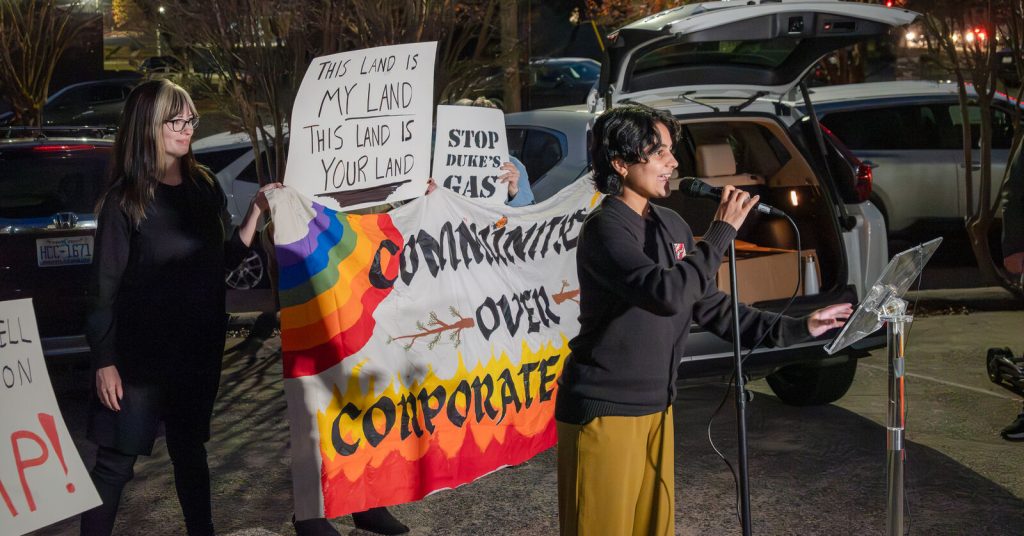
Juhi Modi, North Carolina field coordinator at Appalachian Voices, speaks at the SSEP air permit hearing press conference on Nov. 19. Photo by Jimmy Davidson/Appalachian Voices
For decades, environmental laws like the Clean Water Act and Clean Air Act have helped to ensure that our water is safe to drink and our air is safe to breathe. But we can’t take this for granted. These fundamental environmental protections are currently under attack. Proposed rules and legislation would make our air and water dirtier, leading to more health problems and increased healthcare costs.
Attacks on clean water
Historically, our nation’s waterways served as dumping grounds for everything from raw sewage to industrial chemicals. That all changed in 1972 when Congress passed the Clean Water Act. The CWA requires polluters to obtain permits in order to discharge pollutants into “navigable waters,” which are defined as “waters of the United States,” and the law requires states to develop plans for cleaning up already polluted waterways.
Taking protections away from wetlands and streams: Last year, the EPA proposed a new definition of “waters of the United States” that would eliminate protections for a significant portion of our nation’s wetlands and streams. Of particular concern for Appalachia, small headwater streams that do not flow year-round would no longer be federally protected, meaning that, without strong state or local protections, anyone could dump pollutants into these waterways or fill them in. Since headwater streams flow into downstream waterways, pollutants can make their way into rivers and lakes that people rely on for drinking water and recreation. Additionally, filled-in headwaters could disrupt the flow of water, increasing the risks of flooding in downstream communities. Both pollution and flooding harm our health, while also increasing costs associated with water treatment and disaster recovery.
Limiting states’ authority to protect their waters: The EPA has also proposed a rule to limit the ability of states to have a say in federal projects that could impact their waters. The CWA was designed to allow states and the federal government to work together to address water quality issues. But this rule would take power away from the states and hand it back to the federal government. The federal government could then attempt to force through projects, even if they would have detrimental impacts on state water quality, such as making waters unsuitable for drinking, swimming and fishing. You can submit comments on this proposed rule through Feb. 17.
Undermining clean water: In December of last year, the U.S. House of Representatives passed the PERMIT Act — a bill that would greatly weaken the CWA. The bill would restrict the number of waterways that are protected by the law and exempt some pollutants from coverage. It would also make it harder for community members to hold polluters accountable and restrict the ability of states to set water quality standards that are more protective than those established by the federal government. Another bill that passed the House last year — the Improving Interagency Coordination for Pipeline Reviews Act — would also take away the ability of states to block or place additional conditions on natural gas pipelines that could potentially harm state waters. For either of these bills to become law, they would need bipartisan support in the Senate.
Since the CWA was passed, we have made great strides in cleaning up our nation’s waterways. However, some communities still lack access to clean water. Congress and the EPA should be working to make our nation’s water quality protections stronger — not weaker.
Attacks on clean air
The Clean Air Act gives the federal government the authority to regulate air pollutants that endanger human health and the environment. Since its passage more than 50 years ago, levels of harmful air pollutants in the atmosphere have fallen significantly, and the CAA is estimated to have helped avoid hundreds of thousands of premature deaths, millions of cases of nonfatal illnesses and trillions of dollars in healthcare costs. Despite the clear benefits of the CAA’s protections, efforts are underway to undermine it.
Devaluing human health: The EPA recently announced that it would no longer assign a monetary value to lives saved and healthcare costs avoided as a result of air pollution regulations, while still assigning a monetary value to the costs for polluters to comply with the regulations. This means that cost-benefit analyses will always come out in favor of more pollution, more deaths, and fewer regulations.
Denying climate science: Last year, the EPA also announced plans to rescind the endangerment finding — a scientific report determining that climate change-causing greenhouse gases endanger human and environmental health, and can therefore be regulated under the CAA. The rescission — which was finalized on Feb. 12 — will make it harder for the federal government to regulate industries that contribute to climate change.
Exempting pollutants and putting corporations first: The CAA is also under attack by the legislative branch. Last week, the House Energy & Commerce Committee voted to send seven bills that would make significant changes to the Clean Air Act to the full House for consideration. One bill would require the government to take into account corporate costs in setting the National Ambient Air Quality Standards, despite the fact that these standards are intended to protect human health and not corporate profits. Another bill would give the president the authority to exempt critical mineral facilities and manufacturing facilities from the CAA. Last year, the administration designated metallurgical coal as a critical mineral, meaning that the government could attempt to exempt some coal mining and processing facilities from the CAA under this bill.
Removing clean air protections would lead to higher levels of air pollution, which, in turn, would lead to increased incidences of health problems like asthma and heart attacks as well as premature deaths. By implementing these proposed changes, Congress and the EPA would be abandoning their responsibility to protect public health.
Attacks on other environmental laws
Our clean water and clean air laws are not the only bedrock environmental protections that are under attack. The administration and Congress are also taking steps to weaken the Endangered Species Act, as well as gut the National Environmental Policy Act. NEPA requires federal agencies to consider the environmental and socioeconomic impacts of projects that significantly affect the environment and are carried out, permitted, or funded by the federal government. NEPA allows local residents to learn about potentially harmful projects that are being proposed in their community and gives people like you an opportunity to have a say in those projects. Since local residents know the community best, their input often results in better projects that benefit communities, rather than harming them.
Keeping the public in the dark and ignoring science: One bill that passed the House and will likely be considered soon in the Senate would gut NEPA and make it harder than ever for community members to participate in the decision-making process. That bill — the SPEED Act — would place strict requirements on who can challenge federal actions under NEPA and how much time they have to do so. The bill would also allow agencies to ignore new scientific information in determining the environmental and socioeconomic impacts of a project, including information raised during public comment. These proposed changes would reduce opportunities for the public to engage in the decision-making process, despite the fact that projects typically move faster when there is more community engagement.
The Tennessee Valley Authority recently announced that it is planning to update its NEPA procedures to speed up environmental reviews. These proposed changes would make it easier to get new energy projects permitted more quickly with less thorough consideration of environmental and socioeconomic impacts. Comments on the proposed changes to TVA’s NEPA procedures are being accepted through Feb. 20, 2026.
Despite the challenges we have seen in the last year, Appalachian Voices is dedicated to safeguarding our environmental laws and protecting Appalachians from harmful air and water pollution. We’re closely engaging with lawmakers to fight these dangerous proposals, and we will keep our members and supporters informed about ways you can help.

PREVIOUS
NEXT

Leave a comment
Your email address will not be published. Required fields are marked *
One response to “Our air and water are under attack”
-

Glad to stumble on to this site.

Leave a Comment