
Front Porch Blog
North Carolina utilities are spending billions on methane gas infrastructure
Duke Energy wants customers to pay for new methane gas plants and pipelines for big tech. Power companies have nothing to lose, but we do.

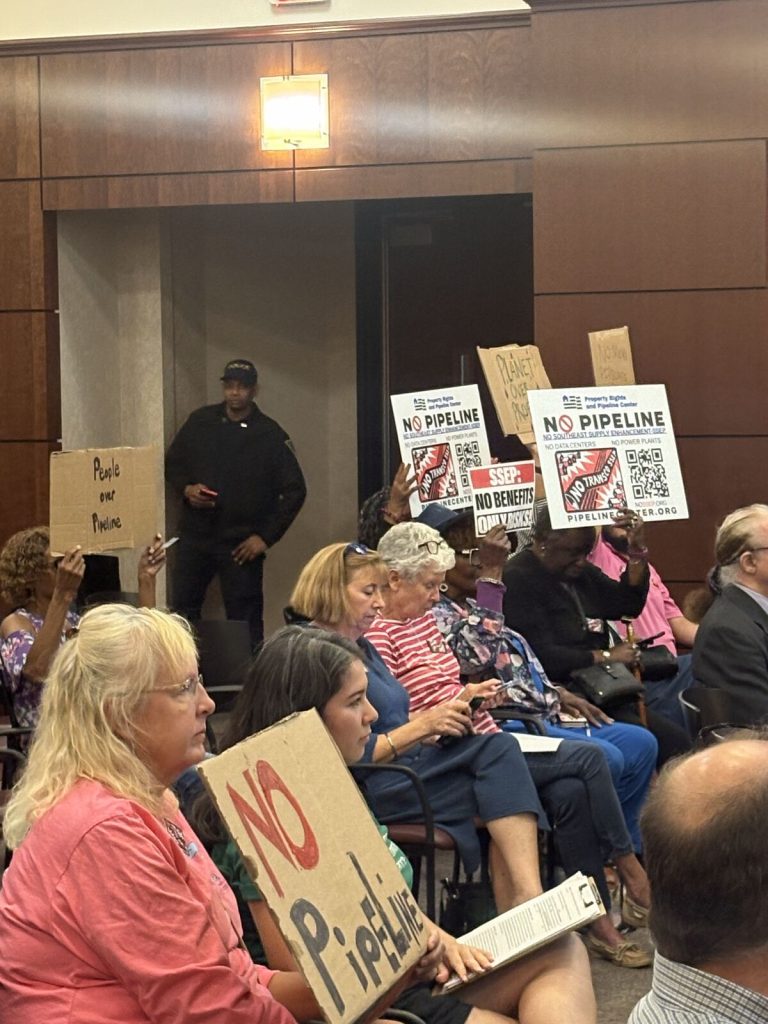
SSEP opponents gather in the rain at a September rally in Kernersville, N.C. Photo courtesy of Iximche Media

Residents in Person County, North Carolina, are tired of living in what many say feels like a “sacrifice zone.” The picturesque rural county just north of the Triangle is already home to the largest coal plant in the state and suffered water pollution from leaking Duke Energy coal ash ponds. Now, Duke and other companies want to build two massive methane gas power plants and a pipeline in Person County to feed them. There’s a mysterious Microsoft project that many assume will be a large data center with its own insatiable energy demands. On top of all of that, Enbridge has proposed and begun construction on a liquefied methane gas storage facility called the Moriah Energy Center.
But many residents are fighting back, strategizing together, speaking out at public meetings and hearings, attending rallies, monitoring construction sites and telling decision-makers that their health and safety cannot be sacrificed.
This mobilization has been inspiring and can inform how residents of other North Carolina counties can take on similar situations. Billions of dollars of pipelines, power plants, compressor stations and other methane gas infrastructure are at various stages of development across our state. We can rise up against this irresponsible surge of new fossil fuels that would increase electric bills while damaging public health and our land, air and water.
The proposed projects include two new gas power plants at Hyco Lake in Person County and the T-15 pipeline to supply them, new gas plants in Catawba and Rowan counties, and the multi-state Mountain Valley Pipeline Southgate and Southeast Supply Enhancement Project. These represent billions of dollars worth of unnecessary fossil fuel infrastructure that will lead to increased air pollution, water pollution and carbon and methane emissions, as well a massive potential increase in electric bills for North Carolina residents.
Why all this new fossil fuel infrastructure, even though state law calls for achieving net-zero carbon emissions by 2050 — and even though studies suggest renewable energy combined with battery storage would be a cheaper and more reliable method to meet increased demands for electricity?
Guaranteed returns on investment
Much of it comes down to the greed of monopoly utilities — which get guaranteed rates of return on these kinds of investments. Duke Energy, the major driver of many of these projects, is guaranteed a 10.1% rate of return on investments like gas power plants. The more it spends, the more the power company earns — and the higher your electric bills go!
In addition, Duke gets to pass along fuel cost increases to its customers — and methane gas is known for its volatile cost swings.
Renewable energy projects don’t cost as much and don’t have the same kind of associated fuel costs (wind and sun power is abundant and free). Plus, Duke gets to be the sole builder and owner of gas plants but has to let other developers build at least 45% of solar infrastructure in the state and buy the electricity from them. This doesn’t return as much cash to shareholders’ pockets.
Duke and other utilities are regulated by state agencies — but they spend a lot of money lobbying state legislators to weaken those regulations. (Yes, your electric bills pay for that, too.)
For instance, the North Carolina General Assembly recently passed Senate Bill 266, the ironically named “Power Bill Reduction Act.” That bill, passed over Gov. Josh Stein’s veto, will:
- Eliminate interim carbon emissions reduction targets (Duke was supposed to lower emissions by 70% by 2030)
- Allow Duke to ask regulators to let it charge you as a customer for the costs of these massive fossil fuel infrastructure projects before they’re even completed or even if the project never finishes.
- Shift more of the burden of paying for fuel to you as a residential customer.
(You can see how your state House members and state senators voted. Even though the bill has passed, you can still contact them to express your disappointment or to thank them for voting in customers’ best interest!)
Data centers drive demand — but projections may be overblown

Of course, utilities don’t say this buildout is about increasing shareholder profits. They say increased power generation is needed for economic growth and to meet the anticipated demand for new data centers. But it’s unlikely that such anticipated demand will ever fully materialize. In fact, one study found that the global semiconductor industry doesn’t have the capacity to make enough chips to supply the number of data centers that utilities around the nation are projecting.
And data center developers are also shopping their potential projects to multiple electric utilities — so the same data center is showing up in the demand forecasts for multiple utilities, even though it would only be built once.
Imagine you’re ordering pizza for a party. You might decide that the best way to get a good deal is to call every pizza place in the county and ask for the price. Adding a hyper-scale data center to the electric grid is more complicated, but essentially, it’s as if the data center developer orders a pizza from every restaurant, even though they will only purchase one pizza. But each restaurant (in this case, the electric utility), still must start making the pizza, to have it ready just in case. In the power sector scenario under the new North Carolina law, regular people (not the utility and not the data center developer) would have to pay for the cost of building unnecessary, polluting infrastructure, even if the data center’s power demand never materializes.
It’s irresponsible and unfair to saddle residential customers with huge electric bill increases to build polluting infrastructure that may never be needed.
As the Southern Alliance for Clean Energy noted in a recent paper, utility customers may end up footing the bill for infrastructure that will end up being used by pipeline companies to export gas to foreign countries, NOT to power the grid. If power companies’ forecasts for the gas they need end up being wildly inflated, utilities can sell excess pipeline capacity to companies that will use it for liquefied natural gas exports — but their customers will still be paying for the projects!
The power companies have nothing to lose, but we do. Everyone who pays a power bill has a stake in this, as does everyone who breathes air and wants a stable climate — methane gas has a devastating climate-altering impact.
There are better ways. Clean, renewable energy and battery storage could meet much, if not all of the actual demand. If utilities still proceed with fossil fuel infrastructure to meet projected data center demand, states could put responsible regulations in place to ensure that the data centers and other high-use industrial customers pay the cost, not residential customers.
Even better, data centers could be required to be powered by renewable energy produced and stored on-site.
We need a fair system with more transparency and less risk — one where regular people do not subsidize shareholder profits and large tech companies through our unaffordable electric bills. We need a system that protects our health and our land, air and water. Currently, North Carolina utility regulators are reviewing Duke’s proposals as part of the state’s Carbon Plan proceedings — decisions that will have a real impact on our bills and our climate.
N.C. gas projects
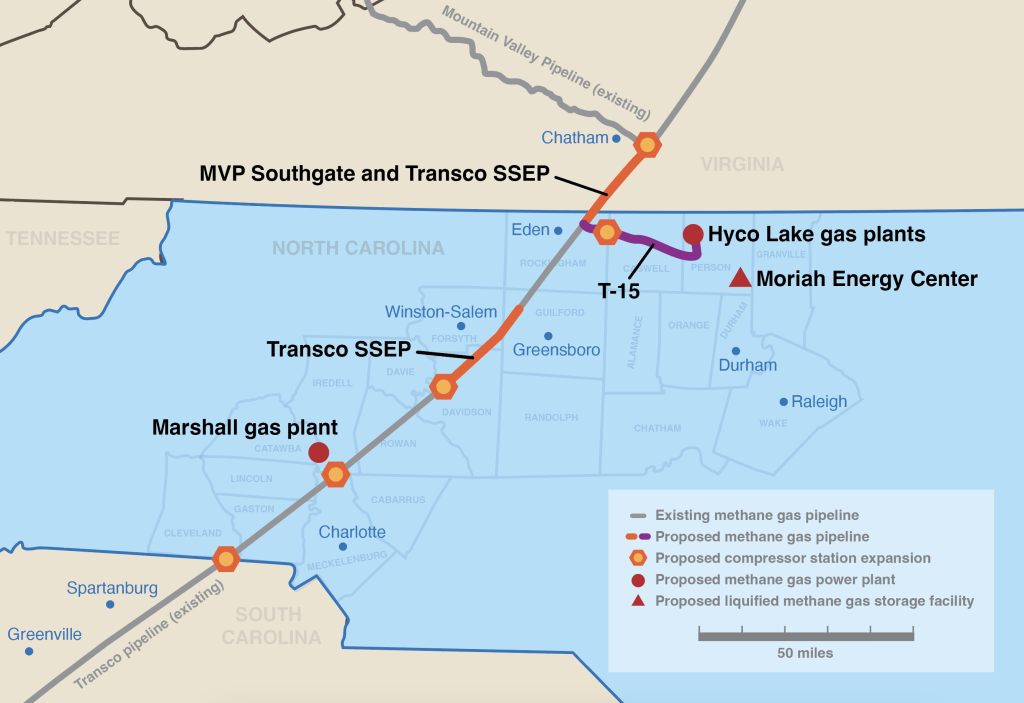
Transco’s Southeast Supply Enhancement Project: A multi-state project that would include 28 miles of pipeline in North Carolina (and 26 miles in Virginia) and the expansion of three compressor stations in North Carolina. The project would pass through areas already considered “environmentally burdened” because of existing pollution sources. Most of the gas the project would transport has been contracted by big utilities (Duke, Santee Cooper and Southern Company, with Duke contracting for the majority). Much of this potential demand is driven by data centers, including many that haven’t been built yet and may never exist.
Mountain Valley Pipeline Southgate: Another multi-state project, Southgate would run from Pittsylvania County, Virginia, to Rockingham County, N.C. The original project was halted in 2021 when the North Carolina Department of Environmental Quality denied a water quality permit, but MVP redesigned the project. The route is now shorter, but the proposed pipeline is larger and would carry even more gas.
Duke Energy has contracted to buy about half of the gas from Southgate. Transco has argued that SSEP makes Southgate unnecessary, and a recent Environmental Assessment by the Federal Energy Regulatory Commission appears to agree.
Enbridge’s T-15 Reliability Project: This 45-mile pipeline would take gas from Southgate in Rockingham County and transport it to Hyco Lake in Person County, North Carolina, to power two proposed methane gas power plants. It would also include a new compressor station in Rockingham County.
Duke Energy gas power plants: Duke Energy is planning an enormous gas buildout as it retires aging coal plants that are currently running at low capacity. Duke justifies the buildout by citing a level of speculative future demand that may not materialize. This includes the Hyco Lake plants, and plants in Catawba and Rowan counties in North Carolina. In its most recent Carbon Plan, Duke is proposing 16 new gas plants, many of which could require additional unplanned pipelines, through 2040.

PREVIOUS
NEXT

Leave a comment
Your email address will not be published. Required fields are marked *
Leave a Comment