

The Shenandoah Salamander
Sparkling shadow of the Blue Ridge night

By William H. Funk
Salamanders are by nature a reclusive, elusive kind of animal — damp and delicate amphibians whose typical habitat is among streaming creek currents or moist and shadowed woodlands. But evolution allows species to slowly change their habitats and behaviors, even their physical forms, over millennia of life on Earth.
The Shenandoah salamander (Plethodon shenandoah) is a woodland salamander which, unlike most of its streamside peers, has adapted to life at higher elevations away from water. This sparkling rarity lives among the dry leaves, cracked logs, and stony hillocks on the highest peaks of Shenandoah National Park, that legendary 199,173-acre bastion of the Blue Ridge Mountains.
Mountaintop forests might seem an unlikely home for cold-blooded invertebrates long understood to only breathe through gills and depend on lowland creekbanks and marshes to lay their eggs. Yet even these highland amphibians, whose young develop completely within the egg and do not require an aquatic larval stage, still require moisture to breathe.
Frequent fog in higher-altitude areas of the park helps keep these unique creatures moist, writes Evan Childress, chief of natural and cultural resources at Shenandoah National Park, in an email. This perpetually moistened air allows the creatures to absorb oxygen through their thin, wet skin, which directly enters blood vessels near the surface.
One might legitimately assume that a salamander that had achieved this very rare capability to leave the sunlit streams behind for higher, drier ground would have fewer competitors and more abundant prey sources that were unready for this bold approach. Jackpot, right?
Sadly, this is not the case. The Shenandoah salamander is listed as critically endangered under the federal Endangered Species Act and is isolated to three undisclosed 2,900-foot-high peaks within Shenandoah National Park in Virginia.
Will this animal’s unique abilities allow it to stave off extinction? As with all else in the swirl of life, that depends.
A small salamander with ‘a large ecological role’
Dark and shiny brown with a speckled auburn stripe down the back and tail, the Shenandoah salamander has two color variations. The striped color phase has a narrow reddish-yellow stripe down the center of the back, while in the unstriped phase, the back is dark brown with scattered bronze-toned flecks. In both color types, white or yellow spots occur along the animal’s slender sides.
Maxing out at 4 inches, the length of an adult’s index finger, the Shenandoah salamander has the wormlike look of its creekside peers, but this creature’s atypical traits make it stand out.
For starters, the Shenandoah salamander is completely nocturnal, moving about, breeding and hunting in the cool night during spring and fall, according to the U.S. National Park Service. The hot summer and frozen wintry nights are spent out of sight, hunkered down immobile among leaves, under logs and rocks, and in the bark of rising tree trunks and fallen limbs on north-facing rocky slopes.
“For most visitors, salamanders, including the Shenandoah salamander, are rarely given much thought unless you are an amphibian enthusiast,” the U.S. National Park Service’s website reads.
Margo Roseum, an educational technician with the National Park Service, explains that despite their tiny size and hidden lifestyle, Shenandoah salamanders play a “large ecological role” in their mountaintop environment.
“These woodland salamanders are long-legged,” she says, which allows for stealth, sudden speed and a lethal leap at prey when on the hunt. “They’re burrowers, which helps aerate the soil, and they do a lot to help keep fly, beetle and mite populations in check.”
Shenandoah salamanders are completely silent, unlike their frog and toad cousins, but their unheard impact on the land around them is substantial, including a beneficial influence on soil dynamics brought about by burrowing for cover during the daylight hours or when it’s too hot or cold.
Main threats facing the Shenandoah salamander
Every positive story seems to come with a sad addendum. Shenandoah salamanders once occupied all of the Shenandoah Valley, where they first evolved, but a warming world pushed them farther and farther up the mountainsides, culminating in their ecological isolation on three isolated peaks. And now, increased warming threatens their very existence.
“The main threats to the Shenandoah salamander are changes in temperature and precipitation regimes — because soil moisture is a key aspect of their habitat — and competition with the closely related red-backed salamander,” wrote the park’s Childress.
The red-backed salamander (Plethodon cinereus) has one of the largest ranges of any North American amphibian. Because of its ability to thrive in both high and low altitudes, the red-backed salamander has a much stronger population than the Shenandoah salamander, enabling it to outperform its cousin in the inevitable competition for food. Inbreeding is another threat, as these two salamanders, though different species, are genetically similar enough to crossbreed, further imperiling the survival of the unique Shenandoah species.
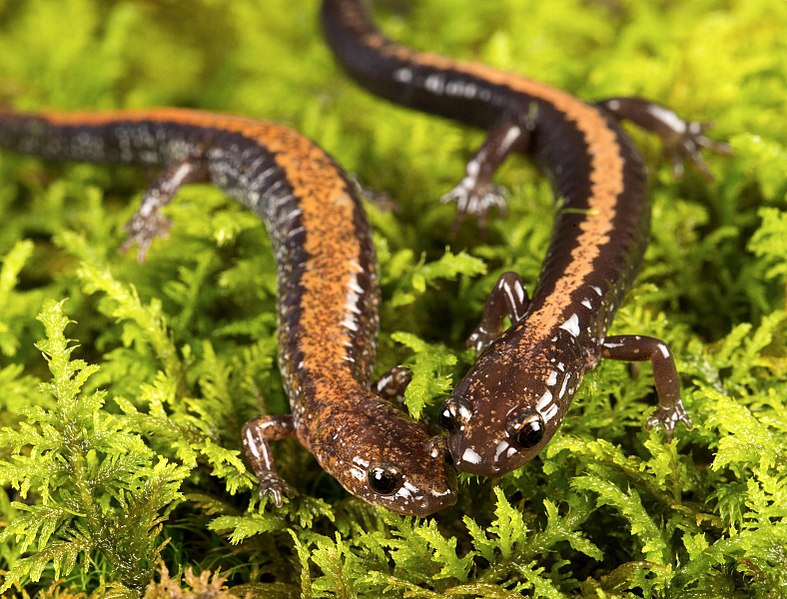
The decline of native ash trees also poses a threat. Evan Grant, a biologist with the U.S. Geological Survey, explains that tree deaths caused by the invasive emerald ash borer open up the forest canopy, allowing direct sunlight and heat onto the forest floor. This in turn dries the undergrowth and poses a direct threat to the Shenandoah salamander’s ability to breathe through its dappled skin.
According to the Virginia DWR, “Confined to a maximum potential habitat of merely 800 acres, this four-legged vertebrate possesses one of the most narrowly restricted geographic ranges on Earth.” And with climate change bringing even drier summers, the long-term prognosis isn’t good.
Furthermore, “the impacts of climate change, habitat loss, and pollution pose a real danger to these sensitive creatures. Increased temperatures, changing humidity levels, wildfires, and droughts wreak havoc on salamanders,” according to the Southern Environmental Law Center. With its tiny, isolated and shrinking habitats, the prognosis isn’t good.
In addition to climate and competition with the red-backed species, the Virginia Herpetological Society cites “alteration of forest canopy cover from defoliation by the introduced gypsy moth (Lymantria dispar)” and acid rain as additional threats.
“We are just at the beginning of the ecological changes that we expect, with the salamander’s range getting smaller and smaller,” Grant says.
How to protect the Shenandoah salamander
Will Harlan, southeast director and senior scientist at the Center for Biological Diversity in Asheville, North Carolina, has an affection for “sallies.”
“We live in the salamander capital of the world,” he says. “More species of salamanders are found in Appalachia than anywhere else on the planet.”
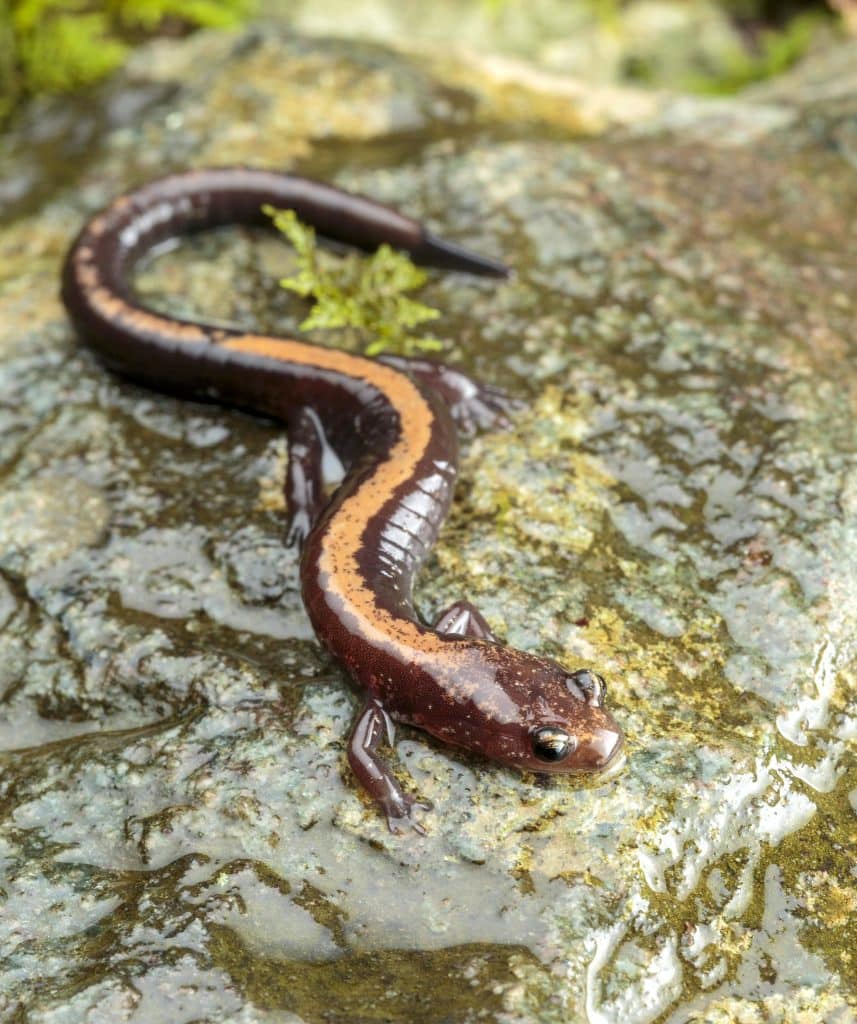
“They are also some of the most imperiled,” Harlan continues. “40% of salamanders are threatened with extinction. Shenandoah salamanders are especially endangered, clinging to survival on three mountains as the climate crisis pushes them closer to the brink.”
The Blue Ridge only rises so high, worn as it is from ages of erosion, and the heated Shenandoah Valley and Piedmont bracketing these mountains will only grow warmer.
“Recent research suggests that maintaining or increasing soil moisture and moss cover are among the factors most likely to help the species persist,” wrote Childress. “However, the feasibility of manipulating those on remote mountaintops is uncertain.”
Visitors to Shenandoah National Park can also lend a hand toward keeping this irreplaceable, shining sliver of life breathing through its skin for another 5 million years. For starters, visitors should stick to designated “hard infrastructure” such as trails. Avoid flipping over logs or rocks that would expose snoozing salamanders to light and heat. And follow visitor guidelines regarding camping and gathering firewood near critical habitat.
In a 2025 U.S. Fish & Wildlife Service report, Shenandoah National Park policy outlined several park restrictions to minimize harm from maintenance activities in the creature’s habitat, including cutting back vegetation instead of using herbicides, among other measures.
Across what’s left of this wild world, humanity’s fellow animals are facing an extinction event unlike anything since the demise of the non-avian dinosaurs, one wholly the result not of meteors or seismic events but of us, ourselves. We are the ones responsible for the future of this ancient glimmer of life, this bright smiling twinkle of the misty mountain night.
Related Articles
Latest News
More Stories

Neighbors Help Neighbors
A photo essay that celebrates the volunteer spirit of the grassroots group Hurricane Helene WNC and speaks to the resourcefulness, collaboration and hard work embodied by thousands and thousands of volunteers, first responders and aid workers across the region after Hurricane Helene.

Halloween Approaches, and Night School Is in Session
The House of Art in Bluefield, West Virginia, looks like a haunted tower, making it the perfect location for its sixth annual haunt event: Night School. The Night School will be open every Friday and Saturday night through Oct. 31.
‘The Most Perfect Act of Love’
Hundreds of people attended the second annual Affirming Sumner Pride celebration on a 24-acre farm dubbed “Fruity Farm” in Bethpage, Sumner County, Tennessee.

Signs of Life: Endangered Bats Found in Nantahala for First Time in More Than a Decade
In the Nantahala National Forest, a team of biologists spotted Indiana bats, an endangered species that hasn’t been seen in North Carolina for the last 11 years.

‘First Line of Defense’
During Hurricane Helene and its aftermath, rural fire departments and other first responder hubs played critical roles in keeping their communities safe, even without power and cut off from outside support for days or weeks after the storm. Two years later, plenty of work remains to ensure these hubs have the resources they need to operate day to day and be ready when emergencies or natural disasters strike.

The Rocky Road — and Bridge — to Recovery
Hurricane Helene is estimated to have damaged nearly 7,000 private roads and bridges in Western North Carolina. Two years later, many restoration projects are complete, but the journey hasn’t been easy — and isn’t over for others.

Leave a comment
Your email address will not be published. Required fields are marked *
Leave a Comment