
Front Porch Blog
Rockingham County residents voice opposition to the SSEP

North Carolina residents hold signs opposing the SSEP at the Sept. 4 N.C. DEQ hearing in Kernersville. Photo by Iximche Media
Tuesday, Sept. 2, was crisp and clear in Wentworth, North Carolina, unmarred by the methane propaganda truck slowly circling the Rockingham Community College parking lot. The vehicle, flashing statements paid for by the Carolinas Natural Gas Coalition, idled outside the entrance to the Advanced Technology Auditorium as guests filed in for a public meeting that evening.
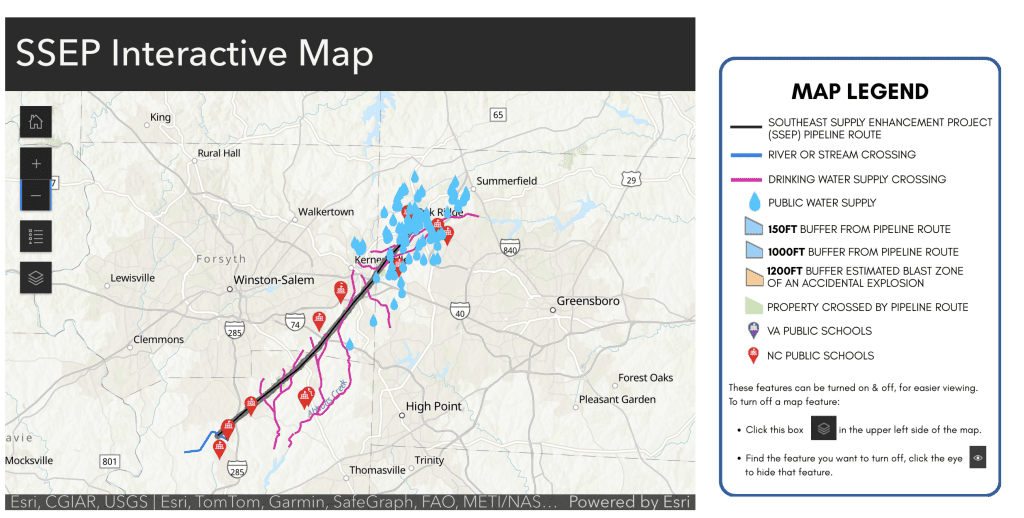
A little over 20 people attended the 401 water quality permit hearing hosted by the North Carolina Department of Environmental Quality for the Southeast Supply Enhancement Project. The agency held the hearing to accept public comments on the water quality impacts of the proposed SSEP methane gas pipeline project. If granted, this certification would pave the way for almost 55 miles of new pipeline, 4.4 miles of which would cut through Rockingham County on the “Eden Loop,” one portion of the overall route. But for the permit to be valid, the project must meet certain criteria:
- The project minimizes adverse impacts to surface waters and wetlands based on consideration of existing topography, vegetation, fish and wildlife resources, and hydrological conditions.
- The project does not result in the degradation of groundwaters or surface waters.
- The project does not result in secondary or indirect impacts that cause or will cause a violation of downstream water quality standards.
- The project provides for replacement of permanent impacts through mitigation.
Almost everyone gathered that Tuesday night was there to make sure regulators took their voice into account.
Before the public comments began, attendees chatted amicably in the lobby, and attendees signed up to speak. A few representatives dressed in suits from Williams Transco, the parent company responsible for the SSEP pipeline application, milled around the door, while Steph Gans of Clean Water for NC set up a table with informational handouts, maps, “NO SSEP” stickers, and a large vase of sunflowers gifted by one of Rockingham’s residents.
The hearing itself began with a brief overview of the permit application and guidance for the commenters. For those who have never attended one of these public meetings, speakers are invited to address the NCDEQ at a microphone for three minutes each, with one of the seated staff helpfully flashing a sign to let speakers know how much time they have left.
Most speakers brought pre-written comments to read, but a few residents spoke from the heart. They were overwhelmingly against permit approval. Only five speakers were in favor of the permitting: four current employees or recent associates of Williams Transco and one regional commissioner. Their main argument for expansion of the SSEP referenced North Carolina’s growing population and increasing energy demands, but they ignored the very real and low-cost option of renewable energy and repeated the persistent myth that building out more pipelines would result in economic benefit.
Economic benefit for whom? Certainly not the residents of Rockingham County. The SSEP pipelines would primarily be in service of companies like Duke Energy and large industrial projects, including proposed data centers. Ratepayers could bear the costs of construction for the pipeline and its affiliated gas plants through higher electric bills. Regardless, misguided hopes of economic benefit are not relevant to the 401 permitting. The NCDEQ public hearing and comment period is specifically concerned with water quality, and locals would bear the burden of increased risks to their drinking water while their increased bills finance the very pipeline that threatens it.
Several speakers worried about negative health impacts for their neighbors and family. One local declared, “Water is life,” and spoke passionately about the intrinsic value of community and natural resources while quoting Potawatomi botanist and author Robin Wall Kimmerer. Others asked why their land needed to be endangered when more affordable, safer renewable energy options are available.
They expressed lack of trust in a company with the troubling safety history of Transco, and were against both the destructive methods of pipeline construction and the decades of potential danger from committing to yet more fossil fuel infrastructure. County resident Gary “Buck” Purgason even brought a visual aide to the auditorium: a 42” diameter cut-out to demonstrate the massive size of the proposed high pressure pipeline. He strongly doubted that miles of drilling to accommodate it would result in “minimal adverse impact.”
As one landowner succinctly put it, “You have the authority to grant this permit, but do you have the capacity to ensure our safety for years afterwards?”
She referred to the fact the state only has five to six engineers to monitor pipeline safety even before the SSEP buildout would affect an additional 87 streams and 70 wetlands.
These concerns were backed up by speakers from the North Carolina League of Conservation Voters, Clean Water NC, Appalachian Voices and the Southern Environmental Law Center, who also provided comments. One advocate cited the exposure of fraudulent pipeline inspection reports, and highlighted their concern that the industry must do more to prevent these events from becoming more frequent in the frenzy of expansion. Transco’s history and an analysis of reported pipeline incidents make it clear that safety events are common, and that the main questions are when, where and how much danger residents will face.
The hearing came to a close after just over an hour of comments and testimony, and as audience members dispersed into the twilight parking lot — now absent the natural gas propaganda truck — spirits were high. Neighbors chatted, helped each other to vehicles and shared dinner plans. Speaker Buck Purgason distributed free bags of fresh-cut okra from the back of his truck, and the residents and advocates of Rockingham County continued to live the sense of community that brought them together to defend their water.
If you would like to be in community with our friends in Rockingham and across the SSEP proposed route, please join our comment party on Sept. 29 at 6:30 p.m. Eastern!
You can still submit comments until 5 p.m. on Oct. 6, 2025. Please submit written comments with project “No. 20240801; version 2” in the ID # field.
Written comments may also be submitted via mail to: Samantha Wooten, 401 Permitting, 1617 Mail Service Center, Raleigh, NC, 27699-1617. Public comments may also be submitted by leaving a voicemail at 919-707-8495.
NCDEQ is expected to make a decision on the permit later this fall.
Appalachian Voices Intern Samantha Collins authored this blog post.

PREVIOUS
NEXT

Leave a comment
Your email address will not be published. Required fields are marked *
Leave a Comment