

Two Interstate Pipelines Clear Regulatory Hurdles Despite Opposition
By Elizabeth E. Payne
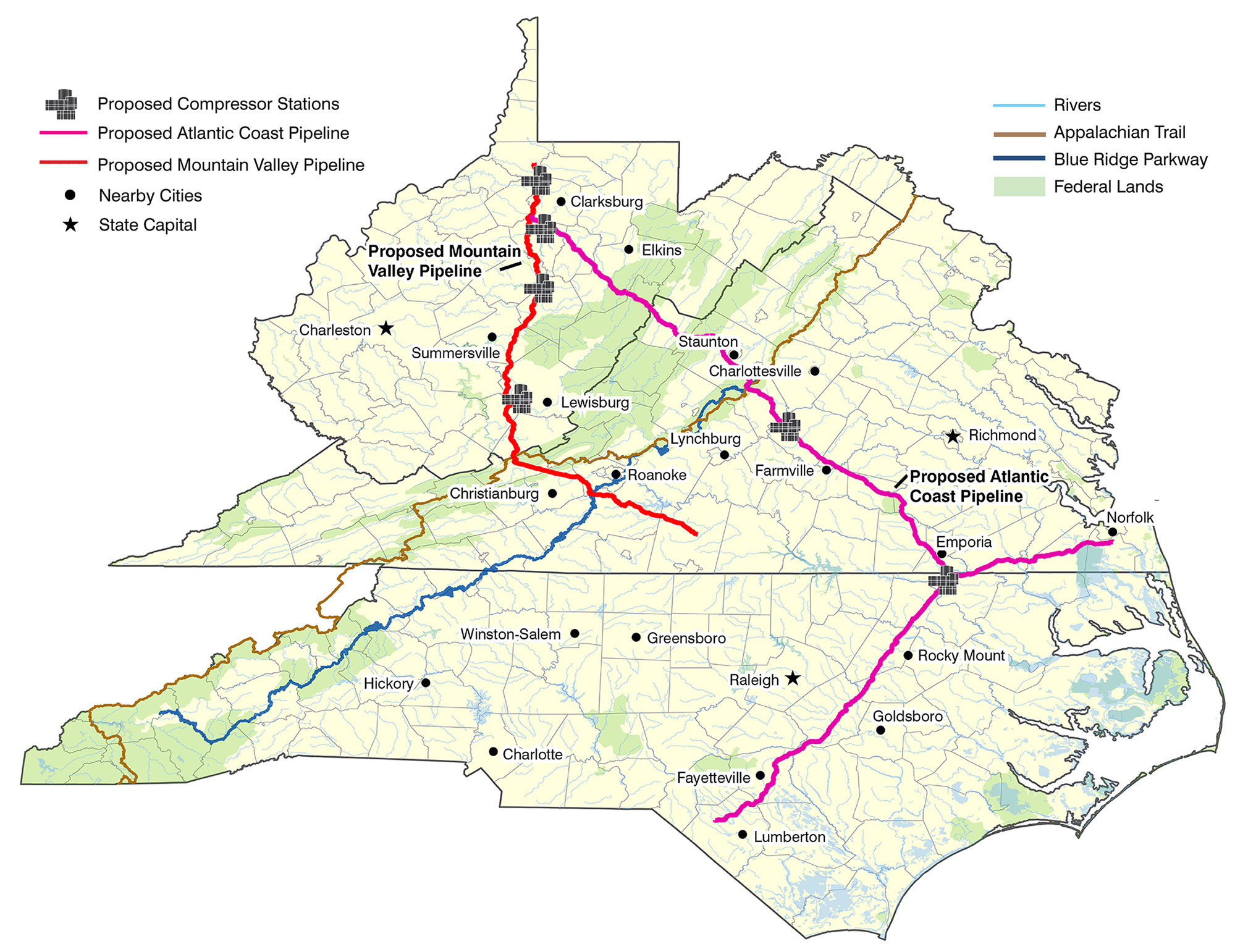
Map of proposed Mountain Valley Pipeline and Atlantic Coast Pipeline route. Click to enlarge. Map produced by Appalachian Voices.
This summer, the Federal Regulatory Energy Commission issued its final environmental review for both the Mountain Valley and the Atlantic Coast pipelines.
These assessments are intended to accurately evaluate the environmental risk the two projects would entail and respond to public concerns about the draft version issued in 2016. But community and environmental groups, including Appalachian Voices, the publisher of this paper, stated that the agency “utterly fails to independently assess whether the project is even needed,” and instead relies on the pipeline companies’ claim that the projects are necessary.
An April 2016 study by the Institute of Energy Economics and Financial Analysis found that natural gas pipelines out of the Marcellus and Utica shale are being overbuilt and that FERC is contributing to the overbuild by granting high rates of return to pipeline companies.
The groups also criticized FERC for overlooking the harm the pipelines would do to the water resources, forests, agricultural lands and wildlife along their routes.
“The Mountain Valley Pipeline will devalue our land, limit its uses and reduce taxes which support our schools and public services,” Maury Johnson, an affected landowner in Monroe County, W.Va., said in a statement. “It will impact the water that we so much depend upon for our families, our farms and our communities.”
“It should be criminal to attempt such a pipeline when the profound environmental damage has not been adequately assessed,” he added.
The U.S. Forest Service is reviewing its plans for the three national forests that the two proposed pipelines would cross. The agency issued its draft decision for the Jefferson National Forest on June 23, which would allow the Mountain Valley Pipeline to cross the forest if approved. Public comments for this plan closed on Aug. 7.
On July 21, the USFS issued its draft decision for the George Washington and Monongahela national forests, which would allow the Atlantic Coast Pipeline to cut through these territories. Comments can be submitted until Sept. 5.
Following a review of any filed objections, the USFS will decide whether to issue a special use permit, pending FERC approval of the pipelines.
Before the companies behind either pipeline can begin construction, each state along the routes must issue water permits required by Section 401 of the federal Clean Water Act.
In March, the West Virginia Dept. of Environmental Protection issued its 401 Water Quality Certification for the Mountain Valley Pipeline. Five environmental groups — including Appalachian Voices — have asked a federal appeals court to overturn this approval.
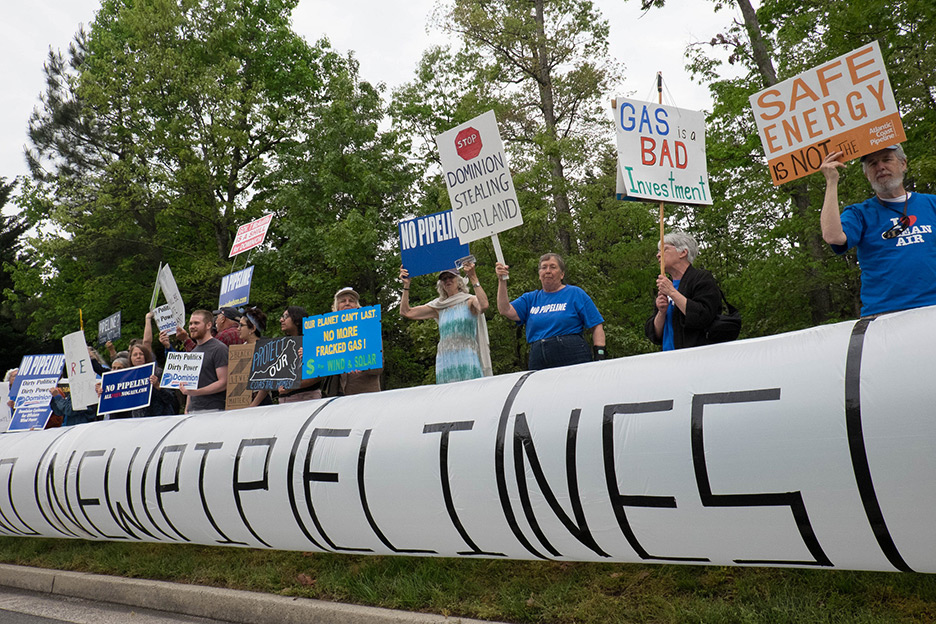
Citizens protested the Atlantic Coast Pipeline outside of Dominion Energy’s 2015 shareholder meeting. Photo courtesy of Chesapeake Climate Action Network
Public hearings for the certification were held in late July and early August for the Atlantic Coast Pipeline in West Virginia, Virginia and North Carolina and in Virginia for the Mountain Valley Pipeline. Written comments to the WVDEP were due by Aug. 4. In North Carolina, written comments must be submitted to the state’s environmental agency by Aug.19, and in Virginia, comments are due by Aug. 22.
“It’s definitely not a done deal, even though they’re presenting it like it is. It falls upon us as citizens to make people understand that it’s not something that’s set in stone,” Jorden Revels, a college student and Appalachian Voices intern told ThinkProgress. Revels is a Native American student at the University of North Carolina at Pembroke in Robeson County, N.C., where the Atlantic Coast Pipeline’s proposed route would cross Lumbee tribal lands.
Construction of the Constitution Pipeline, which would stretch from Pennsylvania to New York, was blocked in April 2016 when the New York Dept. of Environmental Conservation denied the pipeline company’s petition for a 401 water quality permit. Constitution Pipeline Company, LLC, is appealing this decision.
Lewis Freeman, the chair and executive director of the Alleghany-Blue Ridge Alliance, a coalition of 51 organizations working to stop the Atlantic Coast Pipeline, questions the speed with which the bureaucratic hurdles are being cleared.
“What we’re faced with here is misguided inertia,” he says. “Once they discovered all these deposits of gas, there is this inertia that has been created. ‘Oh, we must get it out, and we must use it,’ without thinking longer term: How long will we use it, and are there other energy sources that might replace it?”
A second legal challenge against the Mountain Valley Pipeline has been filed in U.S. District Court in Roanoke, Va. Citizens from Virginia and West Virginia contend that if FERC were to approve the pipeline, it would violate their Fifth Amendment rights under the U.S. Constitution, which requires that private lands only be taken “for public use” and with “just compensation.”
Before leaving for its August recess, the U.S. Senate confirmed two of President Trump’s nominees for FERC, restoring the quorum lost in February when one of the commissioners stepped down.
FERC is expected to make its final decision about the Mountain Valley Pipeline on Sept. 21 and about the Atlantic Coast Pipeline on Oct. 19.
For more information on the 401 hearings, including how to submit comments, visit appvoices.org/fracking/actions. Read about construction problems with two other Eastern pipelines on page 20.
Related Articles
Latest News
More Stories

Halloween Approaches, and Night School Is in Session
The House of Art in Bluefield, West Virginia, looks like a haunted tower, making it the perfect location for its sixth annual haunt event: Night School. The Night School will be open every Friday and Saturday night through Oct. 31.
‘The Most Perfect Act of Love’
After losing its rural pride celebration, hundreds of people attended the second annual Affirming Sumner Pride celebration on a 24-acre farm dubbed “Fruity Farm” in Bethpage, Sumner County, Tennessee.

Signs of Life
In the Nantahala National Forest, a team of biologists spotted Indiana bats, an endangered species that hasn’t been seen in North Carolina for the last 11 years.

‘First Line of Defense’
During Hurricane Helene and its aftermath, rural fire departments and other first responder hubs played critical roles in keeping their communities safe, even without power and cut off from outside support for days or weeks after the storm. Two years later, plenty of work remains to ensure these hubs have the resources they need to operate day to day and be ready when emergencies or natural disasters strike.

The Rocky Road — and Bridge — to Recovery
Hurricane Helene is estimated to have damaged nearly 7,000 private roads and bridges in Western North Carolina. Two years later, many restoration projects are complete, but the journey hasn’t been easy — and isn’t over for others.
After 20 Years, Letcher County Prison Proposal Is Still Alive, Though Obstacles Remain
A $605 million proposal for a federal prison on a former strip mine site in Letcher County, Kentucky, championed by U.S. Rep. Hal Rogers, refuses to die, despite local opposition, a lack of support from the executive branch and numerous other obstacles.

Leave a comment
Your email address will not be published. Required fields are marked *
One response to “Two Interstate Pipelines Clear Regulatory Hurdles Despite Opposition”
-

I am a resident of Wintergreen, in Nelson County, VA. The ACP is going to rape the Rockfish Valley. It could have easily utilized other public easements but Dominion refuses to consider it due to the incremental cost. Hopefully the VA 401 will also fail. I suspect much of this gas will end up being exported which is inconsistent with eminent domain, with which they are taking personal property.

Leave a Comment