
Follow Us on Twitter: Appalachian Voices | iLoveMountains.org

Posts Tagged ‘mountains’

The Emerging Efficiency Lobby: Diverse Interests Find Common Ground

Wednesday, April 18th, 2012 - posted by Madison

By Molly Moore

Conversations about blowing up mountains for easier access to coal or risking offshore oil spills to boost a corporation’s bottom line spark passions in a way that those about financing energy efficiency retrofits don’t. But wherever national energy dialogue goes, talk of energy efficiency and minimizing our energy consumption is sure to follow.

Even in the polarized 112th Congress, energy efficiency has bipartisan support. Cutting costs is a dominant theme of the current Congress, as is job creation. Rob Mosher, director of government relations at the nonprofit Alliance to Save Energy, says that Congress should be looking for ways to address the nation’s present challenges — economic and otherwise — in ways that help financially struggling Americans.

Efficiency advocates like Mosher say that nominal investments in particular energy efficiency programs result in exponentially larger savings for consumers, businesses and government. Conserving energy, whether it comes from the sun or a nuclear reactor, benefits society as a whole through enhanced energy security, more construction and manufacturing jobs, and a lighter environmental footprint.

Although the Southeast still lags behind the rest of the country in realizing its energy efficiency potential, efficiency bills have moved forward in several of the region’s statehouses.

According to a 2009 report by the Southeast Energy Efficiency Alliance and the Appalachian Regional Commission, the implementation of a set of energy efficiency policies in Appalachia could cut energy demand by 7.3 billion kilowatt hours by 2030 — enough energy savings to offset 40 new coal-fired power plants and 182 million barrels of oil. The same study anticipated the creation of 77,300 jobs by 2030 if the region adopted the proposed efficiency policies.

The rewards of investing in energy efficiency are diverse, and so are its proponents. The Alliance to Save Energy’s associate organizations include commercial heavyweights like AT&T, energy providers such as Tennessee Valley Authority, research centers like Oak Ridge National Laboratory and nonprofits such as Habitat for Humanity. Rodney Sobin, senior policy manager at ASE, cites the chemical industry as one of the environmental community’s unlikely allies. “It’s not altruism,” Sobin says. “I think there are a lot of people who want to do the right thing, but it’s to [the chemical industry’s] own interest that energy be used efficiently across the economy because it affects the cost of their inputs.”

Often, the market encourages energy efficiency. Tennessee Valley Authority, a government-owned utility that operates in seven states, says efficiency is the cheapest way to meet energy demand. TVA delivers its energy efficiency programs at a cost of less than two cents per kilowatt hour. “No one is really in favor of wasting energy,” says Mosher. “The cheapest fuel is the one you don’t use.”

The Feds Step In

In addition to purely marketdriven motives, government can encourage efficiency. Federally, efficiency policies range from tax incentives and loans for retrofitting buildings to financing that calculates a building’s efficiency into its mortgage value.

Federal appliance standards are perhaps the government’s highest-profile efficiency tool. The poorly understood Energy Information Security Act, signed by then-President George W. Bush, requires light bulbs to produce more light per watt of electricity used. The lighting standards do not ban incandescent bulbs or force people to buy compact fluorescents. But, as the date for enforcing the lighting standards drew closer, proponents of limited government claimed that the regulations were forcing draconian rules on the marketplace.

Mosher and Sobin disagree with the notion that the lighting standards stifle the free market, and say that the light bulb rules were crafted with the lighting industry’s cooperation and have spurred innovation and increased consumer choice. Still, the backlash has made the national conversation about energy efficiency more divisive.

Possibly the most effective and least contentious way for the government to influence efficiency is by reducing its own power bill. “The federal government is the largest energy consumer in the U.S.; within the federal government the Department of Defense is the 800-ton gorilla,” Sobin says, adding that many in the defense and intelligence communities see energy as both a threat to and opportunity for maintaining national security.

Sobin says “defense hawks” have been concerned about conserving energy since World War II, when generals were running out of gas in North Africa. More recently, energy efficiency has saved lives in Afghanistan. “If you can run your facility off of solar [energy], and you can recharge your batteries, and your generator uses less fuel and your truck uses less fuel, then you have less of a vulnerability to someone blowing up fuel trucks trying to get to you,” he says. Energy efficiency strategies developed by the Department of Energy and field-tested by the Department of Defense can lead to spin-offs in the marketplace.

Graph courtesy of the Southeast Energy Efficiency Alliance and Appalachian Regional Commission's March 2009 report. "Energy Efficiency in Appalachia"

Energizing States

Given all the federal government can do to promote energy efficiency, much is left to the states. Traditionally, Southeastern states have implemented fewer and less aggressive efficiency policies than the rest of the country — but that may be changing.

Twenty-four states, including North Carolina and Florida, have Energy-Efficiency Resource Standards. In states that require utilities to use a certain amount of renewable energy, Energy-Efficiency Resource Standards allow utilities to count increases in ratepayer energy efficiency toward their renewable energy goals.

An even more popular route is Property Assessed Clean Energy, a financing technique that helps homeowners manage the upfront cost of energy-efficiency upgrades by paying it back incrementally in conjunction with their yearly property taxes. PACE programs are run through state and local governments. Twenty-seven states, including Virginia, North Carolina, Ohio, Georgia and Florida have PACE programs.

Efficiency proposals are also more likely to pass when a state’s big energy utilities are supportive, or at least neutral. One way to eliminate a utility’s incentive to sell more energy is to “decouple,” or separate, a utility’s income from the amount of energy it sells. That allows a utility to cover its costs, please its investors and still be indifferent toward the amount of coal or gas that goes through its doors. Half of the U.S. has programs like this for electricity, gas or both. Tennessee, Virginia and North Carolina decouple gas.

By promoting energy efficiency in utility regulations, states can put more money in the pockets of ratepayers and reduce the amount of pollution the state generates.

Virginia — Open For (Efficiency) Business

In many ways, Virginia typifies the Southeast’s slow acceptance of energy efficiency as a resource. The American Council for an Energy-Efficient Economy’s 2011 state scorecard ranked the Commonwealth 34th in the nation for overall efficiency policies and 41st for utility policies alone.

Bill Greenleaf, now the executive director of the Richmond Region Energy Alliance, served on Virginia’s 2008 Commission on Climate Change. While on the Commission, Greenleaf read an ACEEE report detailing Virginia’s energy-efficiency potential and realized that increasing efficiency would be a low-cost, effective means to reduce greenhouse gas emissions. The Commission recommended that Virginia adopt a plan to increase energy efficiency, but in 2009 state legislators rejected the proposal and its goal of 19 percent energy savings by 2025.

“In 2009 there was no trade association for the energy efficiency industry,” Greenleaf says. “There’s an emerging business voice for the energy efficiency industry now.”

Greenleaf’s organization is one of four regional alliances in the Commonwealth that represent business contractors in fields such as heating and air conditioning, insulation and mechanics. Companies like Siemens and Johnson Controls, which provide efficiency retrofits and essentially sell energy savings to local governments, and Virginia-based energy efficiency software company OPower, also have a stake in energy policy. In July 2011, these and other businesses formed the Virginia Energy Efficiency Council, a trade organization that encourages energy conservation.

The coalition’s first challenge was to reform the way the State Corporation Commission approved energy efficiency programs. Because of the commission’s policies, the rapidly growing software company OPower — possibly the loudest pro-efficiency business voice in Virginia — couldn’t do business in its home state, even though it worked with over a dozen utilities in other states.

OPower and members of the fledgling efficiency council began simultaneously working with legislators and lobbyists to change the SCC’s approval process. The SCC had relied on a single measure, the ratepayer impact test, to determine whether to approve an energy-efficiency program. But the pro-efficiency bill that OPower and the Virginia Energy Efficiency Council favored would allow the SCC to approve programs that are able to pass three out of four cost-benefit tests instead.

The bill gained the support of the governor’s office, passed the General Assembly and was signed into law this spring. Greenleaf says the fact that utilities didn’t object helped. Their neutrality came from Virginia’s decoupled regulation that allows utilities like Dominion Power to earn money on efficiency in addition to new electricity generation.

Changing the SCC’s decisionmaking process is significant in Virginia — and according to Greenleaf, the Virginia Energy Efficiency Council is just getting started.

“We can create jobs in every city and county in Virginia if we deploy energy efficiency,” he says. Efficiency upgrades demand local labor, which helps keep jobs and taxpayer money within state borders. And by reducing homeowner utility bills, efficiency also puts money in residents’ pockets that will often be spent in-state.

“The biggest challenge is trying to get the SCC and legislature to see energy efficiency as a real resource,” Greenleaf says. “Is it more cost effective to spend $1 billion on a new power plant or is it more effective to spend $1 billion on an energy-efficiency program? … This year the Virginia Energy Efficiency Council is going to start asking that question.”

Learn more about particular energy efficiency bills currently in Congress here.

Reclaiming Appalachia: Can Legislation and Enforcement Restore Mountains?
Tuesday, February 21st, 2012 - posted by Jamie G. -- AV Communications Coordinator

By Molly Moore

Reclamation is complete at the former surface mine near Hueysville, Ky.

Reclamation is complete at this former surface mine near Hueysville, Ky. Two rock riprap conduits are designed to channel stormwater runoff. Photo by Molly Moore

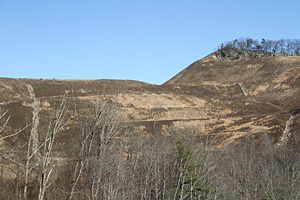
Kathy Selvage has lived in Stephens, Va., her entire life. From her front porch, she can almost see the field where her childhood home once sat. Instead of the hardwood forest that surrounded her home, graded hills lean against each other like a lumpy bag of onions beneath a blanket of savannah grasses and gravel. The sparse grassland across the road will never replace the ridgetops where she went berry-picking as a child.

In 2004, this land became an active surface mining site. Now the coal is gone, but orange water seeps out of the earth mere feet from the mine permit boundary, casting a warning glow down the ravine.

Living in Wise County, where 33 percent of the land has been permitted for surface mining, Selvage is familiar with mountaintop removal. For years, she has watched mine operators blast away mountaintops to access seams of coal, dumping overburden into valleys and burying headwater streams.

In 2009, while reclamation was underway, citizens noticed orange water, a signature indicator of pollution, near the site. Just months after the contaminated water was reported, the coal company and the state and federal agencies charged with enforcing mining laws signed a legal agreement that freed the company from further reclamation responsibility, years ahead of schedule. Now the orange water is back in another location.

“How anyone could look at the Appalachian region from far above it and call this reclamation is beyond me. They may call it reclamation but I call it desecration,” Selvage says, and her soft drawl doesn’t quite veil her frustration.

“Reclamation” is a volatile word in Appalachia. For Selvage, it represents her struggle to bring state attention to the polluted water oozing from the mine permit boundary. For those who worked on the surface mining law in the ‘70s, reclamation is a glaring example of the perils of weak enforcement. Researchers who show how, under certain conditions, tree growth on post-mining land can be comparable to growth on native soil, see reclamation as the flawed but necessary intersection of engineering and ecology. And for the coal companies that walk away from their legal responsibility to restore mined lands, reclamation is simply a forfeited bond amount on a spreadsheet.

* * *

Kathy Selvage surveys orange water near her Virginia home.

Kathy Selvage surveys orange water near her Virginia home. The water emerges just feet from a reclaimed mine stie. "It would take nothing short of a fool to try to convince you that a mountain can rise again," she says. Photo by Molly Moore

Thirty-five years after the Surface Mining Control and Reclamation Act became law, there is little evidence that reclamation in Appalachia is being enforced as the law intended, says Louise Dunlap, former head of the nonprofit Environmental Policy Center.

When the federal surface mining law was enacted in 1977, SMCRA was presented as the regulatory medicine needed to rein in the largely unregulated coal industry. The law created the federal Office of Surface Mining for enforcement, and allowed states to create their own regulatory agencies to implement SMCRA at the state level.

The path toward SMCRA started with a surface mining bill proposed in 1940 by Illinois Senator Everett Dirksen. By the early 1970s, when Dunlap got involved with the bill, strip mining was rapidly expanding. West Virginia Representative Ken Hechler introduced a bill in 1971 that would ban the practice within six months of the bill’s enactment. Hechler’s bold bill drew national attention to the issue.

Support from the United Mine Workers of America was also influential in the ‘70s. “Deep miners living in the hollows were having their houses threatened with boulders rolling down the hills from the strip mines up above,” Dunlap says. “At one time, Miners for Democracy and Arnold Miller, a former president of the UMWA, had a position of banning all strip mining.”

Around the same time, Pennsylvania began enforcing new environmental regulations for surface mines, and the coal industry responded by threatening to leave the state. “It became obvious that if we didn’t have a federal law, the coal industry would try to intimidate different states,” Dunlap says.

This coincided with congressional mark-up sessions being opened to the public, which made it easier for citizens to get amendments into legislation. In the days before Xerox and overnight mail, Dunlap recalls her colleagues making carbon copies of proposed amendments and driving to the midfield post office at the Washington, D.C. airport to send the language to citizens groups across the country. People familiar with similar amendments in their state mining laws would call and provide input. “Many of the provisions in the law were written by coal-impacted citizens,” she says.

Finally, after two vetoes from President Gerald Ford, the bill was signed by President Jimmy Carter. Its hardships began early on with lack of funding and challenges to its constitutionality.

“It’s easier to get a law passed than to get it implemented,” says Dunlap. In addition to problems with enforcement, she says some of the regulations, designed for the steep-slope mining of the 1970s, haven’t caught up to the scale of today’s industry.

A Flat Way Out

Three forestry research plots demonstrate some of Patriot Coal Company's reclamation efforts on Kayford Mountain, W. Va.

Three forestry research plots demonstrate some of Patriot Coal Company's reclamation efforts on Kayford Mountain, W. Va. The 750-acre mine site is supposed to be capable of supporting a commercial forest before reclamation can be considered complete. Photo by Vivian Stockman, courtesy of South Wings

Regarding reclamation, SMCRA is fairly clear. The coal operator is required to restore mined land “to a condition capable of supporting the uses which it was capable of supporting prior to any mining, or higher or better uses.”

When applying for permit, companies must present a reclamation plan that describes the condition of the land prior to mining, designates an intended “equal-or-better” post-mining use and explains how the company will make that future land use a reality.

“It it a privilege, not a right, to mine coal,” Dunlap says, adding that companies that can’t prove how they’re going to reclaim shouldn’t receive permits.

In drafting the law, legislators required that coal operators restore the general lay of the land, borrowing the phrase “approximate original contour” from Senator Dirksen’s 1940 bill.

But SMCRA also legalized swaths of flattened mountains by granting an exception to the approximate original contour requirement if the post-mining use generated an added public or economic benefit, such as a hospital, industrial park or residential area.

A 2009 study by the Natural Resources Defense Council surveyed 410 reclaimed mountaintop removal sites and reported that 89 percent had no verifiable economic reclamation, excluding forestry and pasture. Among the verified development projects: a federal prison, three oil and gas fields, two airports, a hospital, an ATV training center, three golf courses, four business parks, two municipal parks and a county fairground.

Research Takes Root

Since 1977, over 2,300 square miles of Appalachia — an area about the size of Delaware — has been surface mined, according to a 2011 study published in Environmental Management. Of those, over 1,540 square miles are in the mountains of Virginia, West Virginia, Tennessee and Kentucky, which are dominated by biodiverse forests.

Following SMCRA’s implementation, much of this forest was lost. Before the law, loose overburden littered the landscape, exacerbating floods, landslides and surface water contamination. Ironically, the new regulations stabilized mined land by compacting soil with heavy equipment and encouraging fast-growing non-native vegetation, inadvertently creating a climate hostile to native plants, including hardwood trees.

Aware that this was a tough environment for trees, mine operators rarely planted any. When they did, they planted species that survive but don’t restore the land’s biodiversity.

But Dr. Carl Zipper, co-author of the 2011 study and director of the Powell River Project, says that reclamation techniques are improving. The Powell River Project, a public-private partnership in Virginia, formed in 1980 with the goal of making reclamation more effective.

The Project’s research was incorporated into the Forestry Reclamation Approach, a five-step reforestation technique for recovering Appalachian strip mines. The FRA aims to restore the soil’s ability to support planted seedlings and to provide fertile ground for native seeds carried by wind or animals. The Appalachian Regional Reforestation Initiative, a seven-state association, formed in 2004 to advocate for the forestry approach.

Since the FRA was implemented in 2006, 15 square miles have been reclaimed using the technique and more than 46 square miles are permitted. Though a small percentage of the 2,300 square miles already surface mined, these 60-plus square miles represent land that might otherwise be barren.

As the Environmental Management study notes, the oldest sites using the forestry technique are only about five years old, so the science is still out on whether these practices are successful in permanently restoring forests.

Zipper says that reclamation techniques need to be cost-effective to be adopted. He explains that some parts of the forestry approach, such as the FRA’s use of loose soil material and lack of emphasis on heavy fertilizer and seed, save coal companies money. Other aspects, such as the seedlings themselves and the selection of appropriate soil and rock
layers, cost more than conventional grass reclamation.

Nathan Hall, an eastern Kentucky native and former deep miner, believes that revisiting post-SMCRA grasslands and applying the forestry approach will help the land and people move forward. Providing equipment operators who used to work for coal companies with jobs preparing compacted land for tree growth will make use of the region’s workforce, he says. And The American Chestnut Foundation recently received a three-year grant to plant hybrid chestnut trees and native hardwoods on compacted reclaimed land.

Dealing with the Damage

While researchers plan for the future, others are trying to mitigate existing problems.

On Kayford Mountain in southern West Virginia, Patriot Coal Company must produce commercial timber on its 750-acre mine site to achieve the designated post mining land use. Rob Goodwin, coordinator of the Citizens Enforcement Project at Coal River Mountain Watch, says the West Virginia Department of Environmental Protection allowed the permit’s post-mining land use to change to commercial forestry. This “higher and better” land use grants the company a cost-cutting approximate original contour variance.

“Even if you were doing commercial forestry, you wouldn’t necessarily need flat land,” Goodwin says.

Part of the permit hosts three West Virginia University forestry research plots, each the size of a football field. According to a permit map, one of the plots is designated a commercial forestry test plot. This plot use natural topsoil combined with weathered sandstone and minimal compaction. Another plot has similar soil with a different type of compaction, and the third had minimally compacted unweathered sandstone. The plots with natural topsoil are clearly more successful.

Goodwin says West Virgina and other Appalachian states have routinely waived SMCRA’s clear requirement to stockpile and re-spread topsoil during reclamation.

When Marfork Coal Company’s Bee Tree permit came up for renewal last summer, Coal River Mountain Watch intervened and was able to get the company to adopt a Forestry Reclamation Approach topsoil advisory. According to the advisory, operators who don’t have enough natural topsoil should combine the topsoil they do have with weathered sandstone.

Foreseeable Floods

Jack Spadaro, former superintendent of the National Mine Health and Safety Academy, was invited to testify before Congress about the relationship between surface mining and flooding just before President Carter signed SMCRA into law. He recalls an exchange from the 1977 hearing.

“The congressman who was conducting the hearing said, ‘Mr. Spadaro, Do you think the new law will be effective in controlling these negative environmental effects?’ I said, ‘Sir, I’m sorry to say that I don’t think so because I don’t think it’s ever going to be enforced.’ And I was right.”

SMCRA intended to protect surface mines’ downstream neighbors from flash floods intensified by huge expanses of barren, loose spoil. Such flooding was common before the law, so SMCRA requires that companies reclaim as they go.

On July 17, 2010, a wall of water rushed through the Harless Creek area of Pike County, Ky. One house exploded; another split in half. 37 families lost use of their wells.

126 residents are suing two surface mining companies that operate in the Harless Creek watershed for damages in a trial that will begin March 5.

Spadaro, who is serving as an expert witness in the Harless Creek case, says “[Regulators routinely let operators] go long, long periods of time without replacing topsoil, grading, seeding and mulching areas. What you get are these vast wastelands.”

At the time of the 2010 flood, one of the companies, Cambrian Coal Corp., hadn’t even begun to reclaim over half of the permited area, according to Spadaro.

“This company was essentially operating the way it wanted to without any control by the state of Kentucky,” he says, adding that the state inspector overseeing the site was “allowing them to violate the law and the intent of the law for months if not years before this flood happened.”

Immediately following the flood, Cambrian was cited for six violations.

The company’s lack of reclamation had drastic consequences for those downstream. Hydrologists serving as expert witnesses for the residents report that the two companies’ surface mines and failure to reclaim resulted in a 44 percent increase in peak runoff during the July 17 storm.

The Cost of Compliance

When it comes to mandating that coal companies clean up their mark on the land, money talks. SMCRA requires that operators post a bond before they begin mining so that the state has funds available for reclamation in case the company fails to comply. In places with state-level enforcement agencies, those agencies set the bond amounts and sign off on the permits. The money is returned to the company in three stages as the land meets the reclamation requirements of each stage.

In 2010, the federal Office of Surface Mining began a nationwide review of bond amounts. When a bond amount is too low, it can be cheaper for a company to forfeit the bond than reclaim. When that happens, states don’t have enough money to complete the reclamation plan. The reclamation cost is either passed on to state taxpayers or the land pays the price.

In Kentucky, nearly fifty permits were forfeited between January 2007 and May 2010. The Kentucky Division of Abandoned Mine Lands estimated reclamation costs for those sites. When those estimates are compared to the bond amounts the companies paid, the difference amounts to a shortfall of nearly $13 million.

After two years of back and forth between Kentucky state agencies and OSM’s Lexington office, the state has proposed new bond practices that OSM says are still deficient.

“Time continues to elapse without a final solution to Kentucky’s bonding issue,” states a Jan. 17 letter from OSM’s Lexington office to the Kentucky Energy and Environment Cabinet. The letter says that, unless the state comes up with a suitable plan soon, OSM might use its authority under SMCRA to federalize Kentucky bond calculations.

On Feb. 13, OSM began an enforcement review in Kentucky. If the agency finds mines without adequate bonds, it will notify the state, which has ten days to either increase the bond or tell OSM that it refuses to. If the state opts for the latter, OSM can use its authority to enforce the law.

The ability of the federal OSM to take direct action in cases where state agencies aren’t doing their jobs is just one of the tools in SMCRA that, if utilized, could help heal Appalachia’s surface mining scars. But bringing enforcement to bear is a difficult undertaking.

“Congress put an unprecedented array of citizen rights into the surface mining act,” says Tom FitzGerald, a lawyer with Kentucky Resources Council. “What they didn’t count on is how difficult it would be for the average citizen to muster the time and the energy and the resources to effectively monitor the performance of the industry. It is far from a level playing field.”

A PREVENTABLE TRAGEDY- No. 9: The 1968 Farmington Mine Disaster

Tuesday, February 21st, 2012 - posted by Jamie G. -- AV Communications Coordinator

By Jeff Deal

Ninety-nine Americans were working in the No. 9 coal mine just north of Farmington, W.Va., on the morning of Nov. 20, 1968 — but only 21 would return safely to loved ones and the light of day. And of the 78 individuals that died from the coal mine explosion, or by suffocation from the toxic levels of gases present afterwards, 19 would remain forever buried in the mine.

Bonnie Stewart’s Book, No.9: The 1968 Farmington Mine Disaster, is a marvel of cogent narrative. The technical subject matter concerning coal mining techniques and the investigations of state and federal agencies into the deaths of 78 people is clear and easy to follow. The reader is free to explore, sometimes in near disbelief, how Consolidation Coal Company recklessly pursued profit by knowingly disregarding safety standards and labor laws and eventually perverted the justice system of the United States in an effort to maximize profits at the expense of the Americans whose labor originally created the company’s earnings.

The book generously details the lead-up, disaster and aftermath of the tragedy. Stewart carefully exhibits the lax and sometimes irresponsible safety record of the West Virginia mine, right up to the last safety violations the mine received — just 24 days before the deadly explosion. These violations included unsafe roof areas, poorly maintained equipment capable of triggering explosions, airways that weren’t properly supervised and dangerously exposed electrical wires. Stewart conveys testimony by employees and survivors describing how miners who reported safety issues were “rewarded” with the most arduous and hazardous duties the mine had to offer.

The contemptible treatment of the miners’ families and loved ones by the coal industry and their all-too-powerful legal and political machine, skillfully related by the author, was painful to read. Governor Arch Moore, (later found guilty of corruption) assured the public that the disaster was a freak accident, something the workers in the mine and later investigators knew to be patently false. Some employees of the mine were instructed by Consolidation Coal not to cooperate in the state and federal investigations seeking to determine the cause of the initial explosion. The retrieval of the victims bodies took years; 19 miners were never recovered.

After reading Stewart’s revealing account of the tragedy, one realizes that if the disaster had resulted from the careless actions by one or more ordinary citizens, it’s unlikely the persons could have escaped a conviction of second or third degree murder. It is more upsetting still to see a coal company virtually pardoned for the deaths of 78 Americans through legal maneuverings and political contributions paid for by the earnest labor of the victims. Would not this money have been better spent correcting the safety deficiencies within the mine that were known to Consolidation Coal?

The book’s most heart-rending revelation: Nearly all, if not all, coal mine disasters and fatalities are preventable when human safety and well-being is placed before coal production and profits.