
Front Porch Blog
Miners continue long fight for adequate black lung benefits

Members of the Black Lung Association during their visit to Congress in 2024.
On a warm and rainy afternoon in May, cars begin to fill the parking lot of the visitor’s center in Big Stone Gap, Virginia, a sleepy little valley town in Appalachian coal country. Despite the wet weather, some 15 to 20 men and women begin to gather in the large meeting space, exchanging hellos, inquiring about one another’s health and the health of their loved ones, and settling into chairs before calling the meeting to order.
This is a meeting of the Southwest Virginia Black Lung Association Chapter II, and they have a lot to talk about. The administration’s recent cuts and potential additional cuts to mine safety programs around the country, as well as multiple declarations of reviving America’s “big beautiful coal industry” have once again put a spotlight on these communities and the miners who raise their families there.
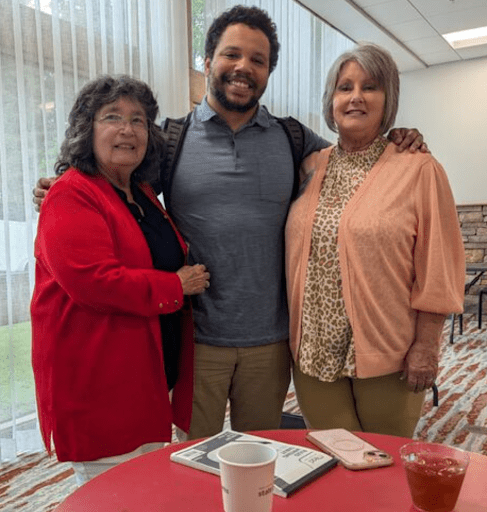
As Marcy Tate, vice president of the chapter put it, “Black lung is one of the residual effects of the millions of dollars that have come out of our mountain communities in the form of coal mining. We built this nation on the backs of our miners for generations, and now it is time to take care of them.”
She appreciated that people are once more paying attention to the needs of disabled miners in the region and wants to see concrete legislative action to show that support.
This chapter is one of many across the region. The groups serve as both an organizing space as well as a support system for miners and the families of miners struggling with the financial and health impacts of black lung disease.
The conversation in the meeting is robust. People recap recent interviews with national news outlets, elect new officers and talk through the current political climate and what the future may hold for those currently working in the mines if they lose the agencies that support them.
I attended the meeting to meet people, introduce myself and my work with Appalachian Voices and to talk with them about their experiences navigating benefits under the provisions of the Black Lung Benefits Act.
The Black Lung Program provides monthly payments and medical benefits to coal miners who are disabled from pneumoconiosis (black lung disease) arising from their employment in or around the nation’s coal mines. The program also provides monthly benefits to a miner’s dependent survivors. In some cases, these benefits are paid out directly by the miner’s former employer. The Black Lung Disability Trust Fund is a federal backstop that pays for these benefits in cases where the miners’ employer has gone bankrupt or where no coal company can be identified as responsible for the miner’s disease. It’s funded by a tax on coal production.
Both surface and underground coal mining exposes workers to harmful silica and coal dust, each of which can lead to black lung disease. According to the Cleveland Clinic, black lung is a severe and painful illness, and can lead to additional medical complications such as tuberculosis and lung cancer.
Getting a black lung diagnosis is a lengthy and cumbersome process involving doctors and lawyers. When a miner is diagnosed, they and their dependents are entitled by law to medical and financial benefits. However, these benefits are inadequate, as noted in this report from Appalachian Citizens’ Law Center. Although benefit levels are assessed and adjusted each year, they are tied to the federal pay scale, rather than the rate of inflation. This means that actions such as federal pay freezes impact the rate of black lung benefits, pushing them further behind the rate of inflation over time.
Inflation increased 8% in 2022, but in January 2023, the black lung monthly benefit only increased 4%. This means that the yearly benefits increase only covered half of the expected costs associated with higher inflation, leaving recipients to make up the deficit on their own.
The benefits for a miner and a dependent in 2025 is $1,178 a month — more than $3,000 lower than the average cost of living for people in coal communities like Indiana County, Pennsylvania; Pike County, Kentucky; and Kanawha County, West Virginia.
For years, miners and their supporters have lobbied Congress in support of legislation that would tie benefits to inflation rates. One bill that has been introduced in previous congressional sessions, the Black Lung Benefits Improvement Act, includes a provision to tie the benefit levels to a cost of living adjustment rather than a federal employee pay raise. The bill has been introduced multiple times since 2014, but despite widespread public support from coalfield communities, it has not yet been enacted into law.
Current Senators still serving who sponsored it in the previous Congress include Sens. Tim Kaine, D-Va.), Mark Warner, D-Va., John Fetterman, D-Penn. and Elizabeth Warren, D-Mass. Current House members who sponsored in the previous Congress include Reps Bobby Scott, D-Va., Steve McGarvey, D-Ky., Alma Adams, D.-N.C.), Summer Lee D-Penn..
According to Judy Riffe, a member of the Wyoming County Black Lung Association, it’s critical to pass the legislation not only for retired miners who have been diagnosed with black lung, but also for young miners who are still working, even after a diagnosis.
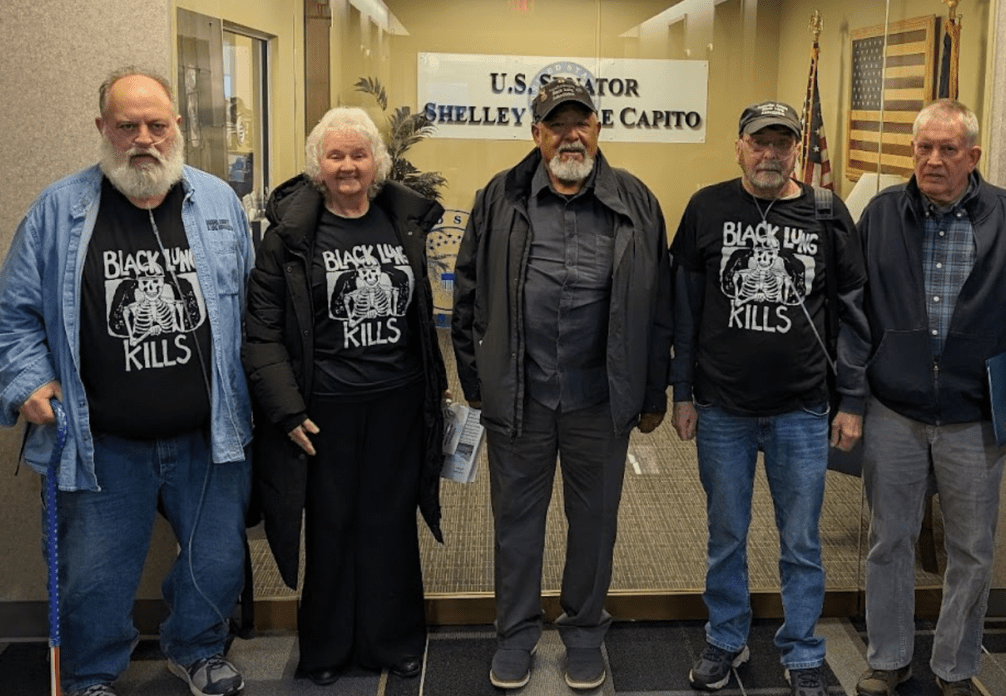
“What are they expected to do?” Riffe asks. “They know they can’t survive on the current benefits.They have families to raise, and so they continue to work for as long as they can, even when it hurts them.”
Black Lung Association members have called their legislators, written to their local papers and even traveled to Washington, D.C, to educate and communicate with members of Congress in person about the importance of this legislation and its potential to positively impact the lives of thousands of miners.
In recent months, a coalition of organizations such as Appalachian Voices and the Appalachian Citizens’ Law Center, along with the national and chapter Black Lung Associations, have worked with county governments to pass resolutions in support of raising the black lung benefits rates, as well as tying those rates to the cost of living. These resolutions aim to garner county-level governments’ official support in urging state and federal legislators to introduce and pass the Black Lung Benefits Improvement Act into law. To date, resolutions have passed in three counties in Ohio, seven counties in Pennsylvania, and 13 counties in West Virginia.
Here in Virginia, resolutions have already been introduced in Wise, Dickenson and Lee counties. In all counties, the resolutions were met with positive support and appreciation from both residents and the board of supervisors to whom the resolutions were presented. Both Wise County and Dickenson County passed the resolution unanimously on the first read.
In Lee County, the first presentation was positively received by community members and the Lee County Board of Supervisors, and the vote on the resolution is on the agenda for its July meeting. Our Black Lung Association allies and I will be presenting additional resolutions in Dickenson, Scott and Russell counties in Virginia. We will continue this work to secure necessary benefits and honor the lives of our hard working miners.
Appalachia’s coal miners helped power our country for generations, and they deserve better. Please take a moment to write your members of Congress and tell them to support increasing the black lung stipend.

PREVIOUS
NEXT

Leave a comment
Your email address will not be published. Required fields are marked *
2 responses to “Miners continue long fight for adequate black lung benefits ”
-

The Black Lung Disability Trust Fund is a federal backstop that pays for these benefits in cases where the miners’ employer has gone bankrupt or where no coal company can be identified as responsible for the miner’s disease. It’s funded by a tax on coal production.”
The employers go bankrupt often, intentionally to avoid these benefits and reclamation.
The state of WV is trying to pass legislation that requires reclamation money be put in before mining. Maybe they should do the same with the black lung money since they aren’t responsible enough to take care of their requirements.
These corporations are responsible even if they do not which one, split it.
Enough giving these corporations short cuts. We have done it for years because we needed jobs but they took advantage of that and manipulated our communities. They have intentionally cut corners that harm us and our land while giving us the “poor us” song and dance and now we are the ones stuck with undrinkable water and 12 years shaved off our life (community members in WV, not miners).
At the end of the day, its just another business to them. They have made by far more money than they let on. Look how they leave our people and our towns.
Hold them responsible. -
“The Black Lung Disability Trust Fund is a federal backstop that pays for these benefits in cases where the miners’ employer has gone bankrupt or where no coal company can be identified as responsible for the miner’s disease. It’s funded by a tax on coal production.”
The employers go bankrupt often, intentionally to avoid these benefits and reclamation.
The state of WV is trying to pass legislation that requires reclamation money be put in before mining. Maybe they should do the same with the black lung money since they aren’t responsible enough to take care of their requirements.
These corporations are responsible even if they do not which one, split it.
Enough giving these corporations short cuts. We have done it for years because we needed jobs but they took advantage of that and manipulated our communities. They have intentionally cut corners that harm us and our land while giving us the “poor us” song and dance and now we are the ones stuck with undrinkable water and 12 years shaved off our life (community members in WV, not miners).
At the end of the day, its just another business to them. They have made by far more money than they let on. Look how they leave our people and our towns.
Hold them responsible.


Leave a Comment