
Front Porch Blog
There’s no excuse for not raising black lung benefits

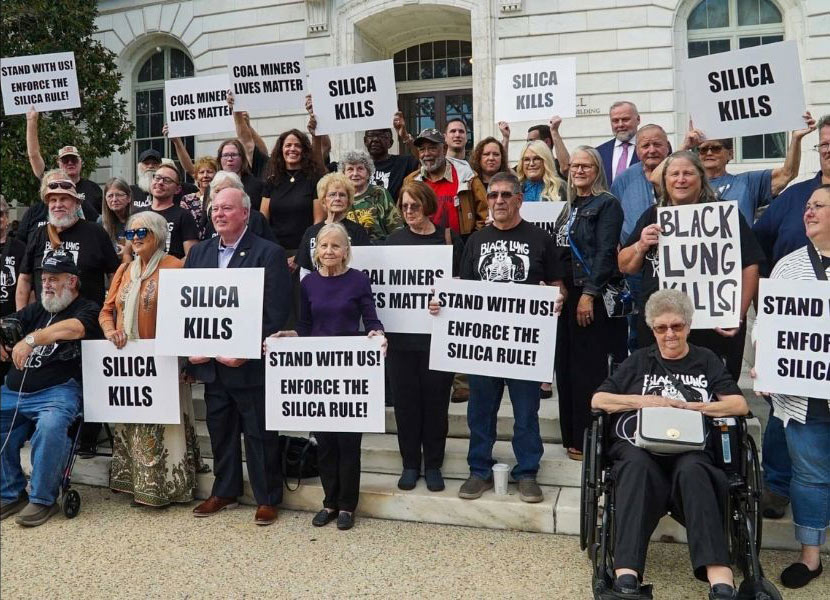
Retired miners, their families and advocates visited the U.S. Capitol in October to urge members of Congress to increase black lung disability benefits and push for stronger protections against the deadly silica dust that contributes to black lung disease. Photo by Jen Lawhorne
Brendan Muckian-Bates, policy & advocacy associate for Appalachian Citizens Law Center, and Caleb Gore, black lung field coordinator for Appalachian Voices, contributed to this blog post.

In August, members of the Black Lung Association of Southeastern Kentucky sent a letter to their U.S. House representative, Hal Rogers, asking him to sponsor the Support Our Miners Act. The bill would increase monthly federal benefits for coal miners disabled by black lung and their dependents, align monthly stipend levels with the rising cost of living and ensure that future payments keep pace with inflation. The need for this is urgent — black lung disease is at a 50-year high and is afflicting younger miners, but black lung benefits have failed to keep up with inflation for decades and are woefully inadequate.
In a statement to the media, Rep. Rogers didn’t address whether he supported increasing the black lung payment, but he did pivot to a common critique of increased black lung stipends: that increases to the disability payment would risk the security of the Black Lung Disability Trust Fund. Rogers said that Democrats who support the bill “talk openly about their desire to increase benefits” but “aren’t being transparent about their movement to destroy the trust fund through their targeted war on coal, and sticking taxpayers with the bill.”
His emphasis on taxpayers covering shortfalls in the trust fund misses the point. The coal companies should be the ones paying to cover black lung benefits, not the American taxpayer. Miners contracted black lung disease on these companies’ watch after they failed to properly protect their employees from the deadly disease. Rogers ignores this in his statement and absolves the coal operators of their duty to these miners and their families.
The trust fund’s finances are complicated, but this is no excuse not to take action to address the hardship faced by miners and their loved ones.
Let’s take a look at how the black lung benefit system works, and the flaws in Rogers’ rationale for not supporting a desperately needed increase in black lung benefits.
Getting black lung benefits
A coal miner who has been diagnosed with black lung disease is entitled to apply for benefits through the national black lung program created by Congress in 1969. The coal company responsible for the miner’s illness is supposed to cover the cost of benefits, though there’s a backstop for situations where the company is bankrupt or no longer exists.
For many miners and their dependents, applying for federal black lung benefits is a long and arduous process. Coal companies often dispute whether the claimant has black lung disease, the severity of the disease progression, and whether the operator is liable for providing these benefits. If the miner’s claim is ultimately successful, they are eligible to receive monthly disability payments and health care related to their diagnosis.
Black lung benefits are too low
The disability stipend that a disabled coal miner receives varies depending on how many dependents they have. In 2026, the monthly payment ranges from $793.60 for a single miner with no dependents to $1,587.10 if the miner has three or more dependents.
Monthly black lung disability payments have never been a fair replacement for future wages lost due to black lung disease. Due to rapidly increasing costs of living, the gap has only gotten worse. Plus, when the black lung program was created, miners with black lung were more likely to be older and have worked for more years. Now, due to increasing exposure to toxic silica dust, miners are getting black lung earlier in their careers. Miners in their 30s and 40s are now facing the reality of a debilitating disease that takes away their ability to provide for their families.
The monthly payment is set at roughly 37% of a GS-2 federal employee — the second-lowest tier on the federal payscale, commonly offered to food service workers in government buildings. When these federal employees don’t get a pay raise, or one that doesn’t reflect a fair cost of living increase, black lung beneficiaries don’t either. In fact, the monthly disability payment is worth 40% less than it was when it was originally created in 1969, when adjusting for inflation.

Efforts to fix black lung benefits
In the last few Congresses, lawmakers have introduced the Black Lung Benefits Improvement Act to fix this and other issues with the claims process. Among other objectives, the bill would permanently tie black lung disability payments to inflation going forward. A 2022 Congressional Budget Office review estimated that this provision within the bill would cost just over $5 million per year over 10 years. This spending is minor compared to the massive tax breaks provided by President Donald Trump’s “One Big Beautiful Bill” or the extravagant renovations of the White House.
For the first time ever, a separate, standalone bill focused on improving the monthly disability payment was introduced earlier this year. The Support Our Miners Act hones in on the benefit provision within the Black Lung Benefits Improvement Act and takes it a step further by retroactively accounting for 50 years of unfair increases and permanently tying benefits to inflation. This would be a small cost compared to the physical price paid by miners who risked their health to power the country, only to receive a preventable disease because coal operators did not do enough to protect them.
Legislation to support Central Appalachia’s coal miners should be a no-brainer. However, when Appalachian Voices, Appalachian Citizens’ Law Center, and other coal miner advocates talk with members of Congress about supporting bills to increase the monthly disability benefit, often the first question from skeptics like Rogers is, “But what about the trust fund’s solvency?”
What does the Black Lung Disability Trust Fund have to do with anything?

When Congress first created the federal black lung benefits program, they severely underestimated how many miners had the disease. They also intended for it to be temporary, thinking that the problem needed to be acted upon quickly and that states would develop relevant workers’ compensation programs to address black lung over the long term. By and large, states did not do this, and the federal government was left to pick up the tab.
In 1977, Congress passed the Black Lung Benefits Revenue Act, requiring coal companies to provide medical care and disability benefits for their workers who contract this disease and establishing an excise tax on each ton of coal mined in order to finance the Black Lung Disability Trust Fund, which provides these crucial lifelines to miners whose previous employers cannot pay.
Although the trust fund is in debt, this debt is owed to the U.S. Treasury. The excise tax, which was updated in 2022 with the Inflation Reduction Act, provides enough revenue to cover the fund’s black lung obligations and administrative costs. But the fund itself is burdened by the interest owed on its debt, which has been accumulating since 1977. In 2008, Congress forgave a portion of the debt, but that wasn’t enough to make the trust fund fully self-sustainable.
Each year, the House and Senate Appropriations Committees give the trust fund the authority to borrow funds from the Treasury to service its debt. It is true that there is an additional small cost for raising the monthly black lung benefit, but it pales in comparison to many of Congress’s other priorities, including handouts to fossil fuel companies. Congress can also take actions to support the fund’s solvency.
What Congress needs to do
The first step in reducing the financial burden on the trust fund is to prevent black lung disease at the source. Lawmakers who claim to support coal miners should demand that the Mine Safety and Health Administration retain and enforce strong protections for miners from silica dust — the agency is currently doing the opposite. If they sincerely care about the well-being of miners and the trust fund’s solvency, they should work to identify ways to improve its finances and request that MSHA follow the recommendations laid out by the Government Accountability Office. One recommendation was to have better oversight over self-insured coal companies, which put a strain on the trust fund’s finances.
Recent congressional actions are a step backward. Last year’s Big, Beautiful Bill included a tax break for metallurgical coal, which is largely exported. There is no excise tax on exported coal, so mining it doesn’t boost the trust fund, but the miners digging that coal are still subjected to conditions that cause black lung. In effect, we are incentivizing an increased black lung risk while not funding the program to support it. Congress should consider increasing the excise tax or shifting towards a severance tax method on exported coal so that it could begin providing some financial relief to the fund.
Addressing the problems facing the trust fund, the increasing black lung epidemic and insufficient disability payment levels should not be subjected to this much hand-wringing by lawmakers like Rogers, whose district has the most people receiving black lung benefits according to DOL data. Many of these miners have paid the ultimate price to power this country and it is only right that they are fairly compensated for the injuries they incurred from this work. Fifty million dollars over 10 years is a low financial cost for the nation, but it would help rectify the massive human cost these miners and their families have paid. Setting aside concerns about the finances and debt of the fund, supporting disabled miners and their families is simply the right thing to do.
Take a moment to tell your lawmakers to endorse the Support Our Miners Act!

PREVIOUS
NEXT
Related News

Leave a comment
Your email address will not be published. Required fields are marked *
Leave a Comment