
Front Porch Blog
What’s next for TVA?
TVA’s new board of directors doubles down on coal, bringing new questions about its future leadership, transparency and energy portfolio

Leah McCord, Tennessee projects coordinator at Appalachian Voices, addresses the TVA Board of Directors at a public listening session in Knoxville, Tennessee, on Aug. 20, 2025. Photo by Abby Hassler/Appalachian Voices
Director of Government Affairs and Strategy Chelsea Barnes contributed to this post.
Editor’s note: This blog was updated from a version published on Feb 9.
The vast majority of residents across the Tennessee Valley likely don’t start their day thinking about the future of the Tennessee Valley Authority, our nation’s largest federally owned electric utility, or its board of directors, which is responsible for its oversight.
But many of us do worry about rising utility bills, growing economic uncertainty, protecting our public lands and waterways, and the increasing frequency of natural disasters. If you’re one of 10 million people across TVA’s seven-state service region, TVA’s future direction and your concerns may be interconnected.
Due to its unique structure, TVA’s reach goes beyond just electricity. It manages thousands of acres of public land that we can use for hiking, camping, hunting, and more. It oversees navigation of the vital Tennessee River, controls flood mitigation efforts and even conducts economic development in the region.
After months of turmoil on its board of directors, TVA’s newly sworn-in board immediately voted to keep its coal plants in operation, eliminate goals around renewable energy and equity, inclusion and diversity, and approve additional power for Elon Musk-affiliated data centers in Memphis, among other decisions. With TVA cutting the public out of crucial decision-making processes and the consideration of another controversial TVA board nominee, you might want to pay attention to what’s been going on and what might be next for this public power provider.
Trouble on the TVA board: How did we get here?
Unlike privately owned utility companies that answer to shareholders and state public utilities commissions, TVA answers to its board of directors. The TVA Board of Directors provides oversight and consists of up to nine members, who serve five-year terms after being nominated by the president and confirmed by the Senate.
Last year, President Donald Trump fired three members of TVA’s board of directors and pressured the remaining members to fire the utility’s new CEO, Don Moul. They did not, and the president doesn’t have the authority to remove TVA’s CEO outright. Meanwhile, the board was left without a quorum, the minimum number of board members required to be present to vote and make key decisions, as only three of the nine positions were filled.
After months of turmoil and uncertainty, four new board members nominated by Trump — Jeff Hagood, Mitch Graves, Randy Jones and Arthur Graham — were confirmed by Congress in December 2025 and sworn into office this year. We’ve previously written about how most of these new board members lack the expertise or diversity we would like to see on the board. During their Senate Environment and Public Works Committee hearing, each of the four nominees said they opposed privatizing TVA. However, there seemed to be some leeway regarding selling some of TVA’s assets, such as when Graham said, “until I hear something different, I don’t see any need to make any changes as far as selling off assets.”
The more controversial fifth nominee, Lee Beaman, underwent a hearing but ultimately didn’t receive a vote, and his nomination expired at the end of last year. More on that in a moment.
It’s important to note that the TVA board may have a quorum for now, but there are two members, Bobbly Klein and the newly appointed Art Graham, whose terms both expire on May 18, 2026. Graham was recently renominated to serve beyond his brief tenure. Both Klein and Graham can stay in their current positions through the end of 2026, even if they have not been reconfirmed or replaced.
Currently, Trump has not nominated anyone to replace Klein. Meanwhile, two positions remain vacant on the board, and Trump could fire additional members, causing the board to lose quorum again.
Embracing coal
TVA once again has a fully functioning board of directors and returned to work at its February board meeting in Hopkinsville, Kentucky. But in a shocking move that appears politically motivated, the newly appointed board voted unanimously to scrap longstanding plans to retire its Kingston and Cumberland coal plants, while bringing new methane gas power plants online at the same sites. This decision was made without any public input, subverting the public power process.
“Let me be very clear: Thanks to the administration and this board, we intend to operate all of our coal units, Cumberland, Kingston, Gallatin and Shawnee for as long as we possibly can to support our energy resilience and energy affordability in the Valley,” said Tom Rice, TVA’s executive vice president and chief financial officer, at the February board meeting.
For years, TVA claimed that its methane gas buildout was necessary to retire these coal plants, citing that keeping the coal units online could increase costs for customers and create reliability concerns.
“TVA already found these coal plants to be uneconomical and unreliable, and that hasn’t changed just because the administration wants to keep coal online,” said Leah McCord, Tennessee Projects and Coalition Coordinator at Appalachian Voices. “For TVA to take this action without public input is contrary to the public power model these new board members all recently affirmed.”
The board also eliminated goals related to renewable energy technologies and equity, diversity, and inclusion from its strategic priorities, and approved 150 megawatts of power for the contested data centers operated by Musk’s xAI in Memphis.
At this meeting, we had anticipated that one topic of discussion would be TVA’s Integrated Resource Plan, which serves as the utility’s “compass” for power generation, shaping the region’s energy future for the next 25 years. TVA released its draft 2025 IRP last year, but because the board didn’t have a quorum, its members couldn’t vote on the final version. At some point, the new board will either accept an existing version yet to be seen by the public or request major changes from TVA staff. However, the board made no mention of this crucial planning process during their first meeting.
Trump renominates Lee Beaman to the TVA board
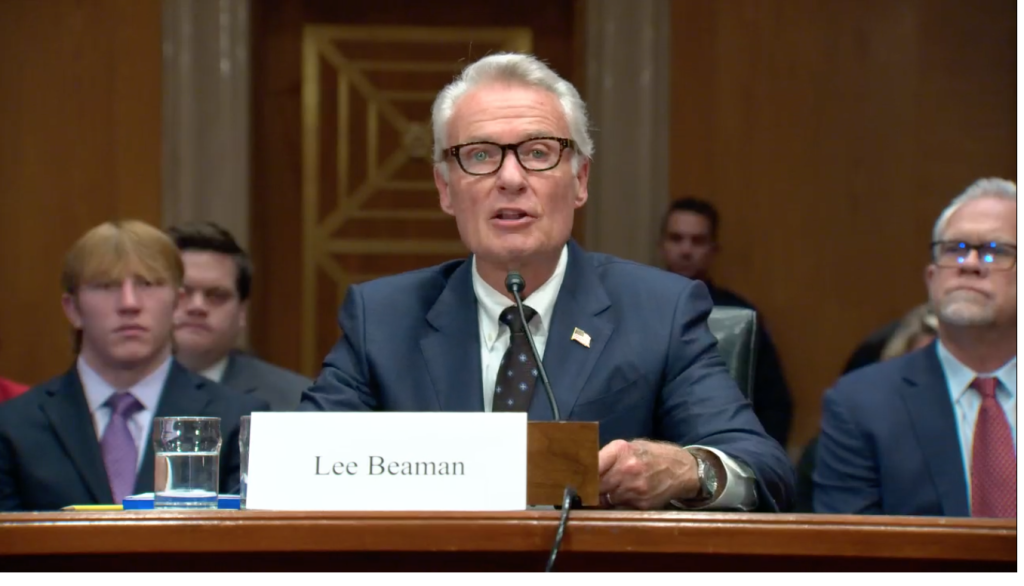
In January, the president renominated Lee Beaman to the TVA board. Put simply, political megadonor Lee Beaman is a poor choice. And to paraphrase Brianna Knisley, director of public power campaigns at Appalachian Voices, we’ve never seen a TVA board nominee who has given us more cause for concern than Beaman. Not only does he lack any known experience in energy or utilities, but there are troubling allegations about his personal conduct and integrity. He may soon go through another Senate Environment and Public Works Committee hearing before his nomination goes to a full Senate vote.
In his opening statement for Beaman’s first hearing, Sen. Sheldon Whitehouse, ranking member of the committee, noted that Beaman “has a ‘Freedom Award’ from the Koch-backed Americans for Prosperity, a battleship of the fossil-fuel influence armada. When the ask comes to raise customers’ rates by backing away from clean energy, it’s a safe bet whose back he’ll have.””
During the hearing, senators grilled Beaman about violent statements his pastor has made — and who Beaman brought to the hearing — along with Beaman’s involvement in alleged campaign finance violations and a related House ethics investigation, allegedly attempting to falsify federal election results, and ethical concerns regarding Beaman renting housing to members of Congress, including House Speaker Rep. Mike Johnson. Not to mention, many community members are concerned that Beaman will help facilitate the Trump administration’s scheme to sell TVA’s publicly owned assets to private corporations.
Ahead of the hearing, Rep. Steve Cohen of Tennessee had urged committee members to reject Beaman, writing that “confirming a nominee without relevant qualifications and burdened by significant ethical and character concerns would risk undermining the stability and integrity of the nation’s largest public power utility at a time when prudent oversight is more important than ever.”
We need real leadership on the TVA Board of Directors. Not Beaman. With electricity prices rising nationwide and the Trump administration’s halt to cost-saving clean energy projects, Beaman is the wrong choice for TVA.
Demand more transparency from TVA
Beyond the TVA board, Congress is considering three bipartisan bills to enhance transparency, accountability and long-term planning at the federal utility: the TVA Salary Transparency Act (H.R. 144 / S. 1354), the TVA Transparency Act (H.R. 1373) and the TVA Increase Rate of Participation Act (H.R. 6357). Here’s what those bills do:
- TVA Salary Transparency Act: This bipartisan bill seeks to strengthen TVA by increasing transparency and accountability for its highest-paid employees while keeping energy prices low. Right now, TVA is only required to disclose salaries of its five top-earning employees in its annual filings — all five make more than $2 million a year, and in 2023, TVA’s former CEO made over $10.5 million, making him the highest-paid government employee in the nation. This act would expand this filing to all employees at the management level and above, among other provisions. Sponsors of the bill include Reps. Tim Burchett and Steve Cohen, and Sens. Marsha Blackburn and Bill Hagerty.
- TVA Transparency Act: TVA’s Board of Directors approves the utility’s long-term energy plan and sets power rates. It also has five committees where much of the board’s deliberations take place and recommendations are developed. These committee meetings are not open to the public. This bipartisan bill seeks to increase transparency and accountability by ensuring more opportunities for public input and participation at the utility’s board and committee meetings. Bill sponsors are Reps. Burchett and Cohen.
- TVA Increase Rate of Participation Act: This bipartisan bill requires TVA to meaningfully involve the public in its long-term energy planning, or IRP, process. While TVA has a hand-selected IRP Working Group and opportunities for public comment, its current process lacks the transparency and consequential stakeholder input processes needed to avoid public distrust and outdated modeling assumptions. Additionally, the bill urges TVA to incorporate extreme-weather risk, resilience measures and public health concerns into its IRP modeling process. Bill sponsors are Reps. Burchett and Cohen.
In a time when public trust in government is at an all-time low, shouldn’t we demand more from our federal institutions and nominated leaders, especially those who set the price of electricity and maintain many beloved public lands in our region?

PREVIOUS
NEXT

Leave a comment
Your email address will not be published. Required fields are marked *
Leave a Comment