
Front Porch Blog
Fighting for breath: Miners and advocates take their plea for stronger black lung protections from the coalfields to the Capitol

Miners and advocates gathered outside the Department of Labor on October 14, 2025. Photo by Chelsea Ruth Barnes
Martha Thomas is a sweet, elderly woman with a lot of grit. She still drives herself around in a small pickup truck and has lived on her own since her husband, Basil, died in 2018 due to complications from black lung disease.
Martha and Basil met in 1975 and enjoyed 38 years of marriage together after a five-year courtship, and had one child. Martha spent her working career in restaurants, and Basil spent his in the mines until he was injured on the job in the 1980s. Shortly after that, he was diagnosed with black lung disease. Basil received black lung benefits, but by the end of the decade, his approval for benefits was reversed. After years of fighting through the court system, Basil’s black lung benefits were reinstated in the 1990s.
“He just kept getting worse and worse,” she said. Basil Thomas’ life with black lung was marked by multiple long hospital stays and an ongoing barrage of respiratory and circulatory health issues.
“I took him to see his regular physician — his primary care doctor — for a regular checkup,” she said. “And when she opened the door and come into the room, she just looked at him, and she started hollering for them to call 911, that he was in respiratory failure. Oh, gosh, and I fell apart.”
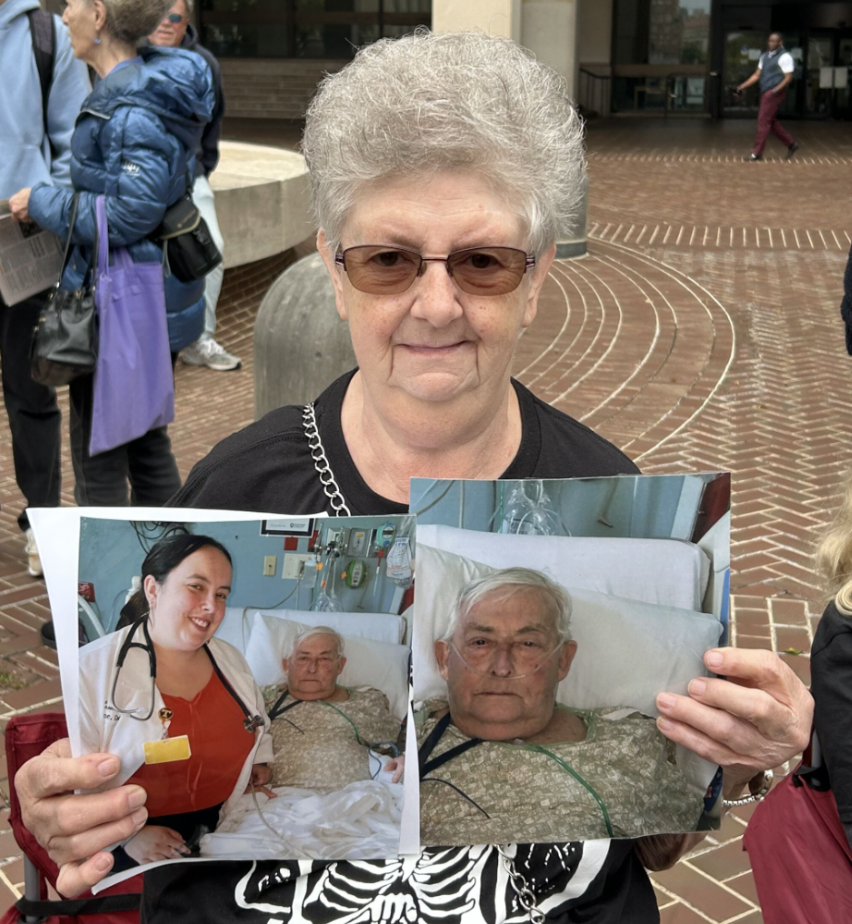
Martha Thomas holds photos of her late husband, Basil, at the rally. Photo by Andrea Garrison
I met Martha during a road trip. I had been asked to drive a large passenger van from Wise County, Virginia, to Washington, D.C. To be completely honest, I was a bit reluctant to do it. I hadn’t driven in the D.C. metro area since 2010, and the thought of facing the big city traffic in a 15-passenger van was just a little intimidating, even for a former delivery driver.
Ultimately, though, I am so thankful I got to have this experience, if for no other reason than it helped me meet some of the folks we support through our work here at Appalachian Voices. As a communications coordinator and writer, I spend a lot of time at my computer on Zoom calls and creating content, and not quite as much time as I’d like out in the “real world” talking to the people our work serves face-to-face.
Truth be told, I suppose I was drawn to Martha because, not only did she share a first name with my own great-grandmother (who I wrote a bit about last year), she also reminded me a lot of Granny Pennington. Both women had that sweet-but-tough demeanor I associate with the many strong Appalachian women who’ve faced their share of hard times that I’ve been blessed to know.
The purpose of the trip was to deliver the most precious cargo I’ve ever delivered. I would be taking a group of retired coal miners, as well as one coal miner’s wife and one widow (Martha) to the Department of Labor to a rally organized by the National Black Lung Association and local chapters. The rally was also supported by Appalachian Voices, the United Mine Workers of America, Appalachian Citizens’ Law Center and others (see sidebar). There, miners and advocates gathered to push the Trump administration to stop delaying a rule that would help protect miners from black lung disease by reducing the amount of respirable silica dust that workers are exposed to on the job.
Silica dust is one of the key contributors to black lung disease, which has been on the rise throughout Appalachia over the past 20 or so years, with miners being diagnosed and even dying at younger ages than ever before. Silica dust exposure is dangerous and deadly, and as the remaining coal in the hills of Appalachia has become harder to mine, miners must cut through ever increasing amounts of sandstone, which means more and more exposure to this deadly dust.
In spite of silica’s known toxicity, it is legal for miners to be exposed to higher levels of silica than any other American worker. A long overdue rule to rectify that was finalized in April 2024 by President Joe Biden and Chris Williamson, then-Assistant Secretary of Labor in charge of the Mine Safety and Health Administration and the grandson of West Virginia coal miners. But the rule has faced multiple delays in the second Trump administration.
The rule was supposed to go into effect in April 2025, but is currently under a court stay due to a lawsuit from the mining industry, with litigation continuing to block the life-saving protections. Rather than counter industry proposals to modify and stay the rule, the Trump Administration is negotiating with them.
Continuing to delay the rule has deadly consequences. As United Mine Workers President Cecil Roberts, who is set to retire later this month, put it in a fiery speech on the steps of the Department of Labor: “We put people in prison for life for murdering people with a pillow — holding it over their face until they’re dead. Right now, those responsible for the lack of action, those responsible for challenging this rule, those who could do something but who aren’t doing something — you are just as guilty as the person that has that pillow!”

On a crisp October morning, over 80 miners and advocates gathered outside the Department of Labor for the rally with major mainstream news outlets such as The New York Times, The Boston Globe, Fortune and others covering the event. The rally also gained attention from those passing by, with several stopping to take photos or just give a friendly wave of encouragement.
Not knowing what to anticipate going into Washington, D.C. given the current political climate, I was pleasantly surprised by the friendliness and helpfulness of the members of the Washington, D.C., metro police who were on-hand at the event as they quickly cozied up to several of the ralliers and thanked us for coming to D.C. to exercise our constitutional rights, an important reminder of the right to free speech and free assembly that we are guaranteed as Americans under the Constitution.
In addition to Roberts, speakers included National Black Lung Association President Gary Hairston, Black Lung Association Vice President Vonda Robinson, United Mine Workers President Secretary-Treasurer Brian Sanson and the University of Illinois Chicago’s Mining Education and Research Center Assistant Director Leonard Go. The rally also included a brief invocation and opening remarks from Rev. Brad Davis, a West Virginia-based Methodist minister who has been working at the intersection of faith and advocacy in the heart of the Appalachian coalfields.

Davis, who lost his grandfather to black lung when he was a child. He sees standing up for the poor, the disabled and historically disenfranchised communities as being at the heart of his Christian faith. I caught up with Davis after the event to ask him about his thoughts on the rally and what he hopes the national attention being brought to Appalachian issues, like the long-delayed silica rule, will accomplish.
“I think that’s what we all want to see, is for that rule to finally be put in place and enforced,” he said, referring to the silica rule. “I would just like to say to the people in power that have the opportunity to do the right thing and implement this rule. You know, our people have suffered long enough. We’ve been exploited long enough. We’ve been sick and dying for far too long. It’s way past time for the exploitation to stop and for our people to be placed above profit margin.”
Amen, Reverend. Amen.
How you can help
Appalachian coal miners and advocates are continuing to fight for stronger black lung protections. You can help by calling your congressional representative and telling them to ensure that the agencies that help protect miners on the job — such as the Mine Safety and Health Administration and the National Institute for Occupational Health and Safety — are fully funded and that the silica rule is enacted.
Making a phone call is one of the most effective ways to make change. Please take a moment to call your House representative through our easy to use click-to-call system. Tell your representative to protect mine safety funding and fully implement and enforce the silica rule!

PREVIOUS
NEXT

Leave a comment
Your email address will not be published. Required fields are marked *
2 responses to “Fighting for breath: Miners and advocates take their plea for stronger black lung protections from the coalfields to the Capitol”
-

Trump is making our country worse and worse with his stupid policies. And it’s hurting all the citizenry. The GOP needs to do the right thing because Trump doesn’t know what that is!!!!!!
-
Our government should be doing everything possible to keep the citizens of this great country safe while working at their jobs. Please help the people who work in the mines. Nobody wants their job to make them sick!


Leave a Comment