

By Sarah Kellogg
Nestled in a mountain forest of oaks, poplars and rhododendron, a neighborhood of charming houses sits lightly on the land. These are the energy efficient homes of the GreenWood Community, a project of the Watauga County Habitat for Humanity. The neighborhood is the result of hard-working families and dedicated volunteers who share a vision that affordable housing can also be sustainable.
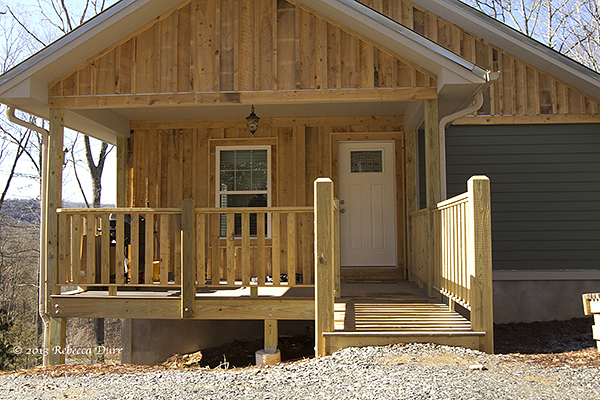
The siding used to construct the GreenWood Community homes is locally sourced hemlock wood. Photo by Alex Hooker
Habitat for Humanity is an international nonprofit organization that helps low-income families finance and build their own homes. Melissa Finger, her husband Kenny and two sons, Isaiah and Dakota, are part of the Watauga County, N.C., Habitat chapter, and will be finishing their own home this February. The experience has been transformative for them — in recent months they have spent every Saturday working and learning together as they construct their sustainable new home.
Since its inception in 1987, Watauga Habitat has constructed 23 homes for those in need of affordable housing. In spring 2011, the organization broke ground on the first of 20 homes that will make up the Habitat GreenWood neighborhood. Today, the two completed houses on this 20-acre plot of land are already a model of affordable and sustainable community development.
“We thought it was important to pull the community together,” says Alex Hooker, executive director of the Watauga Habitat. “The vision is for homeowners to all work together to keep up the community and shape things the way they want to.”
Already, current and future homeowners are bonding as they work on completing the third and fourth houses in the neighborhood. “We’ve all worked on each other’s homes,” says Finger, whose house is GreenWood’s third. “People are going above and beyond — their house is done and they’re still out helping.”
Homeowners and volunteers involved in the construction process have the opportunity to learn about sustainable design, especially when it comes to energy efficiency. “It’s been really exciting to watch my 14- and 17-year-olds learn,” remarks Finger. “I think they’re even more proud than we are.”
Three out of the four homes have south-facing windows with overhangs, which allow sunlight to naturally heat the home, a feature known as passive solar design. Streetlights powered by solar panels are an example of active solar technology, and were provided by a generous donation from Rumple Memorial Presbyterian Church.
The walls of each house are Insulated Concrete Forms — interlocking blocks made of a styrofoam-like substance — that are stacked and filled with concrete. These insulate 50 percent better than what’s required by code, and 20 percent better than Energy Star requirements. The blocks are easy for volunteers to stack, making construction simpler, and are produced only an hour and a half away in Johnson City, Tenn.
Additionally, the GreenWood homes are extremely well-insulated. According to Jim Rogers, the construction coordinator for Watauga Habitat, air leaks in a normal house amount to a window-sized hole, whereas air leaks at the GreenWood homes are the equivalent of a hole the size of a 3-by-5 index card.
Since the homes are so airtight, they are well-suited for a heating and air conditioning unit called a ductless mini-split heat pump. These units can be very energy efficient since they allow for the temperature of each room to be set individually and eliminate the need for air ducts, which account for up to 30 percent of energy loss in a home.
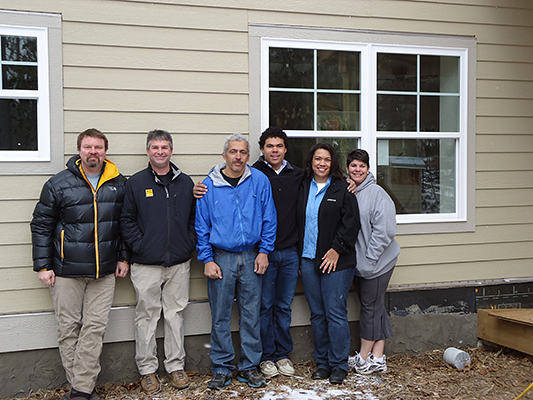
Future homeowners, volunteers and experts help build. Photo by Alex Hooker
Each home is also equipped with Energy Star certified appliances, windows and lighting. All of this energy efficiency means that residents often pay only about $30 a month to heat and cool their 1400-square-foot homes. This will be a major upgrade for the Fingers, who paid almost $450 to heat their home this past December. “We can’t wait to move in,” says Melissa Finger. “We have a single wide trailer that’s freezing cold and our power bills are outrageous, so we’re super excited.”
Watauga Habitat has big plans for the future. They recently received a $50,000 grant from Walmart to build an on-site lumber mill, which will process the hardwood trees that will be cut down to clear the lots for the next sixteen houses. Additionally, Watauga Habitat and the residents plan to expand the community area, build rain gardens and construct sediment ponds to keep runoff from going into streams. They hope to involve students from Green Valley Elementary — just a short walk away — in these projects to provide opportunities for environmental service learning.
With exceptionally low energy bills and exciting plans for community cookouts this summer, everyone at GreenWood is in high spirits. “We truly feel blessed,” says Finger. “It’s an answer to our prayers.”
Watauga Habitat holds regular volunteer days on Wednesday afternoons and Saturday mornings. Call (828) 268-9545.
Related Articles
Latest News
More Stories
Signs of Life
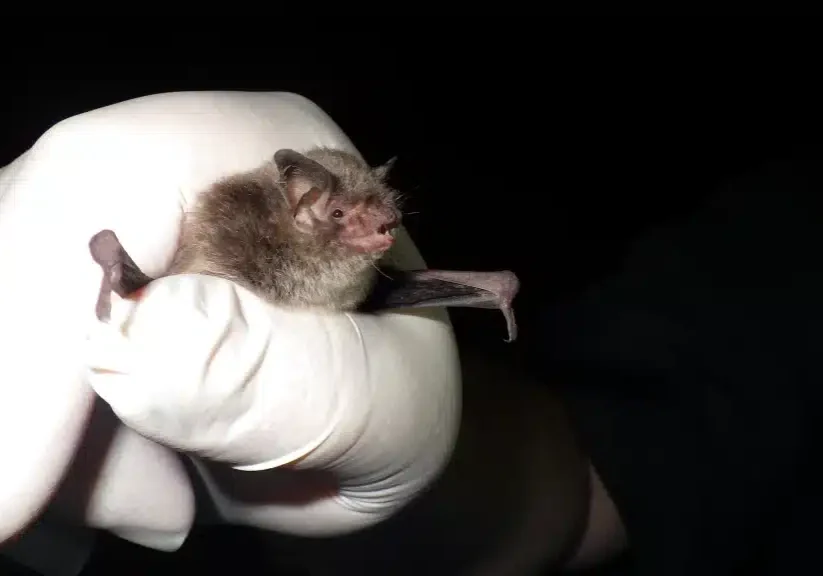
In the Nantahala National Forest, a team of biologists spotted Indiana bats, an endangered species that hasn’t been seen in North Carolina for the last 11 years.

‘First Line of Defense’
During Hurricane Helene and its aftermath, rural fire departments and other first responder hubs played critical roles in keeping their communities safe, even without power and cut off from outside support for days or weeks after the storm. Two years later, plenty of work remains to ensure these hubs have the resources they need to operate day to day and be ready when emergencies or natural disasters strike.

The Rocky Road — and Bridge — to Recovery
Hurricane Helene is estimated to have damaged nearly 7,000 private roads and bridges in Western North Carolina. Two years later, many restoration projects are complete, but the journey hasn’t been easy — and isn’t over for others.
After 20 Years, Letcher County Prison Proposal Is Still Alive, Though Obstacles Remain
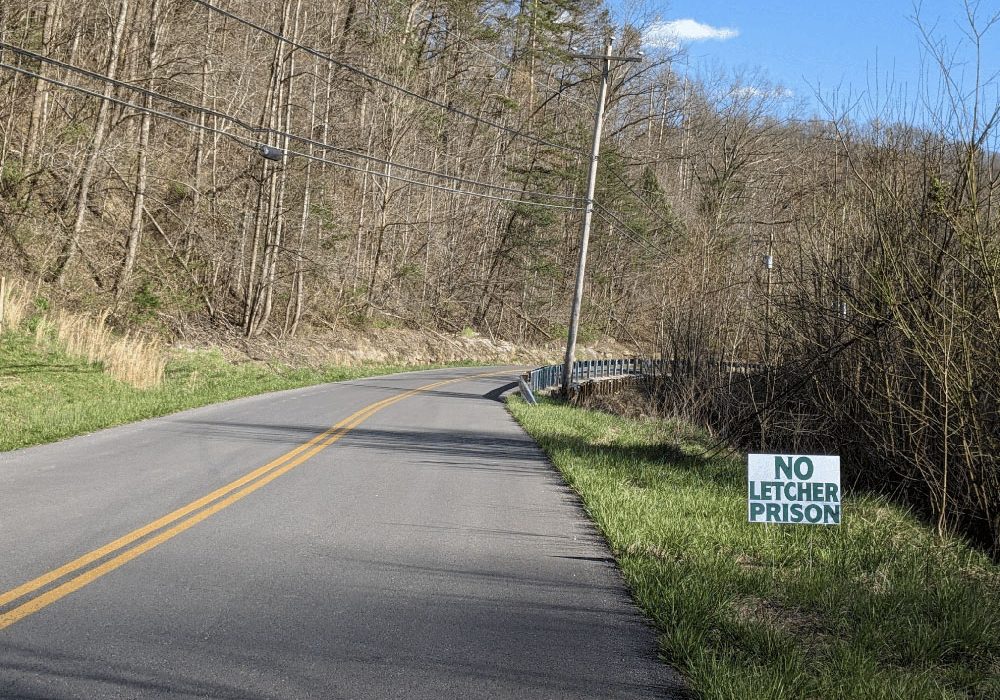
A $605 million proposal for a federal prison on a former strip mine site in Letcher County, Kentucky, championed by U.S. Rep. Hal Rogers, refuses to die, despite local opposition, a lack of support from the executive branch and numerous other obstacles.
The Washout and Rebuild
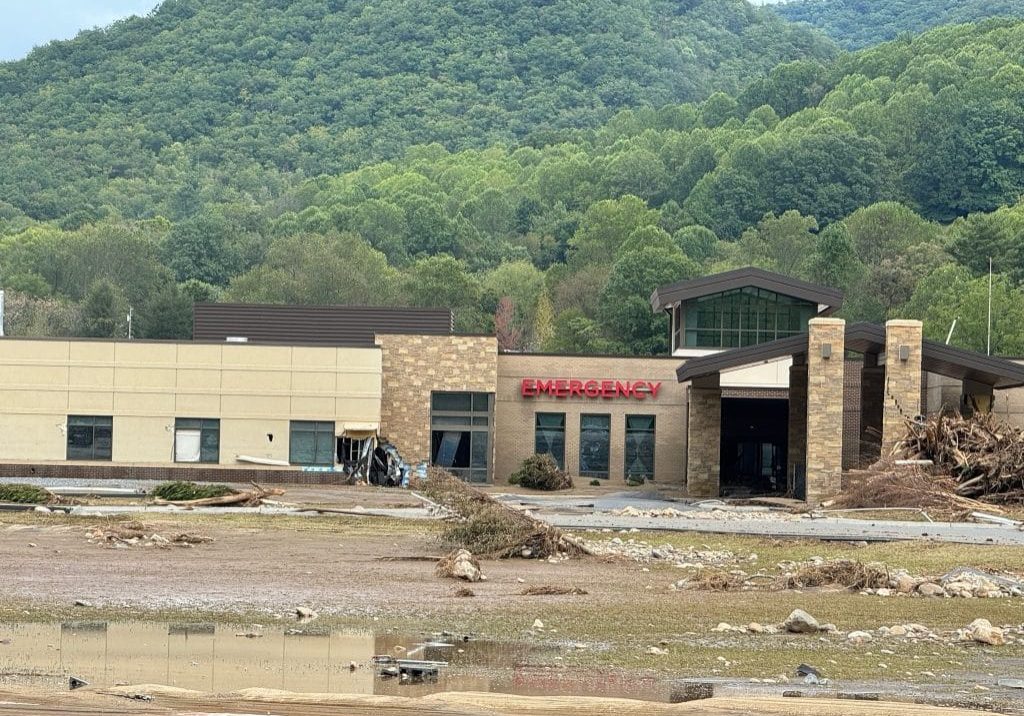
For nearly two years, residents of Unicoi County, Tennessee, have had to make do without a hospital after Hurricane Helene destroyed the rural hospital. Ballad Health, which owns the hospital, broke ground on a new location — in another floodplain — in August 2026.

The Shenandoah Salamander
The Shenandoah salamander is a woodland salamander, which has adapted to life at higher elevations away from water. This sparkling rarity lives among the dry leaves, cracked logs, and stony hillocks on the highest peaks of Shenandoah National Park.

Leave a comment
Your email address will not be published. Required fields are marked *
Leave a Comment