

Report Tracks Appalachian Coal’s Continuing Decline
By Brian Sewell
A report released in May by the West Virginia-based consulting firm Downstream Strategies underscores the need for investment in Central Appalachian counties hardest hit by a decline in coal production and demand. By looking at market and regulatory factors, plus trends in the U.S. and abroad, the report offers a comprehensive examination of the challenges the region faces.
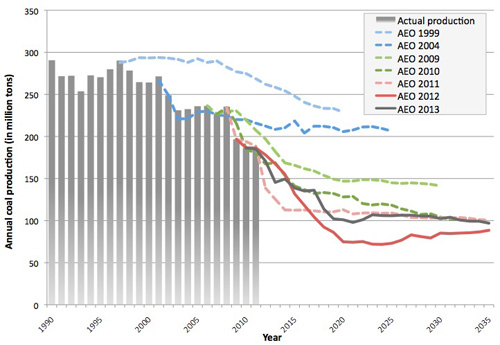
Since peaking in the ’90s, Appalachian coal’s decline has significantly outpaced projections by U.S. Energy Information Administration’s Annual Energy Outlook.
Since its peak in 1997, Central Appalachian coal production has declined faster than annual projections by the U.S. Energy Information Administration. According to the report, production has fallen by 55 percent in Tennessee, 44 percent in eastern Kentucky, 37 percent in Virginia, and 29 percent in southern West Virginia. In 2011, regionwide production was only 185 million tons — just 17 percent of total production nationwide.
The report points out that coal-fired power plants in the eastern United States remain the most important purchasers of Central Appalachian coal, but demand by the electricity sector has dropped precipitously since 2006, contributing to economic turmoil where the coal is mined. The imminent retirement of coal-fired power plants in the region will continue to impact mining employment and severance tax revenues. According to the report, thirty of the 137 power plants that purchased coal from mines in Central Appalachia are scheduled for retirement by 2016.
Counties in eastern Kentucky, where severance tax revenues are in a long-term decline steeper than other states, are most vulnerable to the retirements. Eastern Kentucky mines accounted for approximately 60 percent of all Central Appalachian coal shipped to retiring plants in 2011.
Partially because of this dependency, three counties in Kentucky — Knott, Letcher and Pike — are classified as being highly vulnerable to the factors examined in the report. Wise County, Va., is also classified as highly vulnerable, and ten counties in Virginia, West Virginia, Kentucky and Tennessee are rated as moderately vulnerable.
Read the report at downstreamstrategies.com.
Related Articles
Latest News
More Stories

Halloween Approaches, and Night School Is in Session
The House of Art in Bluefield, West Virginia, looks like a haunted tower, making it the perfect location for its sixth annual haunt event: Night School. The Night School will be open every Friday and Saturday night through Oct. 31.
‘The Most Perfect Act of Love’
After losing its rural pride celebration, hundreds of people attended the second annual Affirming Sumner Pride celebration on a 24-acre farm dubbed “Fruity Farm” in Bethpage, Sumner County, Tennessee.

Signs of Life
In the Nantahala National Forest, a team of biologists spotted Indiana bats, an endangered species that hasn’t been seen in North Carolina for the last 11 years.

‘First Line of Defense’
During Hurricane Helene and its aftermath, rural fire departments and other first responder hubs played critical roles in keeping their communities safe, even without power and cut off from outside support for days or weeks after the storm. Two years later, plenty of work remains to ensure these hubs have the resources they need to operate day to day and be ready when emergencies or natural disasters strike.

The Rocky Road — and Bridge — to Recovery
Hurricane Helene is estimated to have damaged nearly 7,000 private roads and bridges in Western North Carolina. Two years later, many restoration projects are complete, but the journey hasn’t been easy — and isn’t over for others.
After 20 Years, Letcher County Prison Proposal Is Still Alive, Though Obstacles Remain
A $605 million proposal for a federal prison on a former strip mine site in Letcher County, Kentucky, championed by U.S. Rep. Hal Rogers, refuses to die, despite local opposition, a lack of support from the executive branch and numerous other obstacles.

Leave a comment
Your email address will not be published. Required fields are marked *
Leave a Comment