

Fate of Mountain Valley Pipeline’s North Carolina extension still unclear
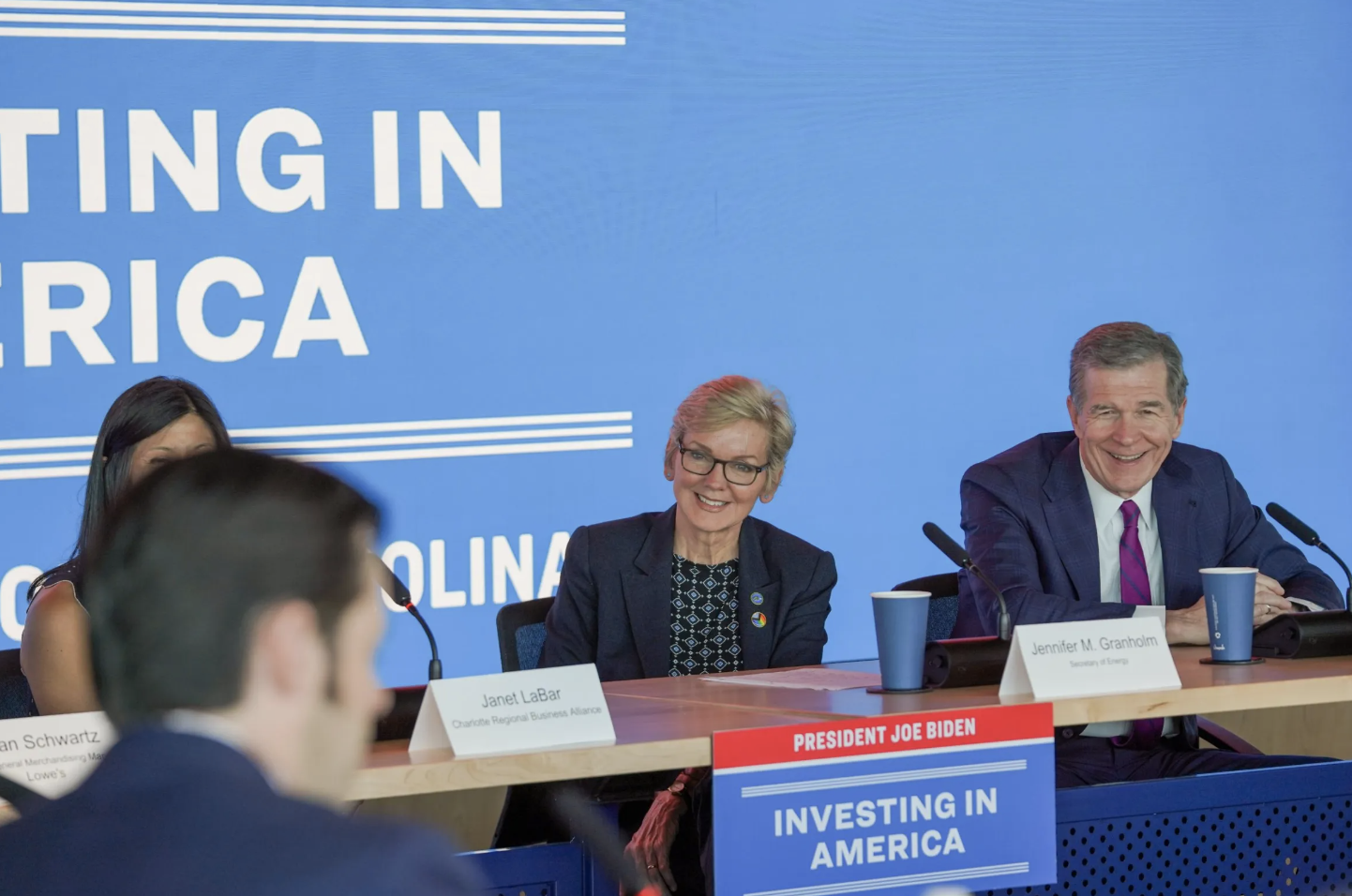
Energy Secretary Jennifer Granholm and North Carolina Gov. Roy Cooper appear at the Clean Energy Roundtable in Charlotte on June 26, 2023. Credit: Department of Energy
By Elizabeth Ouzts, Energy News Network
June 28, 2023
While U.S. Department of Energy Secretary Jennifer Granholm defended the controversial Mountain Valley Pipeline this week, North Carolina Gov. Roy Cooper raised concerns about its planned extension into the state.
The 300-mile natural gas project through the Virginias may be best known as the priority of U.S. Sen. Joe Manchin, the West Virginia Democrat who struck a deal with the White House to unblock its long-delayed permits as part of the recent debt ceiling law.
Granholm, whose agency has no role in permitting pipelines, reiterated her earlier endorsement of the project on Monday, even when asked about recent reports that the project is only slated to run at 35% capacity.
“The administration has supported the MVP on the grounds of energy security,” Granholm said, during a brief sit-down interview with reporters in Charlotte, part of her tour this week to promote federal clean energy initiatives.
“We know that there’s a lot of opposition out there,” Granholm added. “This is the balance that the administration is trying to seek overall. We’ve spent the vast majority of time on the acceleration to clean [energy], while recognizing that there needs to be some fossil available for a period of time until we get to the goal of 100% clean energy.”
Pipeline opponents continue to challenge the project, most recently in lawsuits filed this week arguing that Congress’ interference in executive branch permits is unconstitutional. But no matter what happens with the longer leg, its short extension into North Carolina remains in question.
Proposed to stretch 40 miles through Rockingham and Alamance Counties, the Southgate project has drawn opposition from two local governments and numerous elected officials, many of them Republicans, who argue it interferes with private property rights and local tourism efforts.
Slated to skirt the Haw River, cross the Dan River, and impact dozens of their tributaries, the pipeline extension has also been twice denied a necessary water quality permit from the state Department of Environmental Quality and has yet to reapply.
Southgate also needs reapproval from the Federal Energy Regulatory Commission — permission that U.S. Reps. Kathy Manning and Valerie Foushee, both Democrats, urged the agency this week to reject.
Asked about the project on Monday, Cooper focused on how new natural gas infrastructure could become obsolete in light of the state’s plan to transition to zero-carbon energy by midcentury.
“I have concerns about it,” Cooper said. “We’ve put in place now our Carbon Plan that we hope will rely more on renewable energy. When Duke [Energy] is considering more natural gas plants, I worry about how that will affect costs and consumers, if these are sunken costs.”
He added, “obviously this is a permitting thing. I would hope that the Department of Environmental Quality, when and if the time came, would look carefully at those permits.”
Related Articles
Latest News
More Stories

Halloween Approaches, and Night School Is in Session
The House of Art in Bluefield, West Virginia, looks like a haunted tower, making it the perfect location for its sixth annual haunt event: Night School. The Night School will be open every Friday and Saturday night through Oct. 31.

‘The Most Perfect Act of Love’
After losing its rural pride celebration, hundreds of people attended the second annual Affirming Sumner Pride celebration on a 24-acre farm dubbed “Fruity Farm” in Bethpage, Sumner County, Tennessee.

Signs of Life
In the Nantahala National Forest, a team of biologists spotted Indiana bats, an endangered species that hasn’t been seen in North Carolina for the last 11 years.

‘First Line of Defense’
During Hurricane Helene and its aftermath, rural fire departments and other first responder hubs played critical roles in keeping their communities safe, even without power and cut off from outside support for days or weeks after the storm. Two years later, plenty of work remains to ensure these hubs have the resources they need to operate day to day and be ready when emergencies or natural disasters strike.

The Rocky Road — and Bridge — to Recovery
Hurricane Helene is estimated to have damaged nearly 7,000 private roads and bridges in Western North Carolina. Two years later, many restoration projects are complete, but the journey hasn’t been easy — and isn’t over for others.

After 20 Years, Letcher County Prison Proposal Is Still Alive, Though Obstacles Remain
A $605 million proposal for a federal prison on a former strip mine site in Letcher County, Kentucky, championed by U.S. Rep. Hal Rogers, refuses to die, despite local opposition, a lack of support from the executive branch and numerous other obstacles.

Leave a comment
Your email address will not be published. Required fields are marked *
Leave a Comment