

By Matt Dhillon
Editor’s note: This story provides an update to The Beast of Bristol: The Landfill Haunting Residents of the Twin Cities, a story that first appeared in The Appalachian Voice in March 2022.
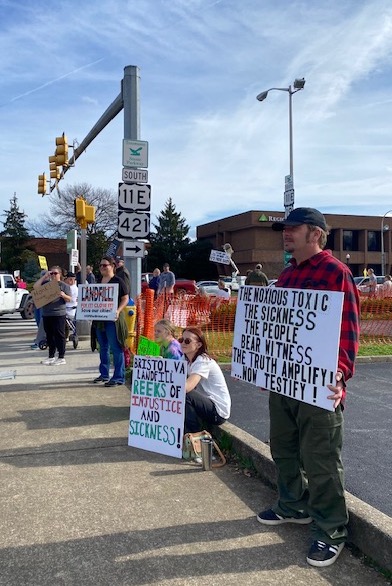
In addition to the noxious smells, residents report headaches, nausea, fatigue, nosebleeds and burning in respiratory passages. Photo by Becky Evenden
Since complaints started in late 2020, Bristol’s twin cities have been grappling with an unwelcome smell coming from the Integrated Solid Waste Management Facility on the Virginia side of the city. But an order from the Virginia Department of Environmental Quality requiring the city of Bristol, Virginia, to cover the landfill offers residents a measure of hope.
“There’s notes of … rotten produce, garbage, feces, death,” says Joel Kellogg, who lives in the Fairmont neighborhood on the Tennessee side of the city.
The smell is so oppressive that residents have taken to calling it “the Beast.”
“There is no getting away from it,” Kellogg says. “It gets in your home; if you open a closet door or a kitchen cupboard, it’s in there. If you open the trunk of your car, it’s in there. If you open your dryer, it is in there. It gets into everything. It gets into your clothes. We’re all running around smelling like landfill.”
Kellogg is the president of HOPE for Bristol, a nonprofit organization formed by locals to push for closing the landfill. But there has been debate over whether it is necessary, or even possible, to close it. In 2021, Bristol, Virginia, spent $2.8 million on efforts to remediate the site. According to Kellogg, however, the smell worsened.
In April 2022, a panel of experts convened by DEQ to evaluate the landfill issued a report. The panel confirmed allegations that high temperatures within the landfill are causing accelerated combustion reactions and the release of offensive gases. The panel recommended strategies for fixing the landfill, including lowering the internal temperature and putting a clay cap on it.
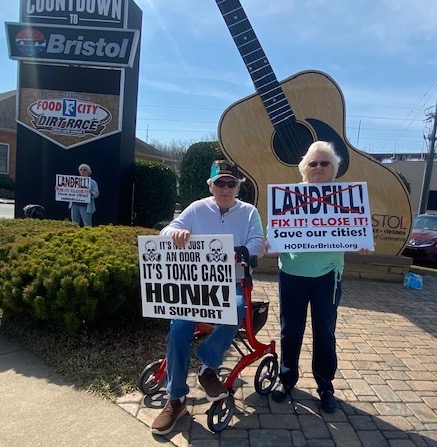
Residents regularly rally in front of the Bristol Chamber of Commerce to protest the ongoing smells from the landfill. Photo by Becky Evenden[
Then, a June 8 letter to the Bristol Virginia City Council from the state DEQ ordered the city to stop receiving waste and install an “adequate intermediate cover” over all existing waste within 90 days. The order also directs the city to implement all of the recommendations suggested by the April report.
The city’s July 6 plan of action in response to the order promises to stop accepting waste by Sept. 9, but says it is unclear whether the city will resume collecting waste after the landfill is remediated.
“It’s a huge win for our community,” wrote HOPE co-founder Becky Evenden in an email referring to the state’s order. “In the meantime, the emissions come and go. People are affected, but the community has become a bit quieter overall as the situation appears to be slowly heading in the right direction.”
Related Articles
Latest News
More Stories
Neighbors Help Neighbors
A photo essay that celebrates the volunteer spirit of the grassroots group Hurricane Helene WNC and speaks to the resourcefulness, collaboration and hard work embodied by thousands and thousands of volunteers, first responders and aid workers across the region after Hurricane Helene.

Halloween Approaches, and Night School Is in Session
The House of Art in Bluefield, West Virginia, looks like a haunted tower, making it the perfect location for its sixth annual haunt event: Night School. The Night School will be open every Friday and Saturday night through Oct. 31.
‘The Most Perfect Act of Love’
Hundreds of people attended the second annual Affirming Sumner Pride celebration on a 24-acre farm dubbed “Fruity Farm” in Bethpage, Sumner County, Tennessee.

Signs of Life: Endangered Bats Found in Nantahala for First Time in More Than a Decade
In the Nantahala National Forest, a team of biologists spotted Indiana bats, an endangered species that hasn’t been seen in North Carolina for the last 11 years.

‘First Line of Defense’
During Hurricane Helene and its aftermath, rural fire departments and other first responder hubs played critical roles in keeping their communities safe, even without power and cut off from outside support for days or weeks after the storm. Two years later, plenty of work remains to ensure these hubs have the resources they need to operate day to day and be ready when emergencies or natural disasters strike.

The Rocky Road — and Bridge — to Recovery
Hurricane Helene is estimated to have damaged nearly 7,000 private roads and bridges in Western North Carolina. Two years later, many restoration projects are complete, but the journey hasn’t been easy — and isn’t over for others.

Leave a comment
Your email address will not be published. Required fields are marked *
Leave a Comment