

Marvin Winstead
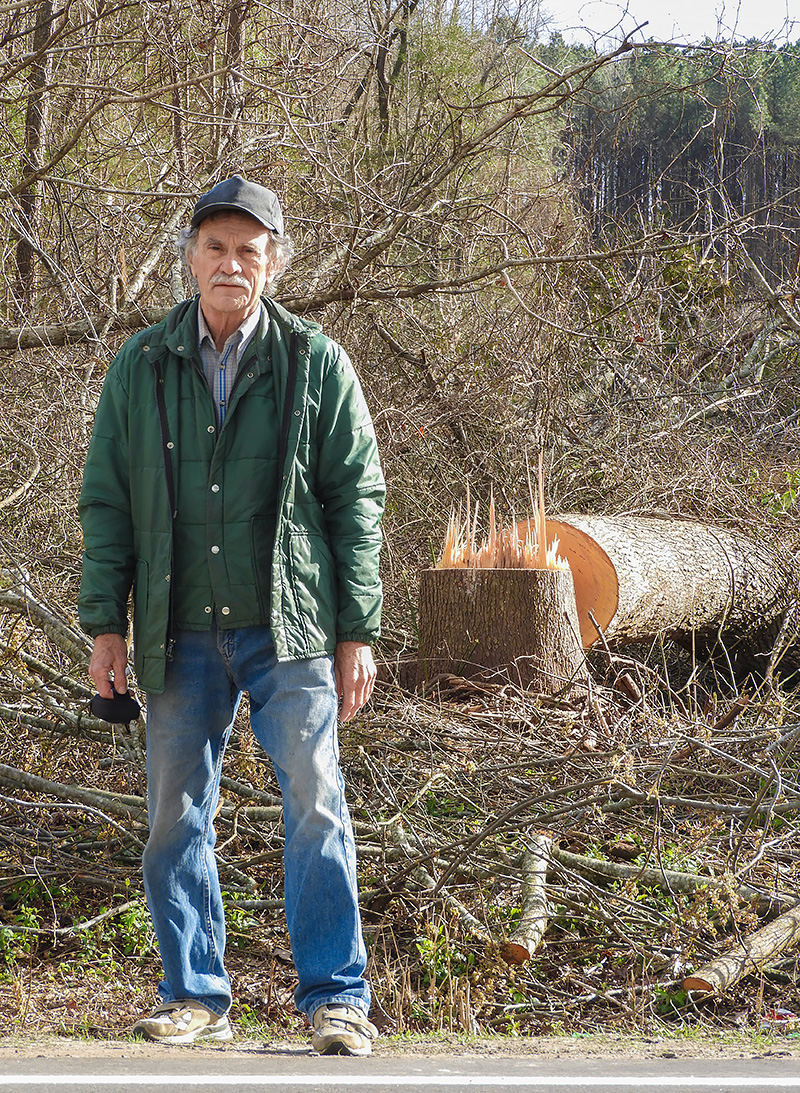
Marvin Winstead stands before trees on his neighbor’s land that were felled for the Atlantic Coast Pipeline. He has gone to court to try and stop pipeline construction on his farm. Photo by John Manuel
Contractors for the Atlantic Coast Pipeline have already cut the trees across the street from Marvin Winstead’s Nash County, N.C., farm, and they have threatened to do the same with his.
But this square-jawed, blue-eyed farmer is not backing down. Marvin has gone to court to stop this action, claiming that contractors have entered his land without permission and that pipeline representatives have been uncommunicative and misleading in their dealings.
He also has not agreed to the compensation offered by the pipeline developers for the rights to his land, a fact that, until now, has not stopped contractors from entering other landowners’ properties. On March 13, U.S. District Court Judge Terrence Boyle sided with Marvin and Halifax County landowner Ronnie Locke, barring pipeline contractors from entering their properties until compensation is agreed upon. This has the potential to delay the juggernaut that is the Atlantic Coast Pipeline.
For generations, Marvin and his ancestors have raised soybeans, corn, cotton and tobacco on their 79 acres of table-flat land. The Atlantic Coast Pipeline is targeted to run diagonally down the length of those fields. Pipeline contractors have assured him that his production will be unaffected once the pipe is laid and buried, but Marvin is unconvinced.
“I’ve seen pictures of land in Johnston County that had a pipeline laid through it 20 years ago,” Marvin says. “The corn growing over the pipeline was stunted compared to what was on either side of it. That’s because they lay gravel on top of the pipeline to handle heavy equipment.”
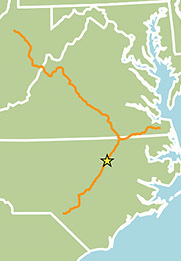
Marvin Winstead’s location in the path of the Atlantic Coast Pipeline.
He is also unconvinced about the promise for local jobs. “The land is being surveyed and the trees felled by out-of-state contractors,” he says. “The only local jobs will be holding up traffic signs.”
And the benefit to locals of natural gas? “I think most of it will be shipped to Savannah and exported,” he says.
In fact, Dominion Energy has announced plans to purchase SCANA, a South Carolina electric and gas utility, and a Dominion executive was recorded saying the company expects to extend the pipeline into the Palmetto State.
Marvin is also concerned about the larger impact of increased natural gas production and consumption.
“Companies are singing the song of clean-burning natural gas,” he says. “It may be cleaner burning than coal, but when you factor in releases at the well site, leaks along the pipeline and emissions at the generating plant, you have raw methane escaping into the atmosphere. That is a more potent greenhouse gas than [carbon dioxide]. Renewables, primarily solar, can meet our needs here and now.”
Whether or for how long Marvin can hold off the ACP is unknown. But for now, he and Ronnie Locke are making history. — By John Manuel
Related Articles
Latest News
More Stories
Neighbors Help Neighbors
A photo essay that celebrates the volunteer spirit of the grassroots group Hurricane Helene WNC and speaks to the resourcefulness, collaboration and hard work embodied by thousands and thousands of volunteers, first responders and aid workers across the region after Hurricane Helene.

Halloween Approaches, and Night School Is in Session
The House of Art in Bluefield, West Virginia, looks like a haunted tower, making it the perfect location for its sixth annual haunt event: Night School. The Night School will be open every Friday and Saturday night through Oct. 31.
‘The Most Perfect Act of Love’
Hundreds of people attended the second annual Affirming Sumner Pride celebration on a 24-acre farm dubbed “Fruity Farm” in Bethpage, Sumner County, Tennessee.

Signs of Life: Endangered Bats Found in Nantahala for First Time in More Than a Decade
In the Nantahala National Forest, a team of biologists spotted Indiana bats, an endangered species that hasn’t been seen in North Carolina for the last 11 years.

‘First Line of Defense’
During Hurricane Helene and its aftermath, rural fire departments and other first responder hubs played critical roles in keeping their communities safe, even without power and cut off from outside support for days or weeks after the storm. Two years later, plenty of work remains to ensure these hubs have the resources they need to operate day to day and be ready when emergencies or natural disasters strike.

The Rocky Road — and Bridge — to Recovery
Hurricane Helene is estimated to have damaged nearly 7,000 private roads and bridges in Western North Carolina. Two years later, many restoration projects are complete, but the journey hasn’t been easy — and isn’t over for others.

Leave a comment
Your email address will not be published. Required fields are marked *
Leave a Comment