

Calls for Action on RECLAIM Act
In October, Jim Ward, the judge executive of Letcher County, Ky., spoke at a press conference in Washington, D.C., joining legislators from both sides of the aisle to call for passage of the RECLAIM Act.
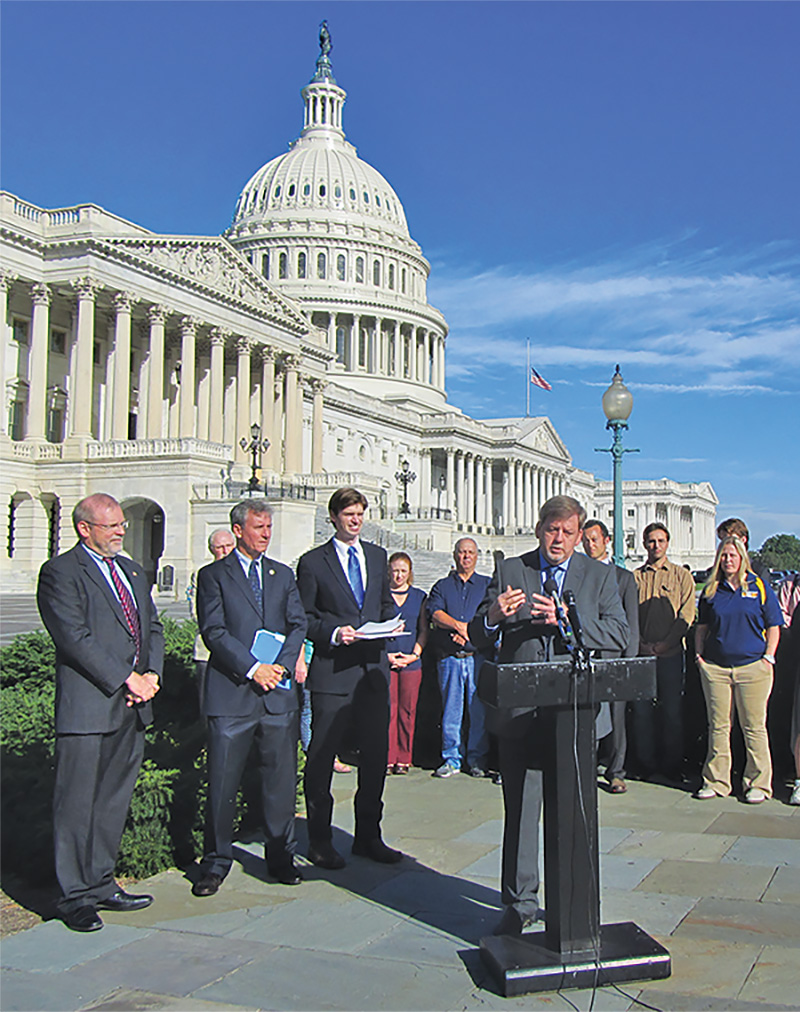
Judge Executive Jim Ward of Letcher County, Ky., discusses the RECLAIM Act. Photo by National Wildlife Federation
The bill, which passed the House Natural Resources Committee in June, would accelerate the disbursement of $1 billion currently in the Abandoned Mine Land fund over a five-year period. Committee members also approved an amendment to require projects that receive funding under the bill to spur local economic development.
“We need to use this money strategically so that with the economic development part, not only do we reclaim the land but we also create jobs, and future jobs, something that’s sustainable,” Ward told the Washington, D.C., audience. “Because we’re looking at having to diversify our economies and this money could really put our people back to work.”
Ward had traveled to the capital along with RECLAIM Act supporters from across the country to urge legislators to cosponsor the bill and hold a vote before the end of 2017. Appalachian Voices, the publisher of this newspaper, helped organize the citizen lobby week, which included nearly 60 congressional meetings.
Citizens also called on the Senate to adopt the House’s version and hold its own vote. Currently, the Senate version does not require that the abandoned mine land projects eligible for RECLAIM Act funding also boost local economies.
Rep. Morgan Griffith (R-Va.), a co-sponsor of the RECLAIM Act, touted the bill’s bipartisan support.
“It’s Democrats and Republicans coming together to identify a way that we can be helpful, help the country, help make the environment better, help create jobs and [help] people who are skilled but want to stay living in the mountains be able to stay there and pursue something different as we move forward in this country,” Griffith said at the press conference.
Related Articles
Latest News
More Stories
Neighbors Help Neighbors
A photo essay that celebrates the volunteer spirit of the grassroots group Hurricane Helene WNC and speaks to the resourcefulness, collaboration and hard work embodied by thousands and thousands of volunteers, first responders and aid workers across the region after Hurricane Helene.

Halloween Approaches, and Night School Is in Session
The House of Art in Bluefield, West Virginia, looks like a haunted tower, making it the perfect location for its sixth annual haunt event: Night School. The Night School will be open every Friday and Saturday night through Oct. 31.
‘The Most Perfect Act of Love’
Hundreds of people attended the second annual Affirming Sumner Pride celebration on a 24-acre farm dubbed “Fruity Farm” in Bethpage, Sumner County, Tennessee.

Signs of Life: Endangered Bats Found in Nantahala for First Time in More Than a Decade
In the Nantahala National Forest, a team of biologists spotted Indiana bats, an endangered species that hasn’t been seen in North Carolina for the last 11 years.

‘First Line of Defense’
During Hurricane Helene and its aftermath, rural fire departments and other first responder hubs played critical roles in keeping their communities safe, even without power and cut off from outside support for days or weeks after the storm. Two years later, plenty of work remains to ensure these hubs have the resources they need to operate day to day and be ready when emergencies or natural disasters strike.

The Rocky Road — and Bridge — to Recovery
Hurricane Helene is estimated to have damaged nearly 7,000 private roads and bridges in Western North Carolina. Two years later, many restoration projects are complete, but the journey hasn’t been easy — and isn’t over for others.

Leave a comment
Your email address will not be published. Required fields are marked *
Leave a Comment