

The Green Side of Heavy Industry
Story by Bill Kovarik
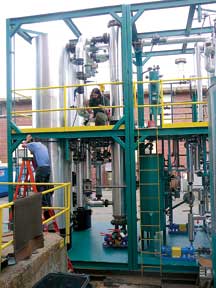
Workers at Pesco-Beam in Roanoke, VA complete work on a molecular sieve. Photo courtesy of Pesco-Beam, www.pescova.com
When most people envision green jobs, they see recycling, ecotourism and solar panels.
Luke Staengl, president of Pesco-Beam in Roanoke, Va., sees cellulosic biofuels, methane and hydrogen gasification, wood pellet manufacturing and other large-scale renewable energy production projects.
“The prospects are spectacular for green jobs in this region,” Staengl said.
For about 15 years, chemical engineers at Pesco-Beam have been making truck-sized units for recycling used chemicals that would otherwise have been thrown away. The units have pipes, process vessels, valves and instrumentation. For an industry that was previously disposing of leftover varnish or other chemicals, recycling saves money and decreases pollution.
These days, with increased interest in green energy, Staengl envisions a network of decentralized biofuel and renewable energy system that will help create a less centralized economy.
“We need more jobs and a more diverse economy,” Staengl said. “I think it’s hugely important that we have a much more diverse and decentralized job market.”
The kinds of jobs to be created in the biofuels and renewable gas industry will include instrumentation and process energy technicians, biochemical engineers and mechanical engineers, Staengl said.
One of the main barriers to building regional bioprocessing facilities is the lack of financing, so Staengl hopes that stimulus money will help create local investment mechanisms working with state governments.
“We’re creating jobs, reducing the carbon footprint, reducing waste and unhooking from dependence on Middle Eastern oil supply, which has cost us a huge amount of money for the past 50 years,” he said.
Related Articles
Latest News
More Stories

Neighbors Help Neighbors
A photo essay that celebrates the volunteer spirit of the grassroots group Hurricane Helene WNC and speaks to the resourcefulness, collaboration and hard work embodied by thousands and thousands of volunteers, first responders and aid workers across the region after Hurricane Helene.

Halloween Approaches, and Night School Is in Session
The House of Art in Bluefield, West Virginia, looks like a haunted tower, making it the perfect location for its sixth annual haunt event: Night School. The Night School will be open every Friday and Saturday night through Oct. 31.

‘The Most Perfect Act of Love’
Hundreds of people attended the second annual Affirming Sumner Pride celebration on a 24-acre farm dubbed “Fruity Farm” in Bethpage, Sumner County, Tennessee.

Signs of Life: Endangered Bats Found in Nantahala for First Time in More Than a Decade
In the Nantahala National Forest, a team of biologists spotted Indiana bats, an endangered species that hasn’t been seen in North Carolina for the last 11 years.

‘First Line of Defense’
During Hurricane Helene and its aftermath, rural fire departments and other first responder hubs played critical roles in keeping their communities safe, even without power and cut off from outside support for days or weeks after the storm. Two years later, plenty of work remains to ensure these hubs have the resources they need to operate day to day and be ready when emergencies or natural disasters strike.

The Rocky Road — and Bridge — to Recovery
Hurricane Helene is estimated to have damaged nearly 7,000 private roads and bridges in Western North Carolina. Two years later, many restoration projects are complete, but the journey hasn’t been easy — and isn’t over for others.

Leave a comment
Your email address will not be published. Required fields are marked *
Leave a Comment