
Coal Labor History Sets Stage for Community
The town of Pound, Virginia, sits just off Route 23 in rural Wise County, a few miles before the highway starts its climb up the mountain that forms a natural border with Letcher County, Kentucky. The community has a rich history, especially as it relates to coal mining in the Appalachian coalfields.
Over the last two years, residents and local leaders have been working hard to bring new life to the Pound’s historic downtown through a series of projects grounded in the needs of the community and informed by feedback from the people who call Pound home. While many of these longer-term projects have been focused on building Pound’s resilience against natural disasters and improving rundown buildings, one upcoming project stands out as a celebration of Pound’s history.
Last year, Pound received funding from Monuments Across Appalachian Virginia to create a labor-oriented monument downtown. Monuments Across Appalachian Virginia is an initiative housed by Virginia Tech and funded by The Mellon Foundation. According to the initiative’s webpage, it aims “to reclaim, imagine, document, reinterpret, display, and amplify histories and experiences that highlight collective struggles for the vitality of people and our shared environment, especially by, for, and with people whose stories have been silenced, denied, or excluded.”
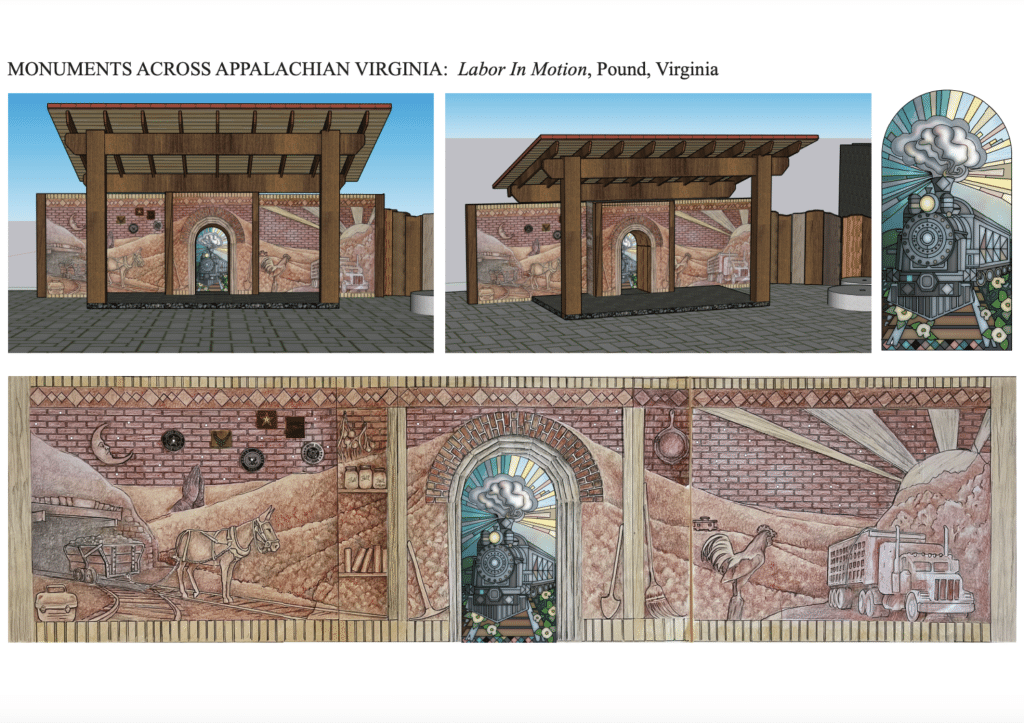
Members of the Pound community were deeply involved in helping to influence the design and decision-making process around the monument. They participated in listening sessions where residents brought photographs, stories and memories to share with the two artists tasked with working on the project — Nashville-based Dana Jo Cooley and Johnny Hagerman, a Tazewell County, Virginia, artist who teaches brick sculpture at Southwest Virginia Community College in Cedar Bluff.
Hagerman explains that working with his students on the project has been one of the key highlights for him.
“I have two students that have fingerprints all over this project,” Hagerman says. “There’s one who’s in their junior or senior year in Radford, and the other one is a third year at UVA Wise, which is only about 12 miles from the job site.”
Pound has been partnering with Appalachian Voices, the organization that publishes The Appalachian Voice, on landslide mitigation and an effort to revitalize blighted buildings. Pound is also collaborating with Appalachian Voices through the Community Strong initiative, a partnership with local residents and governments to develop community-based resilience projects in Pound, Pennington Gap, Clinchco, Dante and Dungannon. Plans for the monument work in tandem with other Community Strong initiatives, such as the creation of a pocket park on the site of the former People’s Bank building, which was demolished in January 2025.
Feedback from Pound residents collected during the listening sessions indicated early on that the monument should not be what some residents called a “pointless” structure with limited use, but rather a central focal point of the pocket park currently in development. As such, the monument will serve as a stage and performance space, hopefully creating momentum around the new community gathering area at the former People’s Bank location.
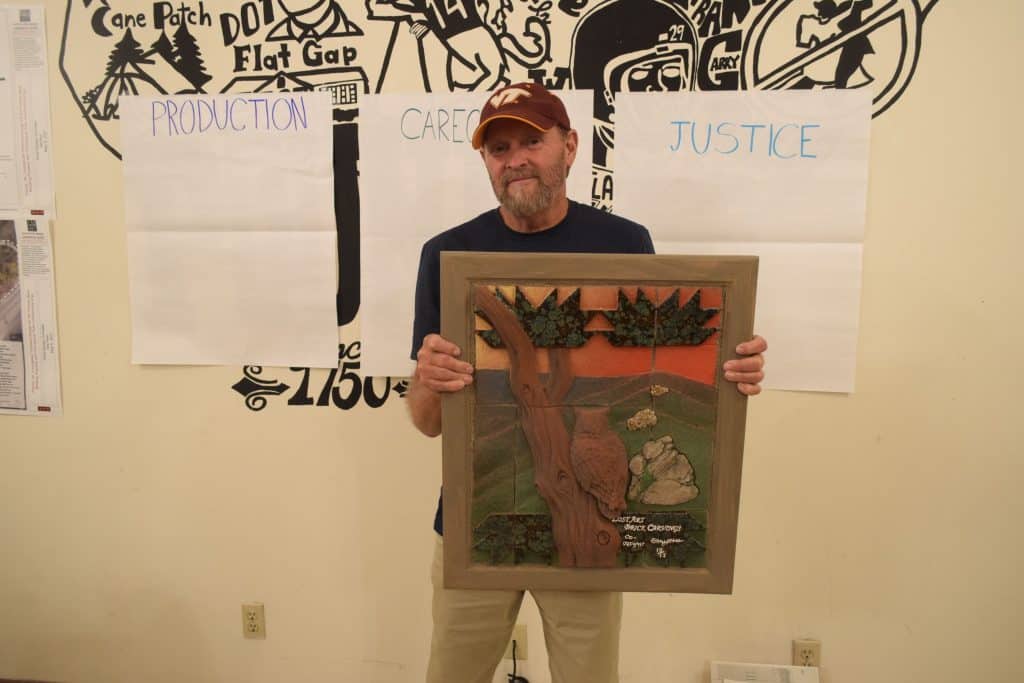
Monuments Across Appalachian Virginia provided stipends for members of an advisory committee that met regularly to keep the project on track, including the artists, town leaders, residents and other key stakeholders.
Dana Jo Cooley is an artist in residence at Nashville’s Downtown Presbyterian Church, and is also a graduate of Vanderbilt Divinity School. Cooley has deep and tragic family ties to coal mining, having lost not only her father, but also an uncle and a cousin at a very young age in the 1981 coal mine explosion in Whitwell, Tennessee, where she grew up. The disaster claimed 13 lives. Cooley says that the tragedy taught her a valuable lesson and has shaped her identity as an artist.
“You’re not guaranteed a whole life,” she says. “You should follow your heart. I think the accident really formed my stubbornness and determination, of like, knowing what I wanted to do and just going straight at it.”
She explains that her work on the monument in Pound has given her a new appreciation and drive for working in the public arts space and has led her to be more active when it comes to participating in the metro arts in Nashville. Her involvement in the Pound monument inspired her to apply for an upcoming fellowship that’s focused on the intersection of public policy and public art. The Pound project has given her a lot of hope.
Cooley wanted to ensure that the design was broad enough to include as many elements of Pound’s labor history as possible, including women’s contributions to the domestic labor that kept households running. She’s incorporating elements such as canning jars, a broomstick and books, and a tribute to Pound’s librarians that have served the community down through the years. A set of praying hands, which were modeled after Cooley’s mother’s hands, is also featured prominently in the design, a tribute to the faith of many miners’ families.
There are no images of people included in the design, as designers expect that the people will be the performers on the amphitheater stage. Instead, key labor-focused design elements include a coal train, a nearby tunnel that was formerly used to transport coal, and animals, including a rooster and a mule pulling a mining cart. The final design will also incorporate stained glass and handmade marbles, created by glass artist Seth Cox, which are made from silver mist and coal dust to create the appearance of starry constellations in the backdrop of the final design.
These marbles will play a key role in the promotion of the new monument, shares Pound Vice Mayor Leabern Kennedy.
“We’re going to include a marble hunt that goes along with the monument to kind of build some excitement there,” Kennedy says. The plan calls for expanding the marble hunt beyond Pound and into the rest of Wise County, since involving the county would help keep the event going and encourage more people to get outdoors and explore different locations. The game involves hiding a marble and posting a clue to its location. Participants who find the marble are expected to report their discovery online using the Pound Has Lost Its Marbles Facebook group.
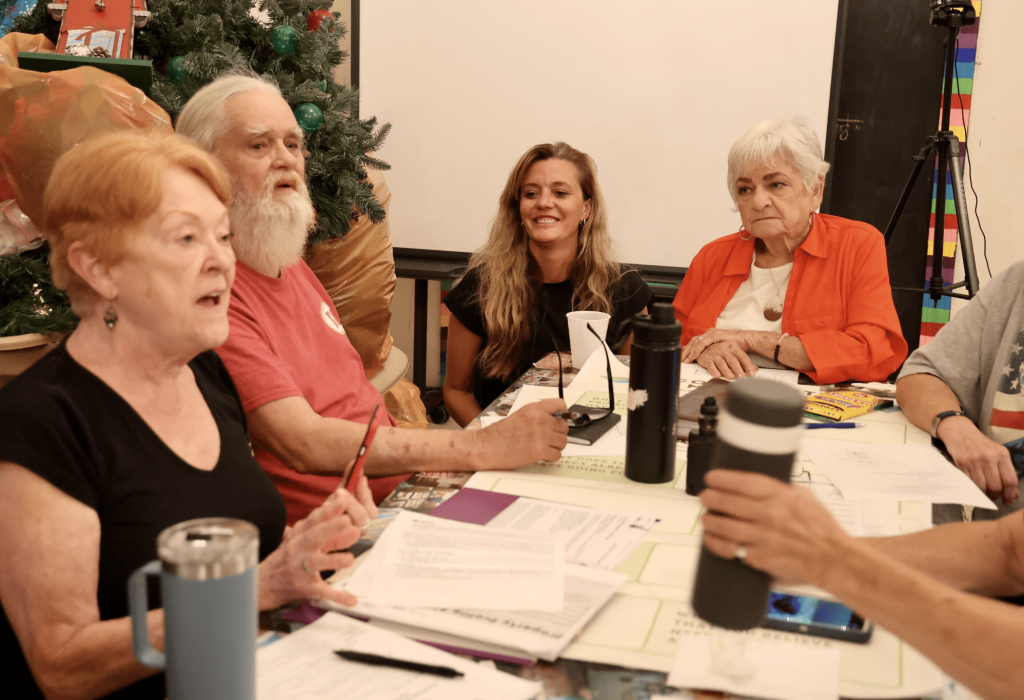
The marbles and marble hunt were inspired by a similar event in Marion County, Tennessee, where artist Dana Jo Cooley is from. Like the marble hunt planned for Pound, Marion County’s marble hunt involves hiding and finding marbles around the county and posting clues to a Facebook group. Marbles designed for the Wise County version of the hunt will include coal-themed marbles and ones that incorporate local icons, such as the legendary “Woodbooger,” a local name for Bigfoot.
In addition to being a beautiful piece of public art, Kennedy has high hopes that the monument and pocket park will be a huge asset for downtown Pound’s economy by allowing the community to have a much-needed local gathering space for festivals, concerts, a farmers market and local food truck rallies. As of January, on-site construction and installation of glass and masonry work is expected to begin in February, with an unveiling ceremony to follow this spring.
When asked what she hopes the monument inspires in the people of town, artist Cooley simply says, “Joy — I hope they feel joy.”
Related Articles
Latest News


Leave a comment
Your email address will not be published. Required fields are marked *
Leave a Comment