

In ‘All These Ghosts,’ Silas House Explores ‘Timesickness,’ Deep Grief, Hope in Dark Times
In his first full-length poetry collection, “All These Ghosts,” Silas House, an award-winning Appalachian author and former poet laureate of Kentucky, grapples with deep personal grief and “timesickness,” or the deep longing for a time, place or spiritual state that no longer exists.
“Where I’m from has changed so drastically that I long for it, I long for that time,” explains House during an October 2025 event in Knoxville, Tennessee. “Part of what I’m longing for is the way it was. The way people were, the way we loved each other differently before this division that has been forced upon us so violently and aggressively.”
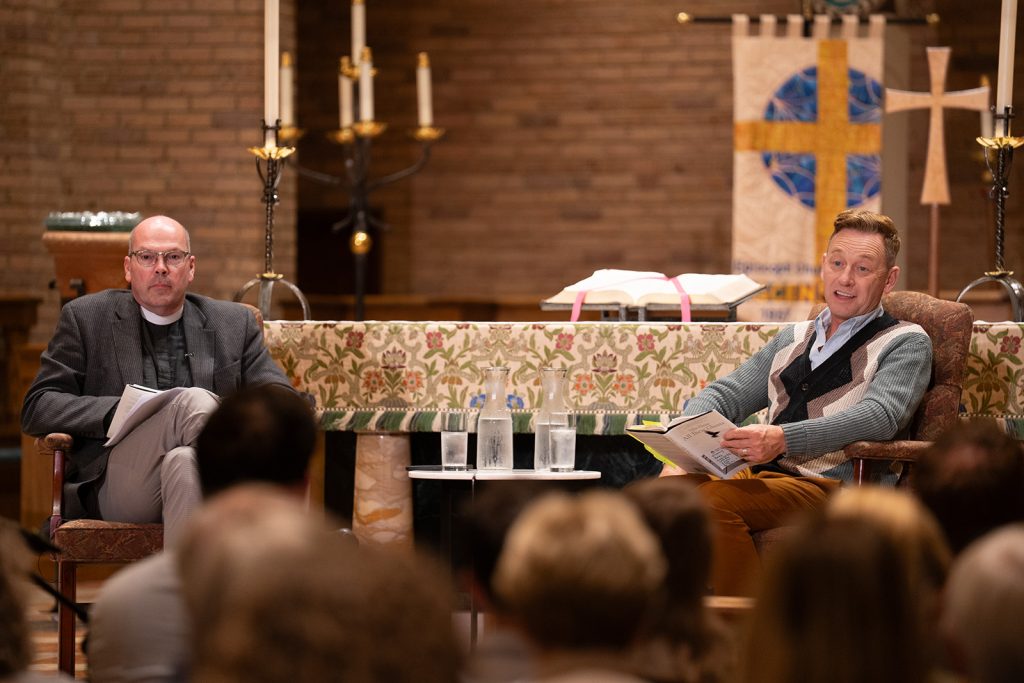
House also writes about his deep grief over the loss of loved ones — primarily his aunt “Sis,” who appears in much of his work — along with grief over the changing climate and natural world he loves so deeply.
“I have been in deep grief for the last decade of personal loss,” House says. “I think that really coincides with my deep grief of witnessing the way our country is changing. And the grief of witnessing climate change and all those big griefs that we’re going through collectively as a people.”
In “North Fork,” he pays tribute to the late Mae Amburgey, a 97-year-old woman from Letcher County, Kentucky, who lost her home to flooding in July 2022. House was haunted by a viral image of Amburgey, where she perched on her bed in her flooded home as she waited for aid — she later swam to safety with the help of rescuers.
House vividly describes Amburgey sitting on “her mattress a drowning lifeboat” and her deep loss: “Because this place is no/more, her home is the past.” But he also imagines Amburgey’s state of mind as she is being rescued, writing about how she used “to swim in the North Fork/on the hottest summer days.”
“In that moment, in her mind, she goes back to being a 16-year-old girl swimming in that river that flooded,” House explains. “It’s like the imagination as a way to survive, to escape.”
“All These Ghosts” also explores finding hope and joy in dark times. In “False Spring,” House describes the beauty of the “little winters” of Appalachia — locust winter, redbud winter, dogwood winter, blackberry winter and more. He writes, “soon/the world will warm and the petite/leaves will venture forth: hopeful,/hopeful, like the dawn-time/warblers who sing to announce/they have made it through/the long night once again.”
In October 2025, Abby Hassler of The Appalachian Voice connected with House about “All These Ghosts” over email. The following Q&A has been lightly edited for clarity.
From the 2022 Kentucky floods to Hurricane Helene, Appalachia has experienced devastating natural disasters in recent years — events you have written about extensively. In this collection, you grapple with personal and collective grief, including grief about climate change. Could you speak about that environmental grief, especially as it relates to “North Fork” or other poems in the collection?
It’s interesting to me that people used to talk about Appalachia as a refuge from climate change, but now we are more certain that it is not going to be that at all; that it will, in fact, be ravaged by extreme weather. It’s important to remember that vast areas in Appalachia had their aquifers and natural drainage irrevocably altered by industry, especially with strip mining and mountaintop removal.
The result is sort of a perfect storm of extreme weather and land that has been devastated or improperly “reclaimed,” if there was an attempt to reclaim at all. So it’s just another example of the way the region has been sacrificed by corporations and our own government. “North Fork” is one of my favorite poems in the collection because it looks at the 2022 floods, although the devastation and heartache around that flood is too large to articulate properly.
In your interview with Barbara Kingsolver in the book, you wrote that when you live in a rural place or seek out the natural world, your life is “richer, more centered, better.” Has your relationship with the natural world changed over time? If so, how?
The older I get, the more important it becomes to me. Perhaps that is because I find the modern world increasingly vitriolic, aggressive and overwhelming. Nature has always been the balm for me, but I need that balm more than ever before. If more people could slow down and find stillness and be present in the natural world, we’d all have a lot more peace.
For readers who have never visited Dale Hollow Lake or Cumberland Falls or experienced the quiet “blue hour” right before dawn in the mountains that you describe so vividly in your poems, what are they missing out on?
The main thing that comes to mind for me in all these mentions is that stillness we all so badly need in our daily lives. Our culture teaches us to always be in motion, to always be producing something, to always be working. But time in nature is not unproductive time; for me, it is the opposite of that.
You’ve said you’re trying to “find hope in a dark time,” and that “you can’t write a book about despair without figuring out what makes you joyful.” What is bringing you hope or joy today — either in Appalachia or in your own life?
I’m lucky to work with a lot of young people, and being with them always makes me more hopeful, mainly because I see how deeply they care about the issues facing us today and because most of them are so fiercely protective of each other and really strive to be the best people they can be. That’s what we need right now: more kindness, more service to others, less focus on power and greed. And the young people I know are trying their best to be good people in the world. That gives me so much hope.
You are a longtime friend of Appalachian Voices and a former board member. What is it about our mission or the organization that made you want to support our work?
Appalachian Voices has always been on the forefront of keeping the public informed, finding ways to fight back against the unjust system in which corporations have more rights than individuals, and has a deep respect for the natural world. That’s a mission I will always support, and I’m grateful for everyone who has been a part of that.
Related Articles
Latest News
More Stories


Leave a comment
Your email address will not be published. Required fields are marked *
One response to “In ‘All These Ghosts,’ Silas House Explores ‘Timesickness,’ Deep Grief, Hope in Dark Times ”
-

Keep publishing please. Many of us a scattered far from home. far from our people and the land. You feed our core, spark memories and remind us of sacred places.
Grateful … Thank you

Leave a Comment