
These songbirds can be tricky to identify during the fall migration season, presenting a fun challenge for experienced birders
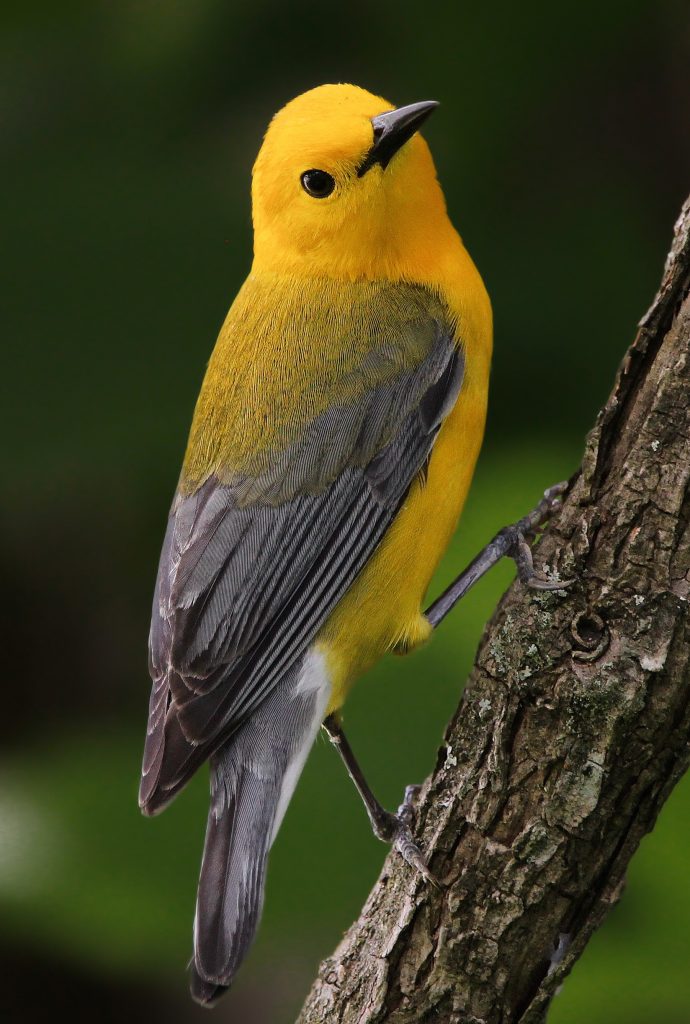
Black-and-yellow prairie warblers are recognizable by dark semicircles under their eyes, giving them a curious, librarian-like appearance. Male American redstarts are always spooky-season ready with their Halloween-chic black-and-orange colors. Prothonotary warblers are so vibrantly yellow that they look like little lemons with wings.
During peak fall migration season, these birds are just a handful of the 36 New World warbler species that birding enthusiasts may be able to spot at Seven Islands State Birding Park in Kodak, Tennessee. The 416-acre park is a birding paradise nestled along the French Broad River, just 30 minutes from downtown Knoxville.
“If you come out here and bird during every season, you’ll probably [see] around 180 birds in a year,” shares Kelly Fox, the state park’s avian biologist. This diversity draws many birders to the park year-round.
![“The hooded warbler is what I call my spark bird, which is [the bird that] gets you into birding,” Fox says. “You see a bird, and it gets you wondering what it is, and then suddenly you discover there's this whole world of birds that you didn't know about.” Photo by Kelly Fox](https://appvoices.org/wp-content/uploads/2025/10/HoodedWarbler-1024x682.jpg)
Warblers 101
New World warblers are songbirds in the Parulidae family. They primarily inhabit forests, but are also found in fields and shrubby areas.
“A lot of warblers look different,” explains Fox. “There’s a lot of different colors, all different patterns. Most of them are fairly small, but there is still a decent range of sizes.”
Most, but not all, are migratory. In East Tennessee, peak fall migration spans from late September through early October, though it can start as early as late August and extend into mid-November.
Warblers can be tricky to identify in the fall. The same bird may look different than it does in the spring breeding season because of molting. During molting, birds shed old feathers and grow new ones.
“A good example would be a cardinal; when they drop those old feathers and get new ones, the new ones look exactly the same as the old ones, so they look the same year-round,” Fox says during a fall warbler identification workshop at the park. “But then there are some birds that drop their old feathers, and they get new ones. And the new ones look pretty different from their old feathers. And so that can be really confusing to people.”
Fox categorized these types of warblers as “shape-shifters,” which can confound even the most experienced birders. Often, birders first learn to identify warblers by their bright breeding plumage, Fox explains.
“Then, when it comes to fall migration, they don’t have that [the same plumage],” Fox says. “You can feel a little lost when you’re not looking for that key characteristic that you know you learned.”
The park also sees many juvenile warblers passing through during this time. Juvenile warblers may not have as vibrant patterns or colors as their more mature counterparts.
“Usually they’re just really pale, they’re really brown, they’re not very colorful,” Fox says. “People will look at them go, ‘I have no idea what this bird is.’”
There are also a few rare or uncommon visitors, or “out-of-towners,” explains Fox. They are not impossible to spot, but may be new to locals and hard to identify.
“This is in their migratory range — it’s just not the most common,” Fox explains about the Connecticut warbler. “Instead of taking [Interstate 40] to go somewhere, this is taking the scenic route for them.”
Beyond the shape-shifters and out-of-towners, Fox dubbed the other 21 warblers in the park as “look-alikes,” because they look the same in the fall as they do in the springtime. Although differences exist based on sex and age — for example, male cerulean warblers are sky blue with dark streaking, whereas females are blueish-green with a blue-green “cap” and a yellow throat or body — the primary identification challenge is recalling each species’ unique features.
“Some of these birds are a slightly paler version of their breeding selves during the fall, but that pattern is still there,” Fox explains. “Those colors are still there.”
How to identify a warbler this fall
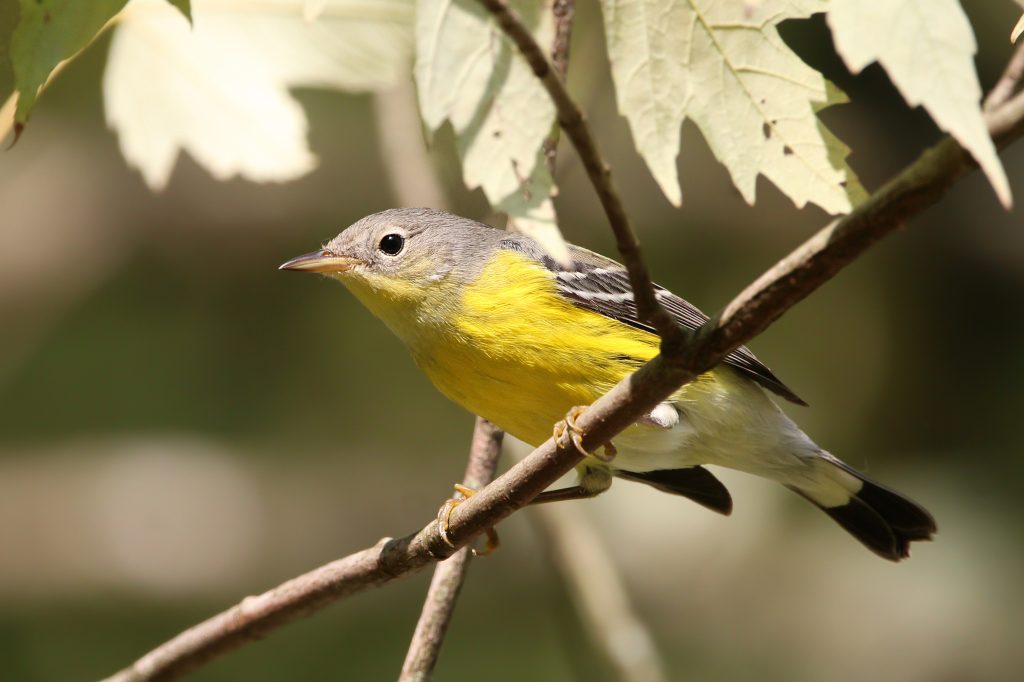
If you’re looking for warblers at Seven Islands State Birding Park this fall, two of the most common species you might encounter are the common yellowthroat, which breeds in the area, or the migratory magnolia warbler.
But before heading out to spot these or the other 34 species, Fox highlights a few key bird anatomy terms and features to keep in mind:
- Eye ring: A ring of color around the eye. It can be a complete circle or a broken circle.
- Eyeline: Exactly what it sounds like — a line of color through the eye.
- Supercilium: A line over the bird’s eye, similar to an eyebrow.
- Wingbars: Stripes across wings — birds can have none, one or two.
- Undertail coverts: The feathers that cover the bottom of the tail.
- Tail rectrices: Tall feathers that could be a variety of colors or patterns.
Fox also groups similar-colored birds into broad categories, making comparison and identification easier based on anatomical features, such as broken eye rings or two wingbars.
- Yellow-and-olive colored birds: female hooded warbler, female yellow warbler, Wilson’s warbler
- Yellow birds with blue wings: prothonotary warbler, blue-winged warbler, pine warbler
- Brown streaky birds: Louisiana waterthrush, Northern waterthrush, ovenbird
- Green birds: female Northern parula, female Cerulean warbler, female black-throated blue warbler
- Gray/yellow/tan birds: mourning warbler, Nashville warbler, female common yellowthroat, Connecticut warbler
- Tan streaky birds: Cape May warbler, yellow-rumped warbler, blackburnian warbler, palm warbler
- Gray-and-yellow birds with stripes: magnolia warbler and Canada warbler
- Plain brown birds: worm-eating warbler and Swainson’s warbler
Some of the most notoriously difficult fall warblers to differentiate include the blackpoll warbler versus bay-breasted warbler and the Tennessee warbler versus orange-crowned warbler. Aside from a few key differences, these birds are nearly identical.
First, the blackpoll warbler and the bay-breasted warbler are similar greenish-colored birds with two white wing bars. Fox recommends looking at the feet.
“If they’re orange, you have a blackpoll warbler,” Fox says. “If they are not orange, you have a bay-breasted warbler.”
Next are the Tennessee warbler and the orange-crowned warbler. Both are greenish-tan in color. Fox says to take a peek at the undertail coverts.
“If they are yellow, you have an orange-crowned warbler,” Fox says. What if they are white? “That’s a Tennessee warbler.”
‘You can bird anywhere’
“I think birding is super fun,” Fox says. “I think everyone should give it a try. It’s easy to do. It’s very accessible. You can bird anywhere.”
For newbie or aspiring birders, Fox recommends downloading the Merlin app, investing in a good field guide, getting an affordable pair of binoculars and tagging along with an experienced birder. Overall, Fox describes birding as good for mental health and a way to connect to the health of natural spaces.
“Birds are literally like canaries in the coal mine,” Fox shares. “They are direct indicators of environmental health. And the environmental health affects us, and so if we can protect them, then we’re doing good things for ourselves as well.”
Related Articles
Latest News




Leave a comment
Your email address will not be published. Required fields are marked *
Leave a Comment