
Neighbors Helping Neighbors
Regional mutual aid groups are stepping into a critical role in community-led disaster relief
By Lou Murrey
When Hurricane Helene tore through the Southern Appalachian Mountains, already swollen rivers rose out of their beds to wash away homes, roads, bridges and entire communities. Saturated soil cleaved from the mountain, causing devastating and deadly landslides that blocked or destroyed roads and made it hard for anyone to get in or out.
Communities across large swaths of Western North Carolina found they were cut off from the world.
“It was surreal,” says Madison County resident Matthew Wallace. “It didn’t take long to realize that there was no help coming, at least in those first few days. We were really all we had.”
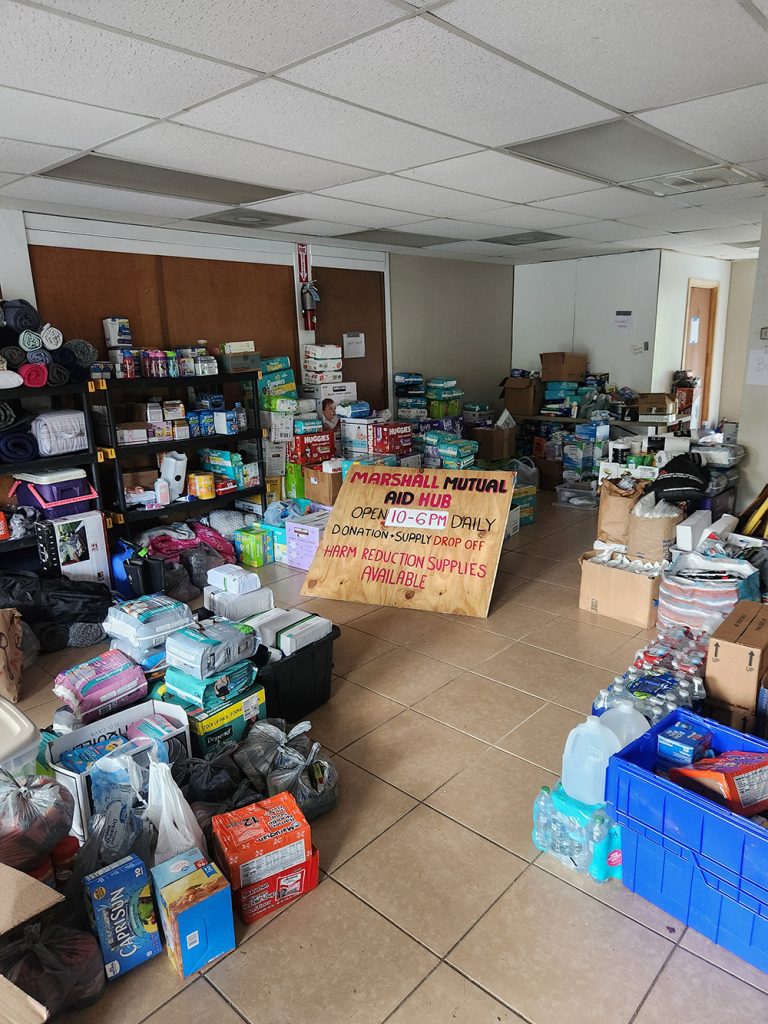
Wallace is a member of Rural Organizing and Resilience, or ROAR, a mutual aid group based in Madison County, North Carolina, that formed in 2017. ROAR sprang into action as soon as the waters began to recede.
Neighbors helping neighbors is common in Appalachia and throughout human history. “Mutual aid” is a more specific term for people helping each other based on shared needs and resources rather than relying on formal institutions and systems.
“Once ROAR members were able to make contact with each other, we quickly organized a meeting, and within 24 hours, we had a mutual aid hub up and running in order to start gathering and distributing supplies,” Wallace says.
For days and weeks after the storm, ROAR members and volunteers were among those working relentlessly in Madison and the surrounding rural counties to distribute supplies, send out crews to cut trees and clear debris, make wellness checks, and deliver firewood to people without heat or electricity.
Wallace shares that ROAR’s approach to mutual aid goes beyond meeting people’s physical needs to help address what he describes as “root causes of inequality” such as race and income level.
Mutual aid projects like ROAR foster community and solidarity and build a shared understanding of why people don’t already have what they need. These networks are growing across the region in response to disasters.
The 2022 floods in Eastern Kentucky
In July 2022, two years before Helene, severe flooding struck 14 counties in Eastern Kentucky. Quickly, those in impacted areas discovered that communities self-organizing relief efforts was the fastest way to get people what they needed.
Willa Johnson of Neon, Kentucky, lost almost everything when the waters rose.
“It was chaotic because I was moving, and so I lost so much that I would not have lost otherwise,” says Johnson. “It was packed up in boxes on the floor ready to be moved out.”
Johnson, who has been organizing mutual aid efforts in the wake of disasters in Appalachia for over a decade, suddenly found herself needing to lean on those networks of support.
“When the 2022 flood happened, it hit my house, it hit my church, it hit my work, it hit my son’s school and so I just had no foundation underneath me,” she says. “Mutual aid is what kept us alive.”
Disaster relief poured into the region from churches, service organizations, and the state and federal government. But, according to Johnson, the immediate support for gas money, supplies and groceries came through Eastern Kentucky Mutual Aid. This aid network started in 2020 in response to the economic hardships exacerbated by COVID-19. When the 2022 floods hit, EKY Mutual Aid had grown and was able to mobilize quickly — organizing supply drives, fundraising for people who lost everything and organizing volunteers to help with clean up.
“It’s hard to talk about, because it is hard to explain that it feels dramatic looking back,” Johnson recalls. “But the truth is we lost everything, and we couldn’t access grocery stores; it was huge for me and my kid. You’re so in the dark, you’re so confused, you’re so overwhelmed, and then there is someone there offering this small amount of help, which may seem small in the grand scheme of things, but it’s those small amounts of help that stabilize you in the initial days.”
Johnson describes a strong sense of community, solidarity and reciprocity that emerges in times of crisis. This community-forward approach is what makes mutual aid different from traditional forms of disaster relief.
“So much of disaster relief feels like it is caught up in red tape that it leaves you feeling really frustrated, and it leaves you really stranded and scared,” Johnson says. “With mutual aid, help comes without the red tape and just offers resources. It’s like there is a better sense of community and ability to adapt.”
The long, storied history of mutual aid in Appalachia
Whether it is called mutual aid or not, communities coming together to take care of each other is nothing new. Mutual aid historically arose in marginalized communities as they created ways to survive systems designed to exclude and oppress them. In the United States, Black mutual aid societies emerged during slavery to pay for burials, food, shelter, legal defense and education of enslaved and freed Black people. In Appalachia, geographic isolation and poverty have long gone hand-in-hand with heavy resource extraction, causing residents to rely on kin networks to survive.
“It might be called something else, but the ethos of taking matters into your own hands and caring for your friends and neighbors, especially in the face of government abandonment, has a long tradition here stretching back generations,” says Matthew Wallace of ROAR. “It’s how people survive.”
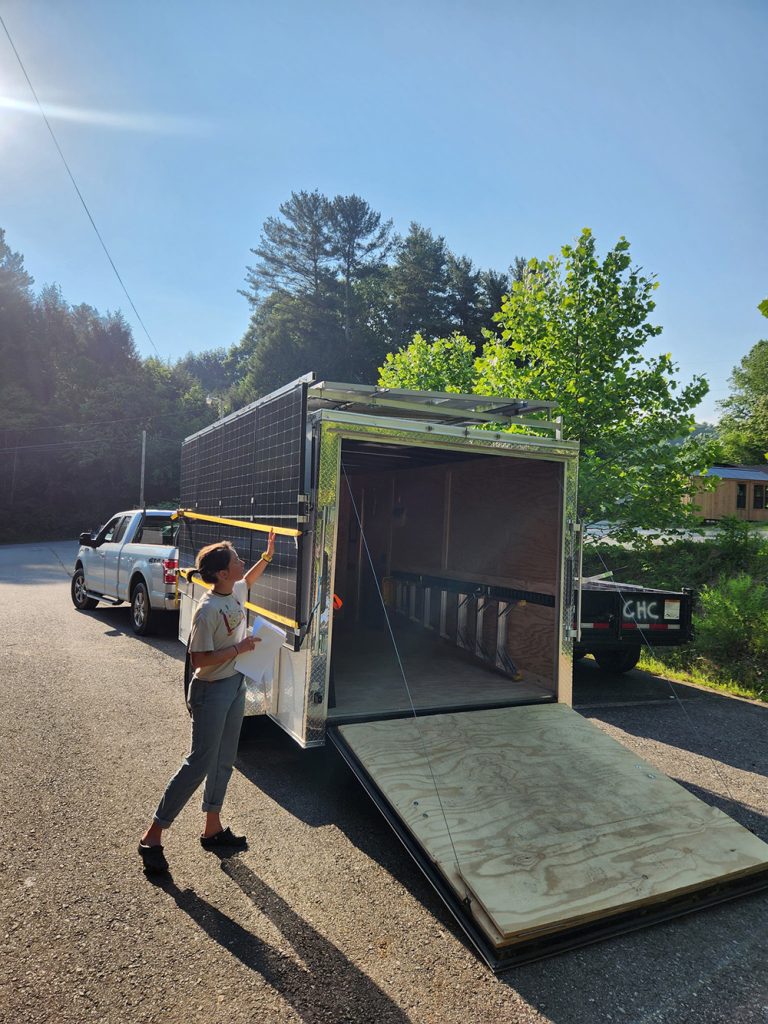
Laura Saunders, a member of the mutual aid group Holler2Holler based in Virginia’s New River Valley, shares Wallace’s sentiments when she talks about how the group responded to the disastrous flooding event that struck parts of West Virginia, Eastern Kentucky and Southwest Virginia in February of this year.
When two days of heavy rains led to flash floods, West Virginia’s Mingo, Mercer and McDowell counties were the hardest hit — all places already dealing with economic, environmental and infrastructure problems after decades of natural resource extraction. Members of Holler2Holler already had a network in place in those counties from years of fighting the Mountain Valley Pipeline. They were able to quickly contact folks to see what resources were needed and where people were not being reached.
For Saunders and the rest of the members of Holler2Holler, fighting the pipeline and continually pushing back against negative regional stereotypes, had taught them that they could not wait for relief. Community was their best option.
“These regions have been in need of support long before these disasters started increasing in frequency, and there’s already a great network here of people who are tuned in to each other and listening and paying attention,” Saunders says. “And what does that look like in a moment of acute crisis, but also longer-term when people are looking away?”
The survival work that ROAR, Holler2Holler and other mutual aid groups in Appalachia are doing in the aftermath of floods, fires, tornadoes and other disasters is critical. But all three groups also point to limitations, especially with sustaining and funding the work.
Many mutual aid groups emerge organically in a moment of crisis as informal community groups, which allows them to adapt and meet people where they’re at. It also means that most of the time, they are not equipped to receive large financial donations and most relief funding goes to charities and churches with the infrastructure to fundraise. Additionally, once the immediate crisis is over, the work can be hard to sustain with just volunteers.
“I don’t think these deficiencies are inherent to the principle of mutual aid, it’s more due to how we currently go about it in our current capacities and mostly volunteer-run efforts,” Wallace adds.
Despite the challenges, people in mutual aid networks are sharpening their skills after every event.
“I feel like after every disaster I see this network grow and get better,” Johnson says. “It is unfortunate that we have to keep doing it, but now I am in contact with folks throughout the entire region.
Now it’s like this entire mobile network that is shifting resources and knowledge throughout the region,” Johnson adds. “We’re becoming a well-oiled machine that crosses state lines in a way that nothing else seems to be doing, and it’s constantly evolving and growing.”
Even as disasters caused or made worse by climate change become more frequent and as looming budget cuts and reductions in federal infrastructure spending become cause for anxiety, Wallace finds hope in the relationships ROAR has built.
“We feel so much more connected to our community and other groups doing this work,” he says. “It is a really wonderful feeling to know when the time comes, we really can have each other’s backs, no matter what the world throws at us.”

Related Articles
Latest News
More Stories

Leave a comment
Your email address will not be published. Required fields are marked *
One response to “Neighbors Helping Neighbors”
-

I reached out to Roar I went through hurricane Helene , am still homeless, disabled living back in uninhabitable home. Working with Fema, pisgah legal. But living in my car. I’ve been told by roar that they are completely out of funding. Yet I am reading about local fundraising. 💭

Leave a Comment