
The Beast of Bristol Saga Continues
A new report validates certain community pollution concerns, as residents voice frustration with city’s landfill response
The Beast of Bristol is back. Or rather, the landfill’s impact and its intense odors, which have grown less frequent but never fully dissipated for some residents, have been recognized in a new federal public health agency report.
Built in a former stone quarry, the Bristol Quarry Landfill, managed by the city of Bristol, Virginia, operated from 1998 to 2022. Due to certain design flaws, the landfill has issues with water collection, resulting in excessive leachate — basically trash juice — and gases that heat up, releasing smelly and toxic fumes into the nearby community.
When the landfill smell is at its worst, Jane Nicholas, a resident of Bristol, Virginia, describes it as “pure sewer.”
Chris Knupp, who lives across the street from the waste facility, paints a much more vivid picture, saying, “It’s like walking into a bathroom after somebody done a number two.”
Community members have spent years advocating for the city to do more to curb the landfill’s noxious emissions. Residents have reported physiological issues from the fumes, such as nausea, nosebleeds and respiratory issues, along with concerns about serious health impacts from long-term exposure.
In 2021, residents founded the nonprofit HOPE for Bristol to provide relief to impacted residents, educate the public, share information and conduct independent air monitoring. The city of Bristol, Tennessee, even sued its neighbor over the landfill’s odors and residential complaints, ultimately settling the lawsuit in 2023.
These efforts prompted remediation by the city, and, by some accounts, landfill odors appear to have become less frequent. For instance, over 1,900 Bristol-area complaints were submitted to the Smell MyCity crowdsourcing app in January 202l, compared to only one singular report in January 2026.
But now, a new report about the landfill validates certain long-held community fears and raises new questions. In a public meeting about the report in January 2026, many residents expressed ongoing frustration with the landfill and the city’s long-term remediation efforts, which advocates believe could have been initiated and conducted faster.
What did the new report find about the Bristol Quarry Landfill?
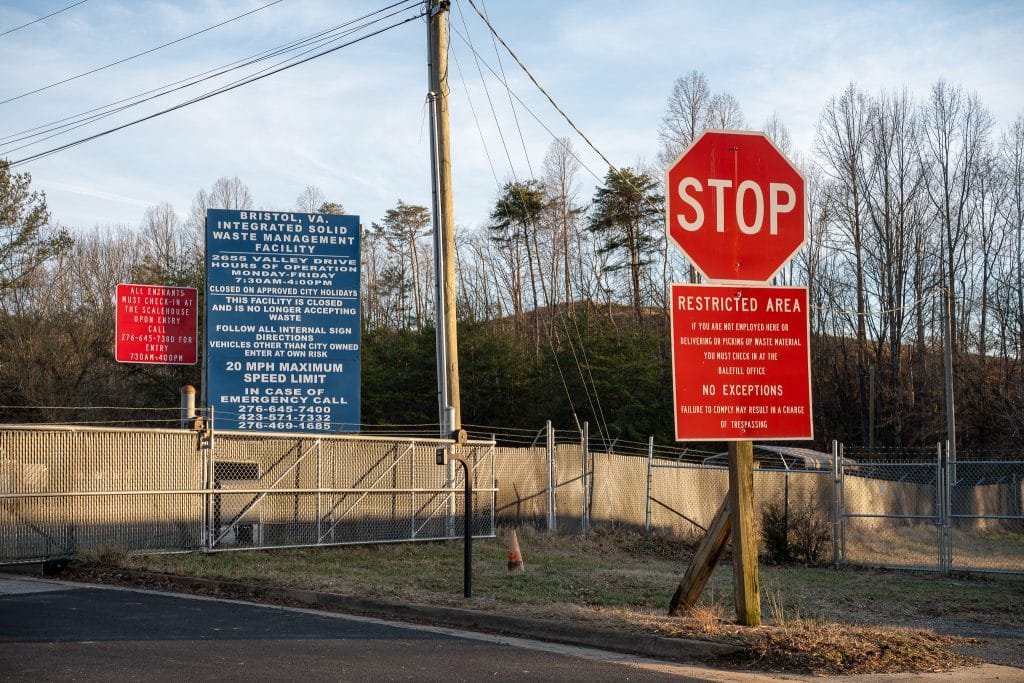
The U.S. Department of Health and Human Services’ Agency for Toxic Substances and Disease Registry released its long-awaited report regarding the air quality around the Bristol Quarry Landfill in December 2025. Community members submitted a request for a public health assessment report in 2021.
ATSDR analyzed air quality data collected by the Environmental Protection Agency and the Virginia Department of Environmental Quality between 2020 and 2022. Some air contaminants examined include volatile organic compounds, such as benzene, as well as ammonia, methyl mercaptan, hydrogen sulfide and sulfur dioxide.
“We don’t look at where chemicals come from,” said ATSDR Region 3 Director Michael Byrns during the January public meeting about the report. “We just look at the levels of chemicals in the air and say, ‘Is this a problem or not?’”
The agency’s analysis found that benzene and sulfur dioxide were at levels high enough to potentially affect people’s health. More specifically, breathing benzene, a carcinogenic volatile organic compound, or VOC, at the detected levels near the landfill for over a year could result in immune suppression and a slightly increased risk of developing cancer, or about one additional cancer diagnosis in 10,000.
Meanwhile, sulfur dioxide, an irritating, pungent gas primarily emitted by burning fossil fuels, can constrict the lungs, making it more difficult to breathe, especially for people with existing respiratory conditions such as asthma or COPD.
The agency also found several odor-causing chemicals, including methyl mercaptan, a gas that smells like rotten cabbage, but the agency doesn’t know enough about the toxicity to definitively say whether it is likely to cause health effects. However, the report contends that unpleasant odors lead to reduced quality of life and to headaches, nausea, loss of appetite and other symptoms.
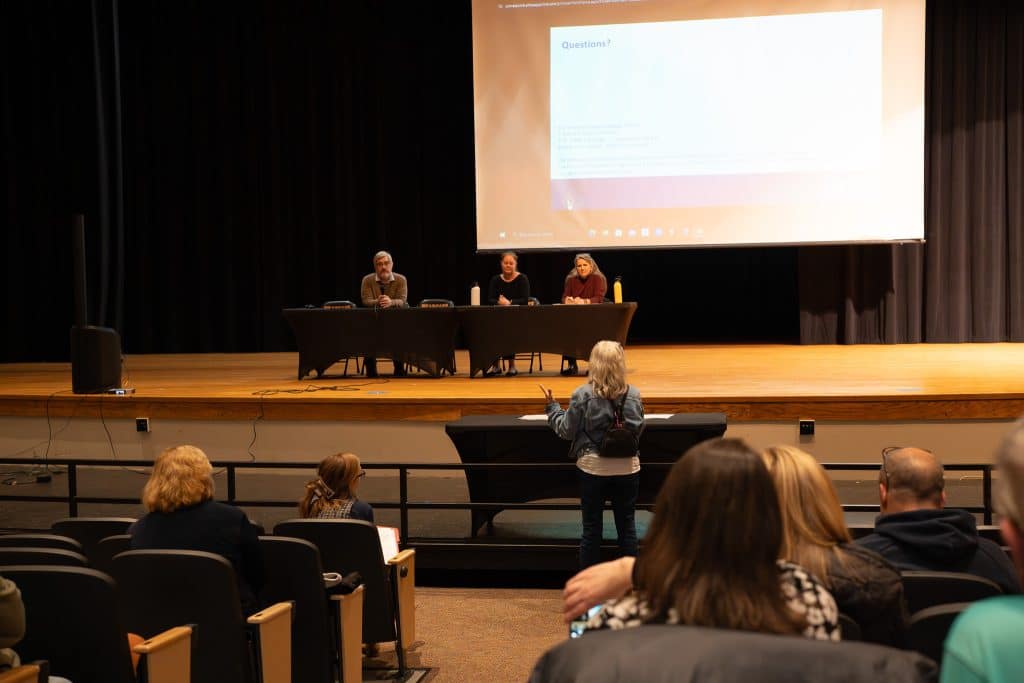
Several HOPE for Bristol volunteers attended the meeting to ask Byrns and his two other panelists questions. They livestreamed the event for those who were unable to join in person — though technical difficulties with the agency’s presentation and microphones cutting out during Q&A were disappointing to some virtual and in-person attendees.
“It’s heard [sic] to hear what questions they are asking,” one commenter wrote. A HOPE for Bristol moderator wrote back, “Unfortunately the AV situation was horrible. We had trouble hearing some of the questions too!”
Among other questions, residents wanted further clarification on the increase in cancer risk and the likelihood of initiating an epidemiological study. In response, Byrns and the other panelists emphasized that analyzing cancer rates, particularly in a small community, can be complicated by data availability, individual genetic makeup and other factors.
Becky Evenden, a community advocate and director of HOPE for Bristol, didn’t find the panelists’ responses on cancer rates particularly helpful or reassuring. But after connecting with a panelist, she learned about the Virginia cancer registry and how residents can report a diagnosis. She hopes to find and share similar information for Tennessee residents.
“I think our community deserved this study and this meeting, but I also think we deserved to see the report much sooner,” Evenden says.
Corroborated findings, remediation recommendations and report limitations
The report’s authors highlighted several limitations of their analysis, including a narrow data set, other potential sources of airborne chemicals and the complexity of landfill gas analysis.
“There are a lot of other chemicals there that we don’t know,” Byrns said at the meeting. “We don’t even know everything that’s there necessarily. And so there may be chemicals that are contributing to health effects that we didn’t even look for.”
ATSDR’s analysis of sulfur dioxide levels corroborates data HOPE for Bristol has been collecting with Appalachian Voices, the nonprofit that produces this publication. Through the Upper South and Appalachian Citizen Air Monitoring Project, or USACAMP, Appalachian Voices helped HOPE for Bristol install two air monitoring devices in 2023.
Matt Hepler, an environmental scientist at Appalachian Voices, explains that air monitoring has consistently shown elevated levels of sulfur dioxide in the area. While the ATSDR’s findings aren’t quite a “smoking gun” regarding the source of the sulfur dioxide, Hepler is “reasonably confident” that it is coming from the landfill.
The USACAMP data doesn’t indicate ATSDR’s same levels of benzene, but the report only found VOCs in areas closest to the landfill, and HOPE for Bristol’s community monitoring locations are a bit further away, Hepler explains.
“I’m glad the community didn’t wait for this health report to begin advocating for the landfill crisis to be addressed,” Evenden says. “I also hope that this report is useful to other communities that experience the unfortunate circumstance of a smoldering or high-temperature landfill, to give them confidence that the exposures are not healthy and a basis to demonstrate the real harm.”
Meanwhile, the city of Bristol, Virginia, called the report “flawed and misleading” and said it was not an accurate reflection of current emissions levels. Officials note that the data is four years old and was collected before remediation work began. Also, they say the findings don’t align with “previous independent studies using mostly the exact same data.”
ATSDR acknowledges that the city has already implemented many of its recommendations. For instance, the landfill stopped accepting additional waste in September 2022 and installed a dirt cover over it in October 2022 as part of ongoing efforts to permanently cap it. Additionally, the city has been conducting air monitoring and air sampling since May 2023 and installed an odor mitigation system in June 2023, among other measures.
But for Evenden and other community watchdogs, the city could have moved faster and still isn’t doing enough.
“The city is not doing the extensive level of monitoring that was suggested at the public meeting,” Evenden says. “There is no recent benzene monitoring, and one of the chemicals of concern, hydrogen sulfide, appears to be reading much higher this winter than in the past. We may have this report on past data, but we still need continued air monitoring and regular review by health experts for the sake of our residents!”
‘Fell behind on the eight ball’
The ATSDR report also provided health recommendations for residents: staying indoors when odors are strongest, continuing to report concerns to the city and installing HEPA air filters.
But for some, these suggestions feel hollow and too-little-too-late after spending years living in the shadow of the Beast. Although the city has spent millions on landfill upgrades and remediation efforts, residents like Nichols still smell it every night. Even now, she rarely turns her heat on because the smell seeps in through her vents.
“It was 52 degrees in my house at 3 o’clock this morning,” she says.
Locals with respiratory issues like Jerry Wolfe, who wore a portable oxygen machine to the January meeting, simply wish the entire saga would be over.
“You go to one meeting, you’ve been to all of them,” Wolfe says. “It’s the same thing every meeting.”
Knupp, who also serves as a director at HOPE for Bristol, acknowledges that the city has done a lot of work since 2022 but believes there is still much more to do.
“They’re doing a good job putting things together,” Knupp says. “It’s just a process, and we just fell behind on the eight ball.”
Related Articles
Latest News



Leave a comment
Your email address will not be published. Required fields are marked *
One response to “The Beast of Bristol Saga Continues”
-

This effects me to,but what do you do???Turn on your air filters that will fix the problem. It really does help.

Leave a Comment